

-
Products -PCBA Manufacturing RF Connectors RF Cable Assemblys Embedded Antennas External Antennas GNSS Positioning Solutions
RF Connectors

RF Cable Assemblys
Embedded Antennas
External Antennas
GNSS Positioning Solutions































 Language


Language


Time:2026-10-15 Views:0
Why Weatherproofing Defines Agricultural GNSS Performance
Precision agriculture has fundamentally transformed how modern farms operate, enabling centimeter-level accuracy for planting, spraying, harvesting, and autonomous vehicle guidance. At the heart of every precision farming system lies a critical component that often goes unnoticed until it fails: the GNSS antenna. Unlike consumer-grade GPS devices designed for occasional use, agricultural GNSS antennas must withstand relentless exposure to dust, moisture, extreme temperatures, vibration, and chemical exposure—all while delivering sub-inch positioning accuracy season after season.
The agricultural environment represents one of the most demanding operating conditions for any electronic component. A tractor-mounted GNSS antenna may encounter mud splatter during spring planting, intense UV radiation during summer spraying, dust clouds during fall harvest, and freezing temperatures during winter maintenance. Add to this the constant vibration from rough field terrain, potential impact from low-hanging branches, and exposure to agricultural chemicals, and the engineering challenge becomes clear. Weatherproofing is not merely a desirable feature for agricultural GNSS antennas—it is the fundamental requirement that determines whether a precision farming investment delivers returns or becomes a recurring maintenance expense.
This comprehensive guide examines weatherproof agricultural GNSS antenna technology, exploring the engineering principles, industry standards, and practical considerations that define this specialized product category. Whether you are evaluating antennas for a new fleet of autonomous tractors, upgrading an existing RTK guidance system, or designing OEM equipment for agricultural machinery, understanding the intersection of environmental protection and positioning performance is essential.
The Agricultural Operating Environment: Understanding the Threats
Particulate Ingress: Dust, Soil, and Crop Residue
Agricultural operations generate substantial airborne particulate matter that poses significant risks to electronic equipment. During soil preparation and planting, fine dust particles can penetrate even small openings in equipment enclosures. Harvest operations produce clouds of chaff, pollen, and crop residue that can accumulate on antenna surfaces and potentially infiltrate through cable connections or mounting interfaces. Unlike clean indoor environments, agricultural settings present a continuous assault of particulate matter that can degrade antenna performance through dielectric loading and mechanical obstruction .
The implications extend beyond simple obstruction. Accumulated dust on an antenna radome can alter its electrical properties, detuning the resonant frequency and reducing gain. Soil deposits containing moisture can create conductive paths that disrupt signal reception. Crop residue, particularly from sugar-rich plants, can attract insects and promote biological growth that further compromises performance.
Moisture Exposure: Rain, Irrigation, and Humidity
Water represents perhaps the most pervasive threat to agricultural GNSS antenna longevity. Direct rainfall during operation is unavoidable in many regions, but agricultural equipment also encounters irrigation spray, morning dew, and high-humidity conditions that persist for extended periods. The challenge is compounded by the need for consistent performance during critical field operations—a farmer cannot simply park the tractor because conditions are less than ideal.
Moisture ingress into an antenna housing can cause catastrophic failure through multiple mechanisms. Water contact with the antenna element alters its impedance characteristics, degrading signal reception. In active antennas containing low-noise amplifiers (LNAs), moisture can cause corrosion of circuit traces and component leads, leading to intermittent or complete failure. Perhaps most insidiously, moisture combined with temperature cycling creates freeze-thaw conditions that can mechanically stress seals and accelerate degradation.
Temperature Extremes and Thermal Cycling
Agricultural GNSS antennas operate across an extraordinary temperature range depending on geographic location and seasonal conditions. Equipment stored in unheated sheds may experience temperatures below -40°C in northern climates, while antennas mounted on vehicles operating in direct summer sunlight can see surface temperatures exceeding +85°C . Beyond absolute temperature limits, the daily thermal cycling between these extremes creates mechanical stress on materials with different thermal expansion coefficients, potentially compromising seals and solder joints over time.
Vibration and Mechanical Shock
Unlike stationary reference antennas, mobile agricultural GNSS antennas experience continuous vibration from multiple sources. Engine vibration, ground irregularities transmitted through the vehicle chassis, and implement operation all contribute to a complex vibration spectrum. This constant mechanical stress can fatigue mounting hardware, stress cable connections, and potentially crack solder joints within the antenna assembly .
Chemical and UV Exposure
Modern farming relies extensively on agricultural chemicals including fertilizers, pesticides, and herbicides. These substances, whether in liquid or dry form, can attack antenna housing materials, degrade cable jackets, and corrode exposed metal components. Simultaneously, ultraviolet radiation from sunlight breaks down polymer chains in many plastics, causing embrittlement, discoloration, and eventual structural failure of non-UV-stabilized materials.
IP Ratings: The International Standard for Weatherproofing
The Ingress Protection (IP) rating system, defined by IEC 60529, provides a standardized framework for evaluating an enclosure‘s resistance to dust and water intrusion. The rating consists of two digits: the first indicating protection against solid particles (0-6), and the second indicating protection against liquids (0-9K). Understanding these ratings is essential for specifying weatherproof agricultural GNSS antennas.
IP67: The Precision Agriculture Standard
IP67 has emerged as the de facto standard for high-quality agricultural GNSS antennas . The ”6“ rating indicates complete protection against dust ingress—a critical requirement for agricultural applications where fine soil particles are ubiquitous. The ”7“ rating specifies protection against temporary immersion in water up to 1 meter depth for 30 minutes.
For agricultural purposes, IP67 provides adequate protection for most field operations. Rain, irrigation spray, and equipment washing are all well within its capabilities. However, it is important to recognize that IP67 does not guarantee protection against prolonged immersion or high-pressure water jets, which may be encountered during aggressive cleaning procedures.
IP69K: For Extreme Protection Requirements
The IP69K rating, occasionally found on premium agricultural GNSS antennas, represents a significantly higher level of protection . The ”69K“ designation indicates resistance to close-range high-pressure, high-temperature water spray—conditions encountered during steam cleaning or industrial wash-down procedures. This rating is particularly relevant for equipment that requires frequent, aggressive cleaning between operations, such as livestock transport vehicles or equipment moving between biosecure zones.
Beyond IP Ratings: The Importance of Breathable Vents
An often-overlooked aspect of weatherproofing is the management of internal pressure differentials. As an antenna experiences temperature changes, the air inside a sealed enclosure expands and contracts. Without compensation, this pressure cycling can draw moisture through seals and accelerate gasket degradation. Premium agricultural GNSS antennas incorporate waterproof breathable vents that equalize pressure while blocking liquid water ingress . This design feature significantly extends product life in field conditions.
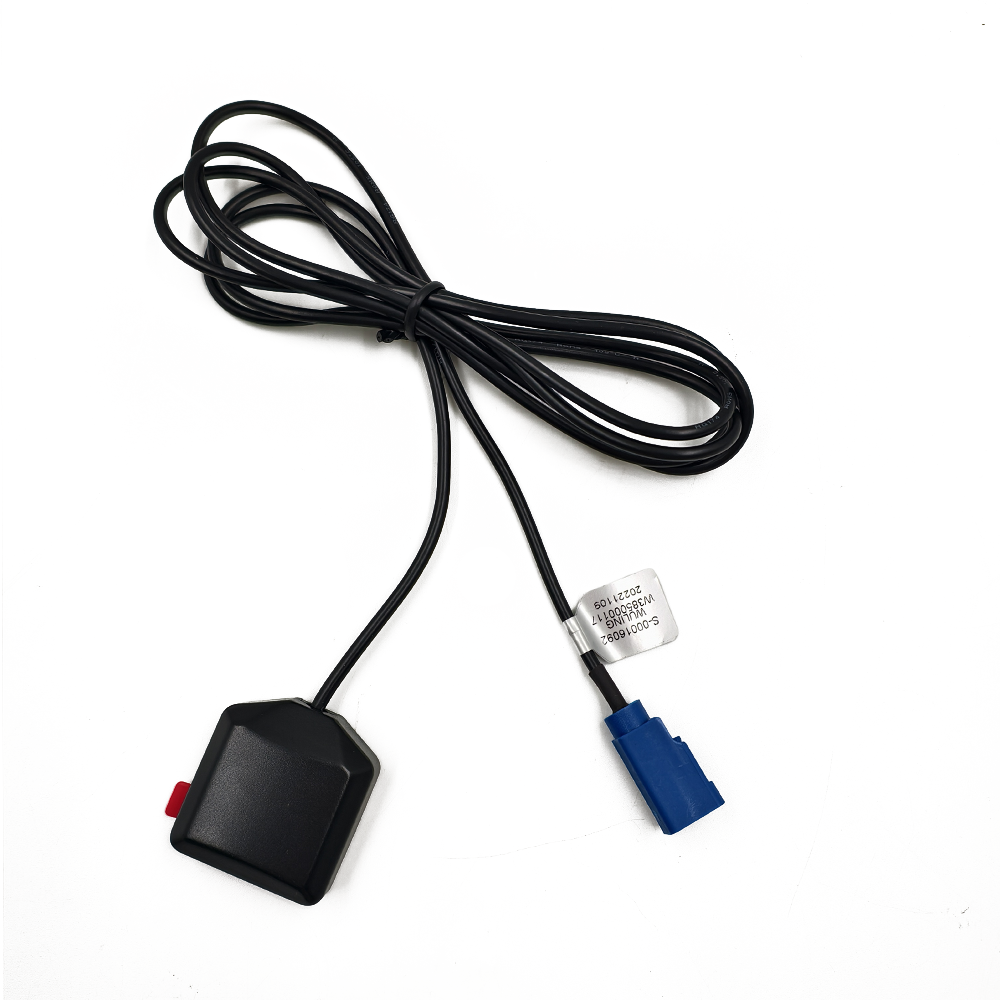
Core GNSS Technologies for Agricultural Precision
Multi-Constellation Reception: More Satellites, Better Reliability
Modern agricultural GNSS antennas universally support multiple satellite constellations to ensure reliable positioning even when individual satellite signals are obstructed. A typical high-precision agricultural antenna receives signals from:
GPS (United States): L1, L2, L5 bands
GLONASS (Russia): G1, G2, G3 bands
Galileo (European Union): E1, E5a, E5b, E6 bands
BeiDou (China): B1, B2, B3 bands
Regional systems: QZSS (Japan), NavIC (India), SBAS corrections
The practical benefit of multi-constellation reception is straightforward: more visible satellites translates to more consistent position solutions, even when operating near tree lines, buildings, or in hilly terrain where satellite visibility is restricted .
Dual and Triple Frequency: The Key to Centimeter Accuracy
Single-frequency GNSS reception provides meter-level accuracy at best, which is insufficient for precision agriculture applications that demand repeatable sub-inch positioning. The solution lies in dual or triple frequency reception, which enables the resolution of ionospheric delays and the integer ambiguity resolution essential for RTK (Real-Time Kinematic) positioning .
When a GNSS antenna receives signals on multiple frequencies, the receiver can compare the arrival times of signals at different frequencies to correct for atmospheric distortion. More importantly, multi-frequency observation enables the receiver to resolve the whole-cycle ambiguity in carrier phase measurements, the foundation of RTK positioning that achieves centimeter-level accuracy.
RTK and PPP: Achieving Centimeter-Level Field Accuracy
For agricultural applications requiring the highest accuracy—autonomous tractor guidance, controlled traffic farming, and precision planting—RTK positioning is essential. RTK systems use a fixed base station at a known location to broadcast correction data to mobile receivers. The rover receiver uses these corrections to eliminate errors common to both stations, achieving accuracy of 1-2 centimeters.
Modern agricultural GNSS antennas support L-band correction services that enable PPP (Precise Point Positioning) without the need for a local base station . This capability is particularly valuable for operations in remote areas where establishing a base station is impractical.
The Critical Role of Phase Center Stability
An often-underappreciated specification, phase center variation directly impacts the repeatability of RTK positioning. The antenna‘s electrical phase center—the apparent point from which signals are received—ideally should remain fixed regardless of satellite elevation angle. In practice, all antennas exhibit some phase center variation, but high-quality agricultural GNSS antennas maintain this variation within narrow bounds, typically ±2mm or better .
Phase center stability becomes critically important for agricultural operations where equipment must follow precisely the same path across multiple passes. A tractor guided by an antenna with poor phase center stability may exhibit “heading wander” that causes implement overlap or skip, directly impacting input costs and crop yield.
Interference Mitigation: Protecting Signal Integrity in Congested Environments
The Growing RF Interference Challenge
Agricultural operations increasingly contend with radio frequency interference from cellular networks, broadband communications, and adjacent electronic systems. LTE and 5G signals, particularly those operating near GNSS frequencies, can saturate antenna LNAs and degrade positioning accuracy. In North America, the planned Ligado network near 1525-1536 MHz poses particular concerns for GNSS operations .
Filtering Technologies: SAW, XF, and Beyond
Premium agricultural GNSS antennas incorporate sophisticated filtering to reject out-of-band interference before it reaches sensitive receiver electronics. Surface Acoustic Wave (SAW) filters provide sharp frequency selectivity and are commonly integrated into antenna designs . Calian’s XF Filtering technology represents a more advanced approach, integrating comprehensive interference mitigation at the antenna level to prevent saturation from LTE, Ligado, and other adjacent-band emitters .
The benefit of pre-filtering at the antenna is significant: by rejecting interference before amplification, the antenna maintains clean signal quality even in electromagnetically congested environments. This translates to more reliable RTK fix solutions and fewer position dropouts during critical field operations.
Multipath Rejection: Combating Signal Reflections
Agricultural environments present numerous reflective surfaces—metal buildings, irrigation structures, and even the metal components of the tractor itself. GNSS signals reflecting from these surfaces arrive at the antenna later than direct signals, creating positioning errors through a phenomenon known as multipath.
High-quality agricultural GNSS antennas employ circular polarization (RHCP) and advanced antenna element designs to reject multipath signals . The combination of excellent axial ratio (a measure of polarization purity) and a stable ground plane ensures that reflected signals with reversed polarization are attenuated, preserving positioning accuracy.
Ruggedized Design Features: Engineering for Field Durability
Housing Materials and Construction
The physical enclosure of an agricultural GNSS antenna must balance multiple requirements: structural rigidity, UV resistance, chemical compatibility, and electromagnetic transparency for the antenna element. High-quality housings typically employ UV-stabilized engineering polymers for the radome (the RF-transparent cover) mounted on a metallic base for structural integrity and ground plane performance .
The choice of materials has direct implications for service life. Inexpensive ABS plastic radomes degrade rapidly under UV exposure, becoming brittle and discolored within a single growing season. Premium antennas use UV-stabilized polycarbonate or specialized radome materials that maintain mechanical integrity and electrical properties for years .
Connector and Cable Protection
Antenna connectors represent a critical vulnerability point for moisture ingress. Agricultural GNSS antennas typically employ TNC or N-type connectors with robust sealing mechanisms . The cable itself must resist UV degradation, abrasion, and chemical exposure while maintaining stable electrical characteristics across temperature extremes.
For permanent installations, proper connector sealing with self-amalgamating tape or heat-shrink tubing is essential practice. Even IP67-rated connections benefit from additional environmental protection in agricultural applications.
Mounting Systems for Agricultural Equipment
Agricultural GNSS antennas must maintain precise orientation and stable positioning despite continuous vibration and occasional impact. Mounting systems vary from magnetic bases for temporary installations to screw-mounted configurations for permanent installation on vehicle roofs .
The mounting system must also provide an adequate ground plane for optimal antenna performance. Many agricultural antennas specify a minimum ground plane size—typically 100-150mm diameter—to ensure proper radiation pattern and gain .
Practical Considerations: Installation, Maintenance, and Troubleshooting
Installation Best Practices for Agricultural Antennas
Successful GNSS antenna installation begins with proper location selection. The antenna should have a clear view of the sky, ideally with no obstructions above a 30-degree elevation angle . On agricultural vehicles, the roof provides the best mounting location, away from exhaust stacks, radio antennas, and other potential interference sources.
Cable routing requires careful attention to avoid sharp bends, abrasion points, and exposure to heat sources. Proper strain relief at the antenna connector prevents cable damage from vibration. For base station installations, the antenna must be mounted on a stable, immovable surface—not on masts or towers that may sway in wind .
Seasonal Maintenance and Inspection
Weatherproof agricultural GNSS antennas require minimal maintenance, but regular inspection extends service life and prevents unexpected failures. Before each growing season, inspect the antenna housing for cracks, the cable for abrasion or UV damage, and the connector for corrosion or moisture. Clean the radome with mild soap and water—never use solvents that may attack the housing material.
Troubleshooting Common Weather-Related Issues
When positioning accuracy degrades or signal reception becomes intermittent, weather-related causes should be considered. Water ingress may cause corrosion at the connector or within the antenna housing, requiring replacement. Ice accumulation on the radome can detune the antenna, temporarily degrading performance until cleared. UV-degraded cable jackets may develop cracks that allow moisture penetration—replacement is the only reliable solution.
Selecting the Right Weatherproof Agricultural GNSS Antenna
Key Specifications to Evaluate
When specifying an antenna for agricultural applications, prioritize the following:
IP Rating: IP67 minimum; IP69K for high-pressure wash-down applications
Frequency Support: L1/L2/L5 at minimum; full-band support for maximum future-proofing
Constellation Compatibility: GPS, GLONASS, Galileo, BeiDou at minimum
Phase Center Stability: ≤2mm variation for RTK applications
Operating Temperature: -40°C to +85°C minimum
LNA Gain: 28-40dB, appropriate to cable length and receiver sensitivity
Interference Filtering: Pre-filtering for LTE/5G and adjacent-band rejection
Matching Antenna to Application
Not all agricultural applications require the same antenna performance. Autonomous tractor guidance demands the highest accuracy and reliability, justifying investment in premium full-band antennas with advanced interference mitigation. Yield monitoring and soil sampling may tolerate slightly lower performance, allowing consideration of more cost-effective solutions. Base station installations prioritize long-term stability and phase center repeatability over compact size.
Future Trends in Agricultural GNSS Antenna Technology
Integration and Miniaturization
The trend toward integrated smart antennas continues, with GNSS receiver modules, inertial measurement units, and communication interfaces increasingly packaged together with the antenna element . This integration simplifies installation, reduces cable losses, and enables advanced features like dead reckoning for continued positioning during brief signal outages.
Enhanced Interference Resilience
As the RF spectrum becomes increasingly congested, antenna-level interference mitigation will become more sophisticated. Machine learning algorithms for adaptive filtering and beamforming antenna arrays may eventually find their way into agricultural GNSS systems, providing unprecedented resilience against jamming and interference .
Sustainable and Recyclable Materials
Environmental considerations are beginning to influence antenna design, with manufacturers exploring recyclable materials and reducing the use of hazardous substances. The transition to lead-free solders and RoHS-compliant construction is already well-established .
For precision agriculture operations, the GNSS antenna represents the foundation upon which all positioning accuracy depends. A weatherproof agricultural GNSS antenna that fails mid-season doesn’t just represent a replacement cost—it threatens planting schedules, input efficiency, and ultimately crop yield. The engineering that goes into a truly weatherproof antenna—IP67 or IP69K sealing, UV-stabilized materials, breathable vents, robust connectors, and advanced filtering—represents an investment in operational reliability that pays dividends across every hectare and every growing season.
As autonomous agricultural equipment becomes more prevalent and positioning accuracy requirements continue to tighten, the importance of selecting antennas engineered specifically for the agricultural environment will only increase. By understanding the environmental challenges, the relevant standards, and the key performance specifications, agricultural professionals can make informed decisions that ensure their precision farming systems deliver the accuracy and reliability their operations demand.
Lucy Yang | lucy.y@toxutech.com
Dotty Zhao | sales04@toxutech.com
Global Business Director / Sales Team / Global Operations


 En
En Cn
Cn Korean
 Home >