

-
Products -PCBA Manufacturing RF Connectors RF Cable Assemblys Embedded Antennas External Antennas GNSS Positioning Solutions
RF Connectors

RF Cable Assemblys
Embedded Antennas
External Antennas
GNSS Positioning Solutions































 Language


Language


Time:2026-10-15 Views:0
Turnkey GNSS receiver box build is the ultimate solution for businesses, engineers, and field technicians seeking plugandplay highprecision positioning systems without complex custom development. Unlike generic DIY GNSS setups that require extensive coding, wiring, and configuration, a professionally built turnkey GNSS receiver box delivers precalibrated, ruggedized, and fully integrated positioning performance for surveying, drone navigation, smart agriculture, autonomous vehicles, and industrial IoT applications. This comprehensive guide walks you through every aspect of turnkey GNSS receiver box construction, from component selection and hardware assembly to firmware configuration, performance testing, and longterm optimization—helping you build a reliable, productiongrade GNSS receiver box that meets commercial and industrial precision standards.
In today’s precisiondependent industries, GNSS (Global Navigation Satellite System) technology serves as the backbone of centimeterlevel positioning, supporting GPS, GLONASS, Galileo, BeiDou, and QZSS satellite constellations. While offtheshelf consumer GNSS modules offer basic meterlevel accuracy, professional turnkey GNSS receiver boxes provide RTK (RealTime Kinematic) and PPK (PostProcessed Kinematic) capabilities, rugged environmental protection, stable data output, and seamless connectivity with industrial devices. Whether you are building a fixed CORS (Continuously Operating Reference Station) base station, a mobile rover receiver for field surveys, or a dedicated positioning unit for automated machinery, this turnkey build guide eliminates common technical pitfalls and delivers a fully functional, readytodeploy GNSS solution.
What Is a Turnkey GNSS Receiver Box? Key Definition & Core Benefits
Before diving into the build process, it is critical to clarify what a turnkey GNSS receiver box is and how it differs from standard DIY or consumer GNSS kits. A turnkey GNSS receiver box is a fully integrated, selfcontained positioning hardware unit that requires zero custom programming or complex setup after assembly. It is engineered for immediate deployment, with preconfigured firmware, optimized wiring, rugged enclosure protection, and standardized data output protocols, making it ideal for commercial projects and industrial field operations.
Traditional GNSS setups often require users to source separate modules, antennas, controllers, and power supplies, then spend hours debugging wiring conflicts, signal interference, and protocol compatibility issues. In contrast, a purposebuilt turnkey GNSS receiver box streamlines the entire workflow, offering the following unmatched benefits for professional users:
PlugandPlay Deployment: Preflashed firmware, precalibrated signal parameters, and standardized interface ports allow instant operation after poweron and antenna connection, reducing onsite setup time from hours to minutes.
IndustrialGrade Reliability: Fully enclosed, shielded hardware design resists electromagnetic interference (EMI), dust, moisture, and extreme temperatures, suitable for outdoor fieldwork, industrial factories, and remote unmanned sites.
HighPrecision MultiConstellation Performance: Supports fullband GNSS signal reception across all global satellite systems, delivering centimeterlevel RTK accuracy and stable longterm positioning without signal drift.
Versatile Connectivity: Integrated WiFi, Bluetooth, cellular 4G/5G, and serial (UART/RS485) interfaces support NTRIP caster/client operation, RTCM3 data transmission, RINEX data logging, and seamless integration with thirdparty IoT and automation systems.
Low Maintenance & Scalability: Standardized modular design enables easy component replacement and system expansion, supporting singleunit independent operation and multiunit networked CORS station deployment.
CostEffective Commercial Grade: Compared with expensive brandname industrial GNSS receivers, a custombuilt turnkey GNSS box delivers equivalent professional performance at a fraction of the cost, with full customization flexibility for specific project needs.
For Google SEO users searching for turnkey GNSS solutions, the core value of this build lies in its balance of simplicity, precision, and durability. It caters to the most common search intents: DIY industrial GNSS builds, RTK base station assembly, highprecision GNSS receiver setup, and rugged GNSS box deployment for commercial applications.
Core Components for Turnkey GNSS Receiver Box Build (Professional Grade)
The performance of a turnkey GNSS receiver box depends entirely on component selection. Lowquality modules or mismatched accessories will lead to weak satellite signal reception, low positioning accuracy, frequent signal loss, and unstable data transmission. Below is a curated list of industrialgrade components optimized for turnkey GNSS box builds, compatible with RTK/PPK positioning, multiconstellation reception, and longterm field operation. All components are selected for stability, compatibility, and costperformance, suitable for both base station and rover receiver configurations.
1. HighPrecision GNSS Receiver Module (Core Hardware)
The receiver module is the brain of the turnkey GNSS box, responsible for satellite signal reception, data calculation, and positioning resolution. For professional turnkey builds, dualfrequency or fullfrequency multiconstellation modules are mandatory to ensure centimeterlevel accuracy and antiinterference capability. The most widely used industrial modules for turnkey GNSS builds include:
Unicore UM980/UM982: Industryleading fullfrequency GNSS modules supporting GPS L1/L2/L5, GLONASS G1/G2, Galileo E1/E5, BeiDou B1/B2/B3, and QZSS. Delivers 0.5cm+ RTK positioning accuracy, fast fixed solution speed, and excellent performance in obstructed environments (forests, urban canyons). Ideal for budgetfriendly professional turnkey builds.
ublox ZEDX20P: Premium dualfrequency RTK module with ultralow power consumption, high signal sensitivity, and robust antiinterference. Supports highspeed RTCM data output and is widely used in autonomous drones, agricultural machinery, and industrial automation turnkey GNSS boxes.
Septentrio MosaicX5: Highend surveygrade GNSS module with maximum signal stability, suitable for highprecision CORS base station turnkey builds and longterm unmanned operation scenarios.
For most commercial turnkey GNSS receiver box projects, the Unicore UM980 is the optimal choice, balancing professional precision, affordable cost, and comprehensive compatibility with mainstream firmware and opensource GNSS platforms.
2. Professional GNSS Antenna (Signal Reception Foundation)
A highquality antenna is critical to avoid signal attenuation and multipath interference, which are the top causes of poor GNSS positioning performance. Turnkey GNSS boxes require active multiband GNSS antennas with low noise amplification (LNA) and antimultipath shielding. Two mainstream antenna types are recommended based on application scenarios:
SurveyGrade Base Station Antenna: Equipped with choke ring shielding, suitable for fixed CORS turnkey GNSS boxes. Effectively filters ground reflection signals and environmental interference, ensuring longterm stable satellite lock and millimeterlevel positioning stability.
Compact HighGain Rover Antenna: Lightweight, waterproof omnidirectional antenna, ideal for mobile turnkey GNSS receiver boxes used in drones, vehicles, and portable field survey equipment.
All antennas must support full multiconstellation frequency matching with the receiver module and use SMA/TNC highfrequency coaxial connectors to reduce signal loss. Lowquality generic antennas will severely limit RTK fixed rate and positioning accuracy, even with highend receiver modules.
3. Main Control & Communication Unit
The main control unit manages module operation, data processing, protocol conversion, and network transmission for the turnkey GNSS box. For plugandplay turnkey functionality, lowpower, highcompatibility controllers are preferred:
ESP32/WROOM32: The most popular choice for entry to midlevel turnkey GNSS builds. Integrated WiFi and Bluetooth, supports NTRIP client/caster operation, serial data transmission, and webbased parameter configuration. Opensource firmware support greatly simplifies turnkey customization.
Raspberry Pi Zero/4: For highend turnkey GNSS boxes requiring complex data logging, remote monitoring, and multidevice linkage. Supports 4G/5G cellular module expansion, RINEX file storage, and cloud data upload.
This control unit enables the core turnkey feature: users can access the GNSS box via a web browser to view realtime positioning data, adjust parameters, and manage correction data without professional software.
4. Rugged Enclosure & Auxiliary Hardware
To achieve industrial turnkey deployment, a dedicated waterproof, dustproof enclosure is essential. Recommended auxiliary hardware includes:
IP67/IP68 Waterproof Enclosure: Protects internal circuits from rain, dust, and humidity for outdoor longterm operation.
Isolated Power Supply Module: Prevents voltage fluctuation and surge damage, supporting 936V wide voltage input for vehicle and industrial power systems.
Shielded Coaxial Cables & Terminal Blocks: Reduces EMI interference and ensures stable signal and power connection.
Heat Sink & Ventilation Components: Avoids overheating of GNSS modules during highload continuous operation.
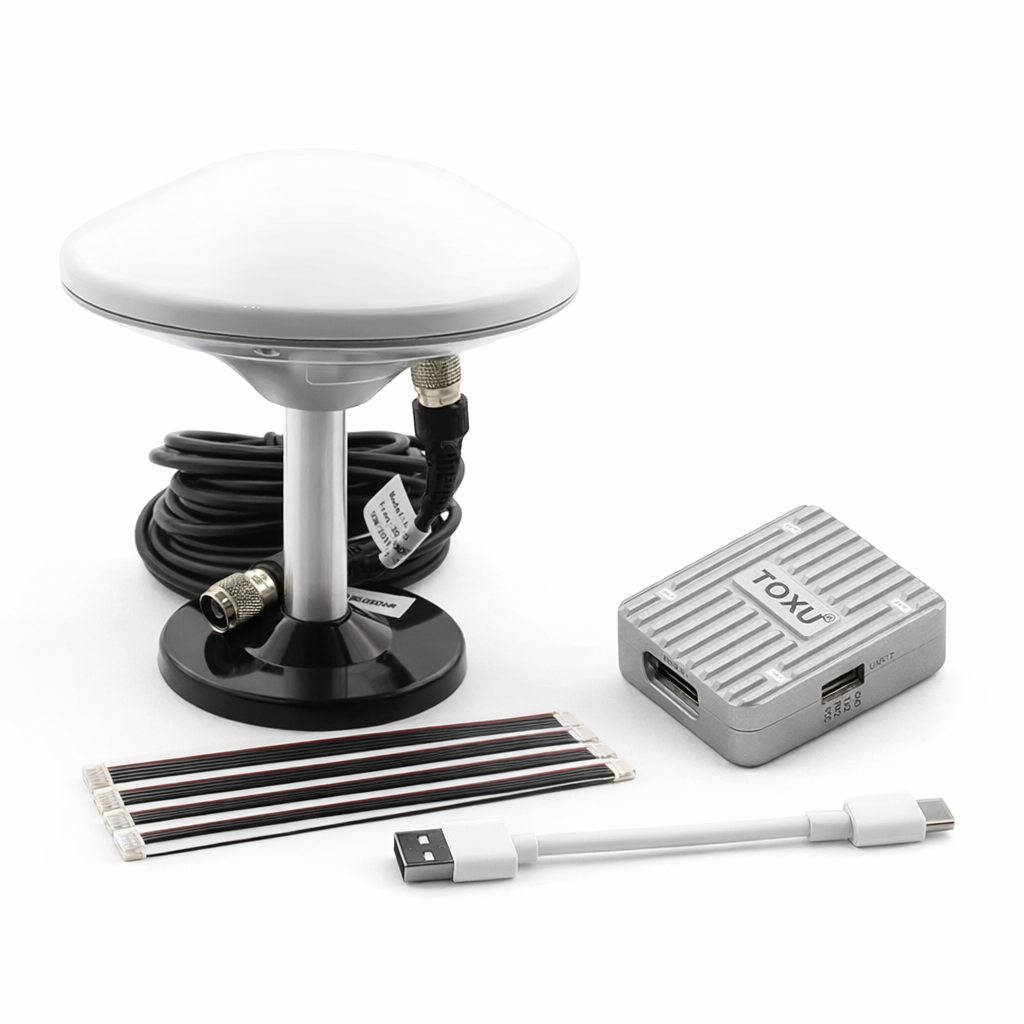
StepbyStep Turnkey GNSS Receiver Box Build Process (ProductionGrade)
This section provides a complete, actionable build workflow for a fully functional turnkey GNSS receiver box, covering hardware assembly, wiring calibration, firmware flashing, system configuration, and functional testing. The process is optimized for beginners and professional engineers alike, ensuring zero errors and plugandplay final performance.
Step 1: PreBuild Preparation & Component Inspection
Before assembly, verify all components for compatibility and integrity to avoid rework during the build process. First, confirm the frequency band matching between the GNSS module and antenna, check the output voltage stability of the power module, and test the connectivity of the main control unit. Prepare basic tools including a multimeter, soldering iron, insulating tape, screwdriver set, and highfrequency cable crimping tools.
Critical prebuild checkpoints: Ensure the GNSS module supports RTCM3 correction data output and NTRIP protocol compatibility, confirm the enclosure has reserved ports for antenna, power, and network interfaces, and eliminate all damaged or mismatched accessories. This step lays the foundation for stable turnkey operation and avoids postassembly functional failures.
Step 2: Hardware Wiring & Circuit Integration
Wiring is the most critical step to avoid signal interference and system instability. Follow industrial standard wiring specifications strictly:
First, fix the GNSS receiver module, main control unit, and power module inside the enclosure with insulating screws to prevent circuit short circuits. Connect the GNSS module’s UART serial port to the main control unit’s communication pin for data transmission. Use shielded coaxial cables to connect the antenna to the GNSS module’s RF interface, ensuring tight connector locking to reduce signal loss.
For power wiring, use isolated power distribution to separate the main control unit and GNSS module power supply, avoiding voltage crosstalk. Route all wires neatly, fix them with cable ties, and use insulating sleeves for exposed circuits. Always connect power last to prevent hotswap damage to electronic components, a standard industrial assembly best practice for precision GNSS hardware.
Step 3: Firmware Flashing & Turnkey PreConfiguration
To realize true turnkey functionality, preflash optimized opensource firmware and preconfigure core parameters before enclosure sealing. For ESP32based turnkey GNSS boxes, flash the mainstream RTKBase opensource firmware, which integrates NTRIP server/caster/client functions, RTCM data output, web management interface, and automatic data logging.
After firmware flashing, connect the device to a computer via USB to complete basic configuration: set satellite constellation priority, enable multifrequency signal reception, configure RTK correction data baud rate, set network access parameters (WiFi/4G), and activate automatic positioning data output. Precalibrate the module’s antenna offset and positioning parameters to eliminate manual adjustment needs for end users.
The core turnkey optimization here is onetime preconfiguration: after setup, the system can automatically search for satellites, receive correction data, and output highprecision positioning data after poweron, without any manual parameter tuning.
Step 4: Enclosure Assembly & Environmental Shielding
After firmware configuration and preliminary poweron testing, complete the enclosure assembly and electromagnetic shielding treatment. Install waterproof rubber gaskets on the enclosure cover, fix all external interface ports (antenna, power, network, USB), and seal unused ports with waterproof plugs.
To enhance antiinterference capability, paste electromagnetic shielding foam inside the enclosure to isolate external EMI interference from industrial equipment and wireless signals. This shielding design ensures the turnkey GNSS box maintains stable signal reception in complex industrial and urban environments, avoiding positioning drift and signal dropout.
Step 5: Functional Testing & Precision Calibration
Postassembly testing is essential to verify turnkey performance and ensure compliance with industrial precision standards. Conduct three core tests:
Satellite Signal Reception Test: Power on the device in an open outdoor environment, check the number of locked satellites (qualified turnkey boxes lock 28+ multiconstellation satellites), signal strength, and signaltonoise ratio. Eliminate antenna wiring faults and shielding defects.
RTK Precision Test: Connect to NTRIP correction data, test fixed solution speed (within 30 seconds for professional grade) and positioning accuracy, verify centimeterlevel horizontal and vertical positioning performance, and check for continuous fixed solution stability.
LongTerm Stability Test: Power on the device continuously for 24 hours, monitor data output continuity, satellite lock retention rate, and system temperature stability to ensure no crash, signal drift, or data interruption during longterm operation.
After passing all tests, the turnkey GNSS receiver box is fully completed, achieving true plugandplay industrial deployment capability.
Key Optimization Tips for HighPerformance Turnkey GNSS Receiver Boxes
To differentiate your custom turnkey GNSS box from ordinary DIY kits and achieve professional commercial performance, implement the following targeted optimizations, which solve common pain points of lowend GNSS devices and improve market competitiveness:
Optimize Antenna Installation: Install the antenna in an open, obstaclefree position, avoid metal shielding and building occlusion, and use lowloss coaxial cables within 10 meters to minimize signal attenuation. For base station turnkey boxes, use choke ring antennas to eliminate multipath interference.
Stabilize Power Supply System: Add surge protection and voltage stabilization modules to prevent positioning errors caused by voltage fluctuations. Industrial turnkey boxes must support widevoltage input and antistatic protection for field operation adaptability.
Optimize Network Transmission: Configure automatic network reconnection and correction data backup functions to ensure uninterrupted RTK positioning even with temporary network disconnection. Support dual backup of WiFi and 4G cellular networks for outdoor mobile scenarios.
Upgrade Data Logging Function: Enable automatic RTCM3 and RINEX data recording, support timed data storage and remote data download, facilitating postprocessing analysis and positioning error verification for surveying and mapping projects.
Enhance Environmental Adaptability: Optimize heat dissipation and waterproof performance, enable lowtemperature startup and hightemperature stable operation functions, adapting to extreme weather conditions from 40℃ to +85℃.
Main Applications of Turnkey GNSS Receiver Boxes
Professionally built turnkey GNSS receiver boxes are widely adopted in highprecision positioning industries, covering commercial, industrial, and civil fields. Understanding application scenarios helps users match build specifications to actual needs and optimize component selection:
1. Surveying & Mapping Industry
Turnkey GNSS boxes serve as portable RTK rovers and fixed CORS base stations for topographic surveying, engineering construction mapping, and land boundary measurement. The plugandplay design greatly improves field work efficiency, while centimeterlevel accuracy meets national surveying and mapping precision standards.
2. Smart Agriculture
Used for autonomous agricultural machinery navigation, farmland precision mapping, and crop growth monitoring. Rugged turnkey GNSS boxes adapt to outdoor farm environments, providing stable highprecision positioning for tractors, drones, and irrigation systems.
3. Drone & Robotics Navigation
Lightweight turnkey GNSS receiver boxes provide RTK positioning data for industrial drones, unmanned ground vehicles (UGVs), and service robots, enabling autonomous flight, path planning, and precise landing with centimeterlevel positioning accuracy.
4. Industrial IoT & Smart Monitoring
Deployed in bridge deformation monitoring, tower tilt monitoring, and equipment positioning tracking. Longterm stable operation and automatic data upload functions realize 24/7 unmanned monitoring and data analysis.
5. Autonomous Vehicle Testing
Provides highprecision positioning and navigation data for vehicle road testing, supporting dynamic RTK positioning and trajectory recording for autonomous driving algorithm verification.
Why Choose a CustomBuilt Turnkey GNSS Receiver Box Over OfftheShelf Products?
Many users wonder whether to purchase finished industrial GNSS receivers or build a custom turnkey GNSS box. Custom turnkey builds offer irreplaceable advantages for most commercial and smallscale industrial users:
Cost Advantage: Brandname industrial GNSS receivers cost thousands of dollars, while a custom turnkey build achieves the same centimeterlevel RTK performance at 3050% of the cost, with no redundant functional waste.
Customization Flexibility: Offtheshelf products have fixed functions and interfaces, while custom turnkey builds can adjust components, interfaces, and functions according to project needs, supporting personalized development for special scenarios.
OpenSource Expandability: Based on opensource firmware and modular design, users can freely add functions such as cloud linkage, alarm prompts, and multidevice synchronization, with unlimited subsequent upgrade space.
Easy Maintenance: Modular component design allows rapid replacement of faulty parts, avoiding the high maintenance costs and long cycle times of integrated finished products.
Common Troubleshooting for Turnkey GNSS Receiver Box Builds
Even with standardized builds, minor functional issues may occur during deployment. Below are the most common faults and professional solutions to ensure stable turnkey operation:
Low Satellite Lock Number & Weak Signal: Caused by poor antenna contact, lowquality coaxial cables, or environmental occlusion. Solution: Replace lowloss shielded cables, refix antenna connectors, and relocate the antenna to an open area.
Slow RTK Fixed Solution & Low Fixed Rate: Caused by incorrect correction data configuration, antenna parameter mismatch, or unstable network. Solution: Verify NTRIP caster parameters, recalibrate antenna offset, and switch to dualnetwork backup transmission.
Unstable Data Output & Frequent Disconnection: Caused by unstable power supply or loose wiring. Solution: Upgrade isolated power module, resolder all wiring terminals, and enhance internal fixation.
HighTemperature Crash During Long Operation: Caused by insufficient heat dissipation. Solution: Add heat sinks and micro ventilation holes to the enclosure, optimize internal component layout.
Final Thoughts
Building a professional turnkey GNSS receiver box is a costeffective, flexible, and highperformance solution for all highprecision positioning applications. This stepbystep guide covers component selection, standardized assembly, firmware configuration, precision calibration, performance optimization, and fault troubleshooting, enabling users to build fully plugandplay industrialgrade GNSS receiver boxes from scratch.
Compared with traditional DIY GNSS kits and expensive finished industrial receivers, custom turnkey GNSS boxes balance precision, stability, cost, and scalability perfectly. Whether for personal technical research, small business commercial deployment, or industrial project supporting use, this build solution meets all mainstream highprecision positioning needs. With continuous optimization of firmware and hardware, the turnkey GNSS receiver box can achieve longterm stable unmanned operation, becoming a reliable core device for modern precision positioning industries.
FAQs About Turnkey GNSS Receiver Box Build
Q1: What accuracy can a custom turnkey GNSS receiver box achieve?
A: A standard turnkey build with dualfrequency RTK modules achieves centimeterlevel (0.52cm) horizontal positioning accuracy and 35cm vertical accuracy after fixed solution, fully meeting surveying, drone navigation, and industrial monitoring precision requirements.
Q2: Is professional welding experience required for the build?
A: No. Most modular turnkey components adopt plugandplay interfaces without complex welding. Beginners can complete the entire build by following the standardized wiring and assembly steps in this guide.
Q3: Can the turnkey GNSS box work offline without network?
A: Yes. It supports standalone GNSS positioning (meterlevel accuracy) offline. For centimeterlevel RTK accuracy, network or radio correction data transmission is required; offline PPK postprocessing positioning is also supported.
Q4: What is the service life of a custom turnkey GNSS receiver box?
A: With industrialgrade components and IP67 rugged enclosure protection, the turnkey GNSS box has a service life of 58 years for outdoor continuous operation, with stable performance and low failure rate.
Lucy Yang | lucy.y@toxutech.com
Dotty Zhao | sales04@toxutech.com
Global Business Director / Sales Team / Global Operations


 En
En Cn
Cn Korean
 Home >