

-
Products -PCBA Manufacturing RF Connectors RF Cable Assemblys Embedded Antennas External Antennas GNSS Positioning Solutions
RF Connectors

RF Cable Assemblys
Embedded Antennas
External Antennas
GNSS Positioning Solutions































 Language


Language


Time:2026-10-15 Views:0
Why Tri-Band GNSS Antennas Are Reshaping Positioning Technology
The global positioning landscape is undergoing a profound transformation. As industries demand ever-increasing levels of accuracy, reliability, and resilience from satellite navigation systems, the humble GNSS antenna has evolved from a simple signal receiver into a sophisticated engineering marvel. At the heart of this evolution lies the tri-band GNSS antenna—a device capable of simultaneously receiving signals across the L1, L2, and L5 frequency bands. This capability is no longer a luxury; it has become a foundational requirement for applications ranging from autonomous vehicle navigation to precision agriculture and mission-critical surveying operations.
The global GNSS and GPS antenna market was estimated at USD 5.32 billion in 2025 and is projected to grow at a compound annual growth rate of 4.60% during the forecast period. Within this expansive market, multi-band, multi-constellation antennas are becoming baseline requirements, pushing premium segments to grow 2–3% per year faster than single-band segments. The high-precision GNSS antenna segment alone was valued at USD 1.43 billion in 2025 and is expected to grow at a CAGR of 6.40%. These figures underscore a fundamental shift: the industry is moving decisively toward tri-band architectures as the new standard for applications where precision is non-negotiable.
Understanding the L1, L2, and L5 Frequency Bands
The Science of GNSS Frequencies
To appreciate the significance of tri-band GNSS antennas, one must first understand the three primary frequency bands used by modern satellite navigation systems. GPS, the pioneering GNSS constellation, transmits on multiple frequencies within the L-band of the electromagnetic spectrum. The L1 band operates at a center frequency of 1575.42 MHz, the L2 band at 1227.60 MHz, and the L5 band at 1176.45 MHz.
The L1 frequency has historically been the primary signal for civilian GPS use, carrying the C/A (Coarse/Acquisition) code that enabled the first generation of GPS receivers. The L2 band was originally reserved for military use with the encrypted P(Y) code, though the introduction of the L2C civil signal has opened it to commercial applications. The L5 band represents the most modern civilian GPS signal, designed specifically for safety-of-life applications with a higher power level, wider bandwidth, and more advanced coding scheme.
Why Tri-Band Matters: The Physics of Precision
The fundamental advantage of tri-band reception lies in the ability to correct for ionospheric delay—the most significant source of error in GNSS positioning. The ionosphere, a layer of electrically charged particles in the upper atmosphere, delays GNSS signals in a frequency-dependent manner. When a receiver can compare signals arriving at two or more different frequencies, it can calculate and remove this delay with remarkable precision. The L1/L2 and L1/L5 dual-frequency combinations are particularly effective for this purpose, with the L1–L5 combination offering the advantage of the higher-power, wider-bandwidth L5 signal.
The L5 band brings additional benefits beyond ionospheric correction. Because L5 operates at a lower frequency than L1, it experiences less atmospheric attenuation, which can enhance reception in challenging environments. The L5 signal's higher transmission power and wider bandwidth make it more resistant to interference and multipath—the phenomenon where signals reflect off buildings and terrain before reaching the antenna. For applications requiring centimeter-level accuracy, such as real-time kinematic (RTK) positioning, the combination of L1, L2, and L5 signals provides the redundancy and error correction necessary to achieve and maintain that precision.
Technical Specifications of Tri-Band GNSS Antennas
Frequency Coverage and Bandwidth
A true tri-band GNSS antenna must cover a wide frequency spectrum to accommodate not only GPS but also other global navigation satellite systems. Modern tri-band antennas typically provide coverage across the following frequency ranges:
L1 Band (1559–1606 MHz): GPS/QZSS L1, GLONASS G1, Galileo E1, BeiDou B1
L2/L5 Bands (1164–1254 MHz): GPS/QZSS L2 and L5, GLONASS G2 and G3, Galileo E5a/E5b, BeiDou B2a/B2b, NavIC L5
This broad coverage enables what is known as multi-constellation operation, where the receiver can track satellites from multiple navigation systems simultaneously. The practical benefit is a dramatic increase in the number of visible satellites, which improves position availability and accuracy, particularly in urban canyons and other signal-challenged environments.
Antenna Architecture: Stacked Patch and Helical Designs
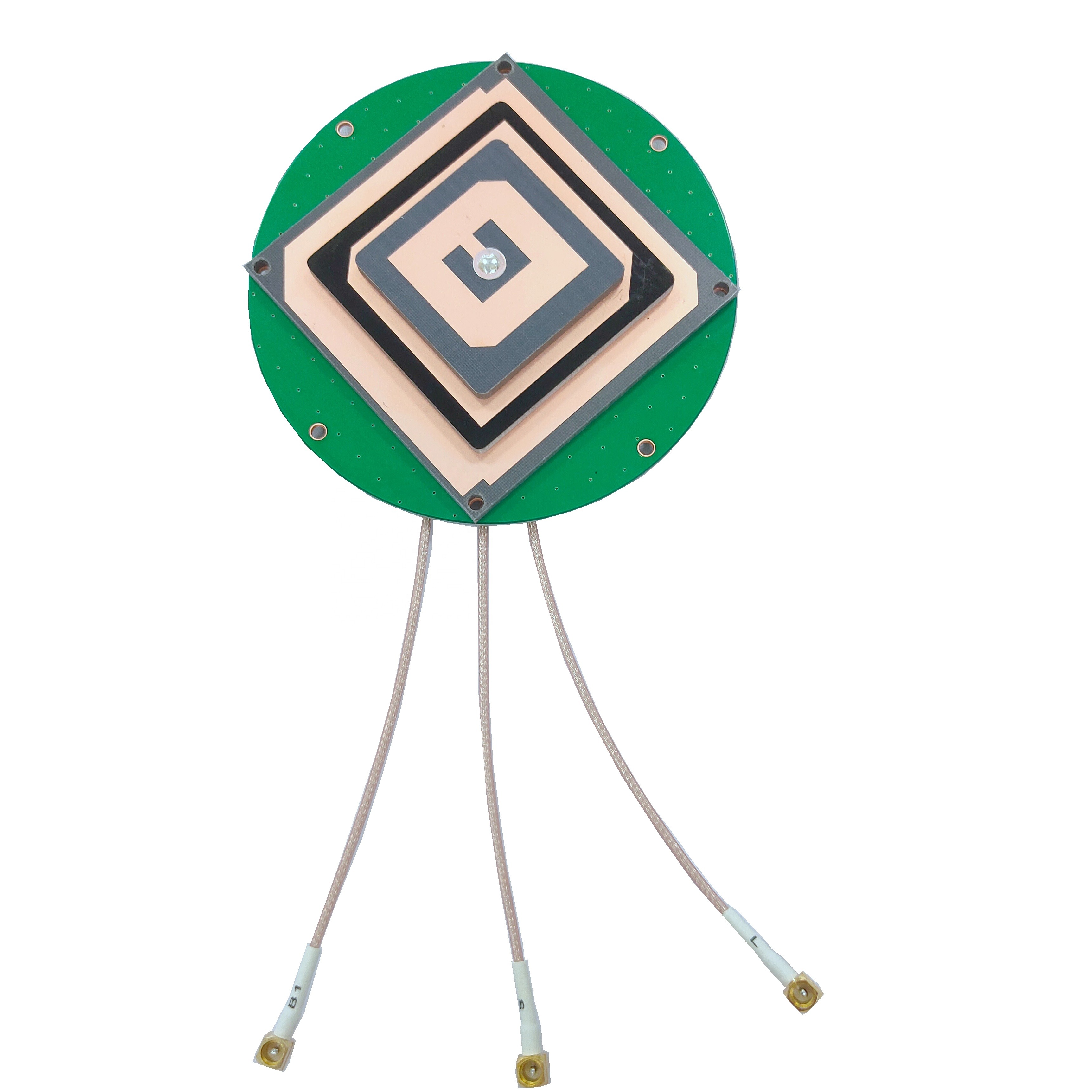
Tri-band GNSS antennas employ sophisticated architectures to achieve their performance characteristics. The most common design utilizes a dual-feed circular stacked patch element. In this configuration, signals from two orthogonal feeds are summed in quadrature, pre-filtered to protect against interfering signals, and then amplified in a high-linearity, wide-band low-noise amplifier (LNA). The signal is then band-split, tightly filtered, and amplified again before recombination at the output.
This architecture provides several critical benefits. The dual-feed circular polarization design enables the antenna to receive the right-hand circularly polarized (RHCP) signals used by GNSS satellites while rejecting left-hand circularly polarized (LHCP) signals that result from multipath reflections. The stacked patch configuration allows the antenna to maintain consistent performance across all three frequency bands, while the multi-stage filtering protects against out-of-band interference from sources such as LTE cellular networks.
Key Performance Metrics
When evaluating tri-band GNSS antennas, several performance specifications are paramount:
Noise Figure: The best tri-band antennas achieve noise figures below 2.5 dB, which is essential for maintaining signal quality in weak-signal environments. A low noise figure directly translates to better carrier-to-noise ratio (C/N₀) and improved tracking performance.
Axial Ratio: Axial ratio measures the circular polarization purity of the antenna. Values below 2.0 dB are considered excellent, ensuring that the antenna efficiently captures the RHCP satellite signals while rejecting multipath and cross-polarization interference.
Phase Centre Variation (PCV): The phase centre is the apparent point from which the antenna receives signals. Tight PCV means that this point remains stable across all frequencies and viewing angles, which is critical for precise positioning applications.
Gain: Tri-band antennas typically offer LNA gains ranging from 28 dB to 33 dB, providing sufficient amplification to overcome cable losses and maintain signal integrity over extended cable runs.
Impedance and VSWR: A 50-ohm impedance with a voltage standing wave ratio (VSWR) of less than 1.5:1 ensures efficient power transfer and minimal signal reflection.
Design Challenges in Tri-Band Antenna Engineering
Multipath Mitigation
Multipath interference remains one of the most persistent challenges in GNSS antenna design. When satellite signals reflect off nearby surfaces—buildings, vehicles, terrain—they arrive at the antenna via multiple paths, causing signal distortion and positioning errors. This problem is particularly acute at low elevation angles, where signals are most susceptible to ground and structural reflections.
Tri-band antennas address multipath through several strategies. The use of circular polarization with high cross-polarization rejection ensures that reflected LHCP signals are attenuated. Ground plane design also plays a crucial role: a properly sized ground plane (typically 100 mm or larger in diameter) suppresses signals arriving from below the horizon and reduces backlobe radiation. Advanced designs may employ choke rings or other structures to further improve front-to-back ratios and pattern roll-off.
Interference Rejection
The RF spectrum has become increasingly crowded, with cellular networks, Wi-Fi, and other wireless services operating in proximity to GNSS frequencies. The LTE 700 MHz band, in particular, poses a significant interference threat to GNSS receivers. Tri-band antennas employ sophisticated filtering architectures—sometimes called "eXtended Filtering" or "XF" technology—to reject out-of-band interference while preserving the integrity of the GNSS signals.
Leading manufacturers incorporate pre-filters and notch filters at strategic points in the signal chain. For example, the u-blox ANN-MB3 integrates an LTE B13 notch filter in the L1 RF path, providing high-performance out-of-band interference mitigation without compromising the GNSS signal.
Bandwidth and Frequency Stability
Covering three distinct frequency bands while maintaining consistent performance across all of them requires careful electromagnetic design. The L1 band spans approximately 47 MHz, while the combined L2/L5 bands cover roughly 90 MHz. Ensuring that the antenna maintains proper impedance matching, axial ratio, and gain across this entire spectrum demands sophisticated modeling and optimization techniques.
Phase centre stability across frequencies is another critical challenge. Because different frequencies experience different propagation characteristics and interact differently with the antenna structure, the phase centre can shift with frequency. Tight PCV is essential for applications that combine measurements from multiple frequencies, such as ionospheric correction algorithms and RTK positioning.
Applications Driving Tri-Band Antenna Adoption
Autonomous Vehicles and ADAS
The autonomous vehicle revolution depends fundamentally on precise, reliable positioning. While LiDAR, cameras, and radar provide situational awareness, GNSS remains the only technology that delivers absolute position in a global reference frame. For autonomous vehicles to navigate safely, they require lane-level accuracy—typically better than 30 centimeters—which only tri-band GNSS with RTK or PPP corrections can provide.
The combination of L1/L2/L5 signals enhances multipath resistance and positioning reliability, which are critical for the safety of autonomous driving systems. In urban environments, where satellite signals reflect off skyscrapers and infrastructure, the ability to track multiple frequencies and constellations ensures that the vehicle maintains a reliable position fix even when some signals are compromised. Tri-band antennas are already deployed in autonomous vehicle tracking and guidance systems, positive train control (PTC), and other mission-critical transportation applications.
Precision Agriculture
Modern precision agriculture relies on GNSS-guided tractors, combines, and sprayers that can operate with sub-inch accuracy. The economic and environmental benefits are substantial: reduced overlap in field operations saves fuel and inputs, while precise seeding and fertilization improve yields. Tri-band GNSS antennas enable the RTK and PPP positioning that makes these applications possible, providing consistent accuracy even when operating near tree lines, buildings, or rolling terrain that can cause multipath interference.
Surveying and Construction
Land surveyors and construction professionals have long been among the most demanding GNSS users, requiring millimeter-level accuracy for boundary determination, topographic mapping, and machine control. Tri-band antennas are ideal for triple-frequency RTK and PPP receivers, delivering the signal quality and phase stability necessary for the most precise surveying tasks. The ability to use L5 signals in combination with L1 and L2 provides improved ionospheric correction and faster ambiguity resolution, reducing the time required to achieve a fixed solution.
UAVs and Robotics
Unmanned aerial vehicles (UAVs) and mobile robots present unique antenna design challenges. These platforms often have limited space, low weight capacity, and complex electromagnetic environments. Lightweight tri-band antennas with compact form factors—such as the Calian HC976P, which weighs only 42 grams—are ideal for these applications. The antenna's helix element provides excellent axial ratios without requiring a ground plane, making it suitable for a wide variety of UAV platforms.
Timing and Synchronization
Beyond positioning, GNSS provides precise timing signals that are essential for telecommunications networks, financial transaction systems, and power grid synchronization. Mission-critical GNSS timing requires antennas that can maintain signal lock even under challenging conditions, and tri-band capability provides the redundancy and interference rejection needed for these applications.
Market Trends and the Future of Tri-Band GNSS
The Shift Toward Multi-Band as Standard
Market analysis reveals a clear trajectory: multi-band GNSS is transitioning from a premium specialty to a baseline requirement. The IndexBox report notes that multi-band, multi-constellation antennas are becoming baseline requirements, with premium segments growing 2–3% per year faster than single-band segments. This shift is driven by several factors, including the modernization of GPS with L2C and L5 signals, the expansion of Galileo, BeiDou, and other constellations, and the growing availability of affordable multi-frequency receiver chipsets.
Cost Reduction and Mass Adoption
Historically, the cost of tri-band GNSS antennas limited their use to high-value professional applications. This is changing rapidly. The u-blox ANN-MB3, launched in September 2025, exemplifies the trend toward affordable, mass-market tri-band antennas. With compact dimensions of 62 × 80 × 25.5 mm and a design optimized for cost-effective manufacturing, the ANN-MB3 makes high-precision GNSS accessible for industrial automation, agriculture, heavy machinery, autonomous vehicles, mobile robotics, and UAVs.
The global GNSS multiband antenna market saw sales of approximately 104 million units in 2025, with an average unit price of about US$12 and an industry capacity utilization rate of approximately 78%. As volumes increase and manufacturing efficiencies improve, prices are expected to continue declining, further accelerating adoption.
Integration and Miniaturization
The trend toward antenna-in-package (AiP) designs and integrated modules is reshaping the component landscape. Rather than purchasing discrete antennas and receivers, OEMs are increasingly opting for integrated solutions that combine the antenna, LNA, and receiver in a single module. This approach reduces design complexity, shortens time-to-market, and ensures optimal matching between antenna and receiver.
Regional Market Dynamics
Supply chain concentration remains a significant factor in the GNSS antenna market. China accounts for an estimated 55–65% of global production, though assembly and testing capacity is rising in North America and Europe for defense-aerospace and sensitive infrastructure procurement. Europe holds a significant share of the GNSS market, driven by automotive applications, particularly ADAS and autonomous driving.
Product Landscape: Leading Tri-Band GNSS Antennas
Calian TW7972 and TW7929 Series
Calian's Tallysman series represents the state of the art in tri-band GNSS antenna design. The TW7972 supports GPS/QZSS-L1/L2/L5, GLONASS-G1/G2/G3, Galileo-E1/E5a/E5b, BeiDou-B1/B2/B2a, and NavIC-L5, plus L-band correction services. Featuring Calian's patented Accutenna® technology, it provides superior multipath rejection, tight phase centre variation, and protection against intermodulation from high-level LTE 700 MHz signals. The TW7929 offers similar capabilities in a lower-power configuration, drawing only 12 mA typical current, making it ideal for power-sensitive applications.
u-blox ANN-MB3
The u-blox ANN-MB3 represents a significant milestone in making tri-band technology accessible to mass markets. Designed for the u-blox F20 high-precision platform and compatible with F9 receivers, the ANN-MB3 provides L1, L2, and L5 coverage with a gain of 3.2 dBic at L1, 4.3 dBic at L2, and 3.8 dBic at L5. Its integrated LTE B13 notch filter ensures reliable performance in harsh RF environments, and its compact form factor enables integration into a wide range of devices.
Tallysman ARM933XF
The ARM933XF is designed for precision triple-frequency positioning where lightweight and low profile are important. Available in two form factors—one with a 100 mm integrated ground plane weighing 140 grams, and another measuring 83 mm in diameter and weighing 138 grams—this antenna features Calian's eXtended Filtering (XF) technology and is available with Low Earth Orbit (LEO) qualified components.
The transition to tri-band GNSS antennas represents more than a technological upgrade; it is a fundamental shift in how positioning systems are designed and deployed. As autonomous vehicles, precision agriculture, advanced surveying, and countless other applications demand ever-higher levels of accuracy and reliability, the ability to receive and process signals across L1, L2, and L5 frequency bands has become essential.
The benefits are clear and compelling: ionospheric correction that removes the largest source of positioning error, multipath rejection that ensures reliability in challenging environments, interference resistance that protects against an increasingly crowded RF spectrum, and multi-constellation support that maximizes satellite availability. These advantages translate directly into improved system accuracy, reduced time-to-fix, and enhanced operational reliability.
For system designers and integrators, the question is no longer whether to adopt tri-band GNSS antennas, but which antenna best fits their specific application requirements. The market offers a growing range of options, from compact, cost-optimized solutions for mass-market applications to high-performance antennas for the most demanding surveying and aerospace applications. With market forecasts projecting continued strong growth and accelerating adoption across multiple industries, tri-band GNSS antennas are poised to become the universal standard for high-precision positioning in the years ahead.
Whether you are developing autonomous vehicles, precision agriculture equipment, surveying instruments, or timing infrastructure, investing in tri-band GNSS antenna technology is an investment in the accuracy, reliability, and future-readiness of your positioning system. The L1/L2/L5 architecture provides the performance foundation that modern applications demand—and that tomorrow's innovations will require.
Lucy Yang | lucy.y@toxutech.com
Dotty Zhao | sales04@toxutech.com
Global Business Director / Sales Team / Global Operations


 En
En Cn
Cn Korean
 Home >