

-
Products -PCBA Manufacturing RF Connectors RF Cable Assemblys Embedded Antennas External Antennas GNSS Positioning Solutions
RF Connectors

RF Cable Assemblys
Embedded Antennas
External Antennas
GNSS Positioning Solutions































 Language


Language


Time:2026-10-16 Views:0
Roof mount combination antenna has become the gold standard for reliable, high-performance wireless connectivity for residential, commercial, industrial, and vehicular applications in 2026. Unlike single-function antennas that only support one frequency band or service, a combination roof-mounted antenna integrates multiple antenna elements into a single compact, weatherproof unit. This innovative design eliminates the need for multiple separate antenna installations, reduces installation costs, minimizes wind resistance, and delivers stable reception for cellular, GNSS, Wi-Fi, DAB+, AM/FM radio, and UHF/VHF signals.
In this comprehensive SEO guide, we will cover everything you need to know about roof mount combination antennas, including their core features, key benefits, working principles, common applications, installation best practices, maintenance tips, and how to select the best model for your specific needs. Whether you are searching for a roof mount combination antenna for home TV reception, fleet vehicle tracking, industrial IoT connectivity, or commercial wireless networking, this guide answers all your critical questions and helps you make an informed purchasing decision.
What Is a Roof Mount Combination Antenna?
A roof mount combination antenna is a multi-functional, externally mounted wireless antenna system designed for permanent or semi-permanent installation on building roofs, vehicle roofs, and outdoor structural surfaces. It combines multiple independent antenna arrays within a single rugged housing to support diverse wireless communication bands and services simultaneously. Traditional antenna setups require individual devices for cellular 4G/5G, GPS/GNSS, Wi-Fi, and broadcast signals, leading to cluttered rooftops, complex wiring, and increased signal interference. The combination roof mount antenna solves these pain points by consolidating all essential connectivity functions into one streamlined unit.
Modern roof mount combination antennas feature omnidirectional signal coverage, high-gain amplification, built-in low-noise amplifiers (LNA), and IP67/IP68 weatherproof ratings. Most models support universal frequency bands, including global 2G/3G/4G/5G cellular spectra, multi-constellation GNSS (GPS, GLONASS, Galileo, BeiDou), dual-band Wi-Fi 6/6E, DAB+ digital radio, analog AM/FM radio, and UHF/VHF digital TV signals. This all-in-one functionality makes it the most versatile connectivity solution for modern wireless communication demands.
The core design philosophy of a roof mount combination antenna is integration and optimization. Each antenna element is precisely isolated within the housing to prevent cross-band interference, ensuring every signal type maintains maximum clarity, strength, and stability. The low-profile aerodynamic design reduces wind load and noise, making it suitable for both stationary building installations and high-speed vehicular applications.
Core Key Features of High-Quality Roof Mount Combination Antennas
Not all roof mount combination antennas deliver the same performance. Premium-grade models are engineered with industry-leading features that ensure long-term durability, stable signal performance, and universal compatibility. Below are the must-have features of a top-tier roof mount combination antenna:
1. Multi-Band Multi-Functional Integration
The defining feature of a roof mount combination antenna is its ability to support multiple wireless services from a single unit. High-end models offer 5-in-1, 10-in-1, or even 15-in-1 connectivity options, covering all mainstream wireless frequencies. Typical integrated functions include 5G/4G LTE MIMO cellular communication, high-precision GNSS positioning, 2.4G/5.8G Wi-Fi MIMO, DAB+ digital audio broadcasting, AM/FM analog radio, and UHF/VHF digital television reception. This full-spectrum coverage eliminates signal dead zones and ensures seamless connectivity in urban, suburban, and rural areas.
2. Rugged Weatherproof Construction
As an outdoor roof-mounted device, combination antennas must withstand extreme environmental conditions. Premium roof mount combination antennas adopt industrial-grade ABS and aluminum alloy housings with IP67 or IP68 ingress protection ratings. This full waterproof, dustproof, and corrosion-resistant design protects internal antenna components from rain, snow, hail, UV radiation, high temperatures, and strong winds. The anti-rust and anti-aging coating ensures stable performance for 5–10 years of outdoor exposure without signal attenuation or structural damage.
3. High-Gain Low-Noise Signal Amplification
Equipped with built-in low-noise amplifiers (LNA) and high-gain antenna elements, professional roof mount combination antennas boost weak incoming signals while filtering out electromagnetic interference. The optimized signal gain significantly improves reception distance, enhances signal stability in remote areas or signal-blocked environments (such as high-rise building clusters and mountainous regions), and reduces pixelation, audio stuttering, and network disconnection issues. The pre-filter design effectively eliminates cross-frequency interference between different antenna modules, ensuring independent and stable operation of each signal channel.
4. Omnidirectional 360-Degree Coverage
Most roof mount combination antennas feature omnidirectional signal radiation patterns, providing full 360-degree horizontal coverage without manual angle adjustment. Unlike directional antennas that only receive signals from a fixed direction, omnidirectional combo antennas capture signals from all surrounding cell towers, broadcast stations, and wireless access points. This feature is especially critical for mobile vehicles and multi-directional building signal reception environments, ensuring uninterrupted connectivity regardless of signal source direction.
5. Low-Profile Aerodynamic Design
Modern roof mount combination antennas adopt ultra-slim, aerodynamic shark-fin or flat-panel designs, replacing bulky traditional antenna structures. The low-profile shape minimizes wind resistance and wind noise, making it ideal for vehicle roof installation during high-speed driving. For building rooftop installation, the compact design maintains architectural aesthetics, avoids wind load damage to the roof, and reduces snow and dust accumulation on the antenna surface.
6. Easy Single-Hole Installation & Universal Compatibility
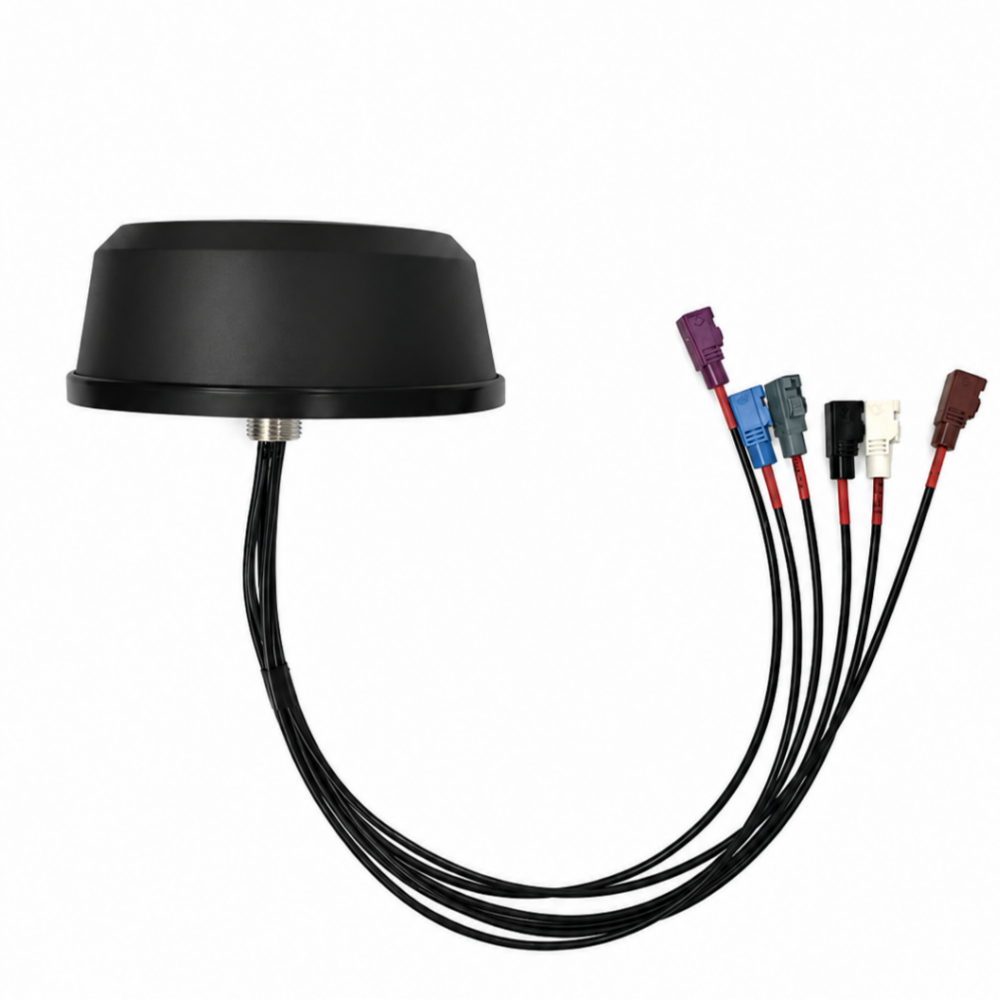
Premium roof mount combination antennas support single-hole roof mounting, which greatly simplifies the installation process compared to multi-antenna setups. The all-in-one unit requires only one drilling hole for wiring and fixing, reducing roof damage, shortening installation time, and lowering labor costs. Meanwhile, these antennas are equipped with universal SMA, RP-SMA, and FAKRA connectors, compatible with all mainstream routers, modems, vehicle tracking systems, navigation devices, and TV receivers. They support 12V DC vehicle power supply and municipal AC power adapter options for diverse application scenarios.
Key Benefits of Using a Roof Mount Combination Antenna
The growing popularity of roof mount combination antennas stems from their unique advantages over traditional single-function antennas and indoor antenna solutions. For residential users, business owners, and industrial operators, this all-in-one antenna solution delivers unparalleled practical value and cost savings:
1. Significant Cost and Space Savings
Installing multiple single-function antennas requires separate equipment costs, independent mounting brackets, multiple drilling holes, and complex wiring systems. A single roof mount combination antenna replaces 3–8 individual antennas, drastically reducing equipment procurement costs, installation fees, and maintenance expenses. It saves valuable rooftop space, avoids messy cable layouts, and eliminates the need for multiple mounting fixtures, creating a cleaner and more organized outdoor equipment layout.
2. Enhanced Signal Stability and Anti-Interference Performance
Traditional multi-antenna setups often suffer from cross-signal interference, which reduces signal quality and causes frequent network fluctuations. Professional combination antennas adopt modular isolated design technology, with independent shielding structures for each frequency band module. This completely isolates signal interference between cellular, GNSS, Wi-Fi, and broadcast signals, ensuring each channel operates at optimal performance. The outdoor roof-mounted position also avoids indoor signal attenuation caused by building walls, metal structures, and indoor electronic interference, achieving stronger and more stable signal reception.
3. Wide Environmental Adaptability
With industrial-grade weatherproof and anti-aging performance, roof mount combination antennas work stably in temperatures ranging from -40°C to +85°C, adapting to extreme cold winters, hot summers, rainy seasons, and windy weather. Whether used in coastal high-humidity salt fog environments, desert high-temperature arid areas, or mountain low-temperature snowy regions, the antenna maintains consistent signal output without failure. This wide environmental adaptability makes it suitable for global residential, commercial, and industrial deployment.
4. Versatile Multi-Scenario Application
A single roof mount combination antenna can meet multiple connectivity needs simultaneously, covering home entertainment, vehicle communication, industrial IoT, commercial networking, and fleet management. Residential users can access free HD digital TV, stable radio broadcast, and enhanced home Wi-Fi/cellular signals. Commercial and industrial users can realize high-precision positioning, real-time 5G data transmission, and wireless device networking. This multi-functional versatility makes it a one-stop connectivity solution for diverse user groups.
5. Long Service Life and Low Maintenance Costs
High-quality roof mount combination antennas are made of high-strength, anti-corrosion materials with no easily damaged movable parts. The fully sealed housing prevents internal circuit oxidation and water ingress, ensuring a service life of more than 8 years under normal outdoor use. Compared with single antennas that require frequent replacement and maintenance, combo antennas have extremely low failure rates, reducing long-term equipment replacement and after-sales maintenance costs for users.
Common Applications of Roof Mount Combination Antennas
The flexible multi-band performance and rugged outdoor design make roof mount combination antennas widely used in residential, vehicular, commercial, industrial, and public service fields. Below are the most mainstream application scenarios in 2026:
1. Residential Home Outdoor Connectivity
For household users, roof mount combination antennas are the perfect solution for cord-cutting TV reception and home network optimization. They support long-distance UHF/VHF digital TV signal reception, capturing free local HD TV channels with zero monthly fees, completely replacing expensive cable TV and satellite TV subscriptions. Meanwhile, the integrated cellular and Wi-Fi modules enhance home wireless signal coverage, solving network dead zones and weak signal problems in villas, multi-story houses, and rural residences. The built-in DAB+ and AM/FM radio functions also provide clear audio broadcast reception for home entertainment systems.
2. Vehicular Communication & Fleet Management
Vehicle roof mount combination antennas are standard equipment for modern commercial vehicles, including trucks, buses, vans, and engineering vehicles. The integrated 4G/5G cellular, high-precision GNSS positioning, and Wi-Fi modules support real-time vehicle tracking, fleet remote monitoring, driver behavior analysis, and in-vehicle wireless networking. The aerodynamic low-profile design adapts to high-speed vehicle operation without increased wind noise or driving resistance. Many fleet companies adopt multi-in-one roof mount combination antennas to simplify vehicle modification, reduce failure points, and improve the efficiency of intelligent fleet management systems.
3. Industrial IoT & Smart Device Networking
In industrial scenarios such as smart factories, remote monitoring stations, solar power stations, and environmental monitoring equipment, roof mount combination antennas provide stable multi-band wireless connectivity for IoT devices. They support 5G high-speed data transmission for real-time monitoring data upload, GNSS precise positioning for equipment location tracking, and Wi-Fi local networking for on-site device communication. The industrial-grade weatherproof design ensures stable operation of IoT systems in harsh outdoor industrial environments, realizing unmanned remote monitoring and intelligent management.
4. Commercial Building & Campus Wireless Coverage
Shopping malls, office buildings, schools, and campus parks widely use roof mount combination antennas to supplement outdoor wireless signal coverage. These antennas eliminate cellular signal dead zones in building peripheral areas, enhance public Wi-Fi network stability, and support building digital TV and broadcast signal coverage. The centralized roof installation method realizes large-area signal coverage with a small number of devices, reducing commercial networking costs and improving user wireless experience in public areas.
5. Special Vehicle & Mobile Communication Equipment
Emergency vehicles, communication vehicles, and field operation vehicles rely on roof mount combination antennas for multi-functional communication support. The all-in-one design meets emergency communication, real-time positioning, on-site network coverage, and broadcast reception needs in field environments without fixed network infrastructure. The fast installation and stable signal performance ensure the normal operation of mobile communication systems in complex field scenarios.
How to Choose the Best Roof Mount Combination Antenna (2026 Buying Guide)
Selecting a suitable roof mount combination antenna is critical to ensuring optimal signal performance and long-term stable operation. With numerous models and specifications on the market, users need to focus on the following core factors to avoid inferior products and mismatched models:
1. Confirm Required Functional Bands
First, clarify your core usage needs. Home users focusing on TV and radio reception can choose 3-in-1 (TV + DAB + FM) combination antennas. Fleet and industrial users requiring network and positioning functions need 5G/GNSS/Wi-Fi multi-band combo antennas. Avoid purchasing over-functional models with redundant features to save costs, and do not choose under-equipped antennas that cannot meet daily usage demands. Priority should be given to models supporting global universal frequency bands to ensure signal compatibility in different regions.
2. Check Weatherproof and Durability Ratings
Outdoor roof-mounted antennas must have excellent environmental adaptability. It is recommended to select models with IP67 or higher waterproof and dustproof ratings, anti-UV aging housing, and anti-corrosion metal brackets. For coastal, high-altitude, or extreme temperature areas, prioritize industrial-grade enhanced versions with salt-fog resistance and high/low temperature resistance to extend service life.
3. Verify Signal Gain and Coverage Performance
Signal gain directly determines reception distance and signal stability. For rural, suburban, or remote areas far from signal towers, choose high-gain roof mount combination antennas with built-in LNA amplifiers to capture weak distant signals. For urban dense signal areas, standard-gain models are sufficient to avoid signal saturation. Prefer omnidirectional coverage models for multi-directional signal sources to ensure no blind spots in reception.
4. Confirm Installation Method and Compatibility
Prioritize single-hole roof mount models for simple installation and minimal roof damage. Check whether the antenna connectors (SMA, FAKRA, RJ45) match your existing equipment such as routers, modems, and receivers. Vehicle users need to confirm 12V DC power supply compatibility and aerodynamic design suitability for high-speed driving. Building users should select lightweight models with wind-resistant brackets to adapt to rooftop installation environments.
5. Prioritize Brand Quality and After-Sales Service
Choose professional antenna manufacturers with mature R&D and production experience to ensure product circuit optimization, interference shielding, and performance stability. Avoid cheap inferior products with unqualified shielding design, which are prone to signal interference and short service life. Prefer products with long warranty periods and professional after-sales technical support to solve installation and debugging problems in a timely manner.
Roof Mount Combination Antenna Installation Best Practices
Professional installation directly affects the signal performance and service life of a roof mount combination antenna. Even high-quality products may suffer from signal attenuation and failure due to irregular installation. Follow these industry best practices for optimal installation results:
1. Select the Optimal Installation Position
Install the antenna on the highest open area of the roof to avoid obstructions such as building parapets, metal brackets, trees, and high-rise buildings. Metal objects will shield wireless signals and cause serious signal attenuation. Ensure the antenna is exposed to open air with 360-degree unobstructed reception to maximize signal capture efficiency. For vehicle installation, choose the middle position of the roof to balance signal reception and aerodynamic performance.
2. Standardize Drilling and Waterproof Treatment
For single-hole mounting, control the drilling diameter strictly according to the product manual to avoid oversized holes that affect waterproof performance. After threading and fixing the antenna, use the matching waterproof rubber gasket and sealant provided by the manufacturer to fully seal the drilling hole, preventing rainwater and dust from penetrating into the roof and causing water leakage and circuit damage. Avoid random drilling and wiring to ensure installation safety and aesthetics.
3. Optimize Cable Layout and Connection
Use high-quality low-loss coaxial matching cables to reduce signal transmission loss. Minimize cable length and avoid excessive bending and winding, which will increase signal attenuation. Ensure all connectors are tightly connected and fixed with waterproof tape to prevent oxidation and poor contact caused by long-term outdoor exposure. Separate different signal cables appropriately to avoid manual cross-interference during wiring.
4. Fix Brackets Firmly for Wind Resistance
Install all mounting brackets and fixing screws firmly according to the installation instructions. For areas with frequent strong winds, add auxiliary wind-resistant fixing parts to prevent the antenna from shaking or falling off in extreme weather. Regularly check the firmness of fixed parts during subsequent maintenance to avoid loose screws caused by long-term wind vibration.
5. Debug and Test Signal Performance After Installation
After installation, use signal testing tools to detect the signal strength, stability, and channel clarity of each functional band. Adjust the installation position slightly according to the test results to achieve the best reception effect. Test all integrated functions (TV, radio, network, positioning) to ensure no functional failure or signal interference, and complete installation debugging records.
Daily Maintenance & Troubleshooting Guide
Scientific daily maintenance can effectively extend the service life of a roof mount combination antenna and maintain stable signal performance. Regular inspection and simple troubleshooting can solve most common usage problems:
Routine Maintenance Tips
Clean the antenna surface regularly every quarter to remove dust, leaves, snow, and bird droppings, avoiding surface coverage that affects signal transmission. Check the waterproof seal of the mounting hole and connector parts annually, replace aging sealant and gaskets in time to prevent water ingress. Inspect the firmness of brackets and screws to eliminate hidden dangers of loosening and falling off. Avoid placing heavy objects on the antenna or manually twisting the antenna housing. For long-term unused equipment, cut off the power supply and do a good job of dust and water protection.
Common Faults and Solutions
1. Weak Signal and Unstable Reception: The main causes include blocked antenna signal, loose cable connectors, aging low-loss cables, or interference from surrounding new metal buildings. Solutions: Clean obstructions around the antenna, re-fix and waterproof connectors, replace aging cables, and adjust the antenna installation height appropriately.
2. Single Function Failure of Multi-Band Signals: Individual band signal failure is usually caused by internal module line failure or single-channel connector looseness. Solutions: Detect the corresponding channel line and connector, re-plug and fix, and contact after-sales maintenance if the internal module is damaged.
3. Water Ingress and Antenna Short Circuit: Caused by aging waterproof seals or unstandardized installation. Solutions: Immediately cut off the power supply, dry the internal circuit, replace all waterproof accessories, and re-seal the mounting hole to prevent secondary water ingress.
4. Wind Noise and Antenna Vibration: Caused by loose fixing brackets or inappropriate installation positions. Solutions: Fasten all fixed screws, add auxiliary wind-resistant parts, and adjust the antenna installation position to avoid wind vortex impact.
FAQs About Roof Mount Combination Antenna
Q1: What is the difference between a combination antenna and a single-function antenna?
A roof mount combination antenna integrates multiple signal receiving modules into one unit, supporting multiple wireless services simultaneously with single-hole installation, low interference, and low comprehensive cost. Single-function antennas only support one signal band, requiring multiple installations for multi-service needs, with high cost, large space occupation, and easy cross-signal interference.
Q2: Can roof mount combination antennas work in rural remote areas?
Yes. High-gain roof mount combination antennas with built-in low-noise amplifiers can capture weak distant signals, effectively solving the problem of insufficient signal coverage in rural and remote areas. The outdoor high-position installation avoids indoor signal attenuation, providing more stable reception than indoor antennas.
Q3: Is professional installation required for roof mount combination antennas?
Although the single-hole installation design is simple, professional installation is recommended to ensure standardized drilling, waterproof treatment, and signal debugging. Professional installation can avoid roof water leakage, signal interference, and unstable fixing problems, ensuring long-term stable operation of the equipment.
Q4: How long is the service life of a roof mount combination antenna?
Industrial-grade high-quality roof mount combination antennas have a service life of 8–10 years. With regular daily maintenance and standardized installation, the service life can be further extended. Inferior products generally fail within 2–3 years due to poor materials and unqualified shielding design.
Q5: Can vehicle roof mount combination antennas be used for building roofs?
Most universal combo antennas support both vehicle and building roof installation. Only need to replace the corresponding mounting brackets and power supply modes to adapt to different application scenarios, with strong versatility.
As wireless communication technology continues to iterate towards 5G popularization, IoT intelligence, and high-precision positioning, the roof mount combination antenna has become an indispensable core device for modern outdoor connectivity. Its all-in-one multi-functional design, rugged outdoor durability, stable signal performance, and cost-saving advantages completely subvert the traditional multi-antenna installation mode, bringing efficient and convenient connectivity solutions for residential, vehicular, industrial, and commercial users.
When purchasing and using a roof mount combination antenna, users should prioritize matching functional bands, industrial-grade durability, and professional installation and maintenance. Choosing high-quality regular products and standardizing installation and use can maximize the performance advantages of the combo antenna, achieve long-term stable multi-band wireless connectivity, and create a more reliable wireless communication environment for home life, business operation, and industrial production.
Lucy Yang | lucy.y@toxutech.com
Dotty Zhao | sales04@toxutech.com
Global Business Director / Sales Team / Global Operations


 En
En Cn
Cn Korean
 Home >