

-
Products -PCBA Manufacturing RF Connectors RF Cable Assemblys Embedded Antennas External Antennas GNSS Positioning Solutions
RF Connectors

RF Cable Assemblys
Embedded Antennas
External Antennas
GNSS Positioning Solutions































 Language


Language


Time:2026-10-16 Views:0
1. What Is a Low Profile Multi-Band Antenna?
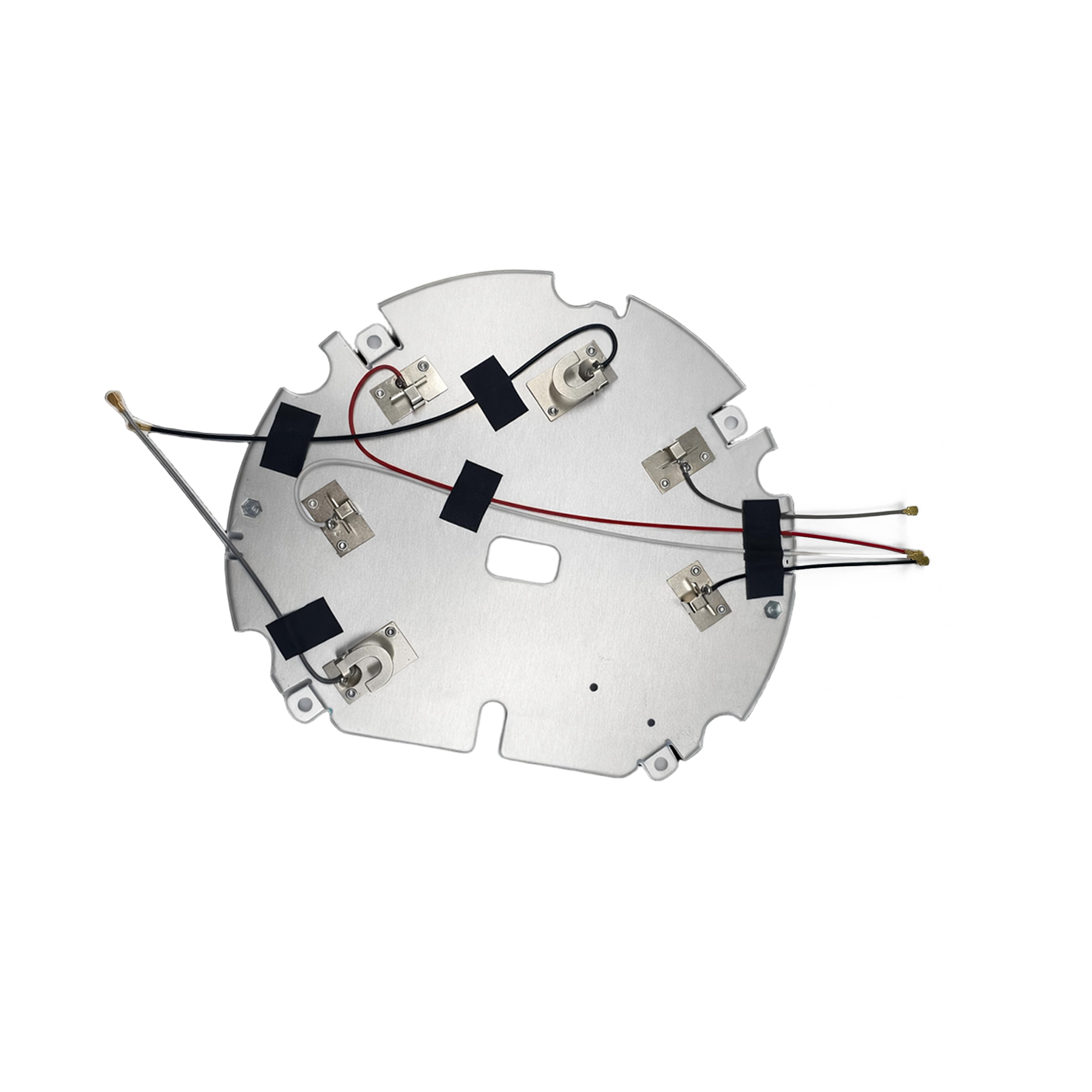
A low profile multi-band antenna is a compact, low-height wireless antenna designed to operate efficiently across multiple discrete frequency bands while maintaining a minimal vertical footprint. Typically defined by a height of less than 5mm (or 0.01–0.05 times the operating wavelength) and a flat, planar structure, this antenna type abandons the tall rod, helical, or parabolic designs of conventional antennas, adopting microstrip patch, planar inverted F (PIFA), magnetoelectric dipole, and metamaterial resonant structures to achieve multi-band functionality in a slim package.
The term “multi-band” means the antenna can cover two or more independent frequency bands, including common cellular bands (2G/3G/4G LTE/5G Sub-6GHz), Wi-Fi bands (2.4GHz, 5GHz, 6GHz Wi-Fi 6E), GPS/GNSS bands, and dedicated industrial IoT frequency bands. Unlike wideband antennas that cover a continuous frequency range, professional low profile multi-band antennas target specific standardized communication bands, ensuring optimized gain, impedance matching, and signal stability for each operational frequency.
Core structural features distinguish low profile multi-band antennas from ordinary antennas: planar substrate integration, shared-aperture multi-resonance design, low-loss dielectric materials, and integrated impedance matching circuits. These features eliminate the need for multiple single-band antennas, reducing device size, weight, and installation complexity while maintaining consistent wireless performance across all target bands.
2. Core Working Principle of Low Profile Multi-Band Antennas
The operational mechanism of low profile multi-band antennas relies on multi-mode resonance and optimized electromagnetic field distribution in a limited planar space. Traditional single-band antennas only excite one resonant mode at a fixed frequency, while multi-band low-profile antennas utilize structural optimization and material tuning to trigger multiple independent resonant modes corresponding to different communication bands.
Most mainstream low profile multi-band antenna designs adopt microstrip patch resonance technology and complementary split ring resonator (CSRR) metamaterial structures. By adjusting the length, width, gap spacing, and shorting via positions of the planar radiation patch, designers can excite TM11, TM31, and TM51 resonant modes, covering low, medium, and high frequency bands respectively. For example, a typical tri-band low profile antenna can resonate at 2.4GHz (Wi-Fi), 3.5GHz (5G Sub-6GHz), and 5.8GHz (industrial wireless) through multi-mode excitation without increasing structural height.
Another key technical principle is isolation optimization. Multi-band antennas face inherent signal interference between different frequency channels. Modern low profile multi-band designs integrate parasitic elements, stub augmentation, and decoupling structures to improve inter-band isolation, suppressing mutual coupling and ensuring each frequency band operates independently with minimal signal attenuation. Low-loss dielectric substrates such as FR4, ceramic, and paper-based composite materials further reduce electromagnetic loss in ultra-thin structures, maintaining high radiation efficiency despite the compact low-profile form.
3. Key Technical Characteristics of High-Performance Low Profile Multi-Band Antennas
Premium low profile multi-band antennas are defined by a set of standardized technical parameters that determine their wireless performance, adaptability, and durability. Understanding these characteristics is critical for product selection and system integration.
3.1 Ultra-Low Profile & Compact Size
The most intuitive feature is the ultra-thin planar structure. Most industrial-grade low profile multi-band antennas have a height of 1–4mm, with a planar area optimized for embedded installation. Some advanced magnetoelectric dipole low-profile antennas achieve a profile as low as 0.012λ (wavelength of the lowest operating frequency), enabling seamless integration into ultra-thin devices such as smart terminals, wearable electronics, and flat IoT sensors. The compact shared-aperture design replaces 2–3 single-band antennas with one unit, saving over 60% of installation space.
3.2 Multi-Band Compatibility & Wide Frequency Coverage
High-quality low profile multi-band antennas support universal coverage of mainstream wireless frequency bands. Common band combinations include: 2.4GHz + 5GHz + 6GHz (Wi-Fi 6/6E tri-band), 4G LTE + 5G Sub-6GHz (n77/n78/n79 bands), cellular + GPS + Bluetooth integrated bands, and industrial 315MHz/433MHz + 2.4GHz dual-band. Custom multi-band designs can also cover millimeter-wave bands for 5G advanced and 6G pre-deployment applications, balancing low-profile size and wide-frequency compatibility.
3.3 High Radiation Efficiency & Stable Gain
A common misconception is that low-profile compact design leads to poor signal performance. Modern optimized low profile multi-band antennas adopt low-loss substrate materials and precision impedance matching circuits, achieving radiation efficiency above 85% for mainstream frequency bands. The gain is stabilized at 2–5dBi for omnidirectional models and 6–12dBi for directional models, ensuring stable signal transmission and reception in complex electromagnetic environments. Unlike ordinary wideband antennas with fluctuating gain across frequencies, multi-band dedicated designs maintain consistent performance for each target band.
3.4 Strong Anti-Interference & Decoupling Performance
Equipped with built-in decoupling networks and parasitic suppression structures, professional low profile multi-band antennas effectively reduce inter-band mutual coupling and external electromagnetic interference. The optimized isolation performance (≥20dB between adjacent bands) ensures no signal crosstalk during simultaneous multi-band operation, supporting stable concurrent connectivity for multiple wireless protocols.
3.5 Environmental Adaptability & Durability
Industrial and commercial low profile multi-band antennas feature waterproof, dustproof, and anti-corrosion packaging. Embedded PCB antennas adopt high-temperature resistant dielectric substrates, while external flat antennas use ABS and metal alloy shells, supporting operating temperatures from -40℃ to +85℃. This wide environmental adaptability enables stable operation in outdoor, industrial, vehicle-mounted, and smart city scenarios.
4. Core Advantages of Low Profile Multi-Band Antennas Over Traditional Antennas
Compared with conventional single-band rod antennas, bulky directional antennas, and ordinary wideband antennas, low profile multi-band antennas have irreplaceable competitive advantages in modern wireless system design, making them the mainstream choice for new-generation wireless devices.
4.1 Space-Saving & High Integration
Traditional wireless devices need to reserve independent installation space for Wi-Fi, cellular, and Bluetooth antennas, resulting in complex internal structure and increased equipment volume. The low profile multi-band integrated design realizes multi-function integration in a single ultra-thin unit, greatly simplifying product structural design, reducing equipment thickness and weight, and meeting the ultra-thin and portable design requirements of consumer electronics and compact industrial equipment.
4.2 Lower System Cost & Simplified Installation
Adopting one low profile multi-band antenna instead of multiple single-band antennas reduces hardware procurement costs, wiring complexity, and installation labor costs. The unified antenna structure also simplifies subsequent maintenance and replacement work, lowering the overall operation and maintenance cost of wireless systems. For large-scale IoT device deployment and wireless base station construction, this cost-saving advantage is particularly significant.
4.3 Optimized Signal Stability & Compatibility
Ordinary wideband antennas sacrifice partial performance to expand frequency range, leading to unstable signal gain and high attenuation in partial bands. In contrast, low profile multi-band antennas are optimized for each target frequency band through targeted structural design, ensuring excellent impedance matching and radiation performance for every working band. They are fully compatible with mainstream wireless protocols such as 802.11ax (Wi-Fi 6), 5G NR, Bluetooth 5.3, and LoRa, achieving plug-and-play stable connectivity.
4.4 Aesthetic & Versatile Installation
The flat, ultra-thin, low-profile appearance avoids the bulky and protruding structure of traditional antennas, enabling hidden embedded installation, surface mounting, and flush mounting. It does not affect the overall aesthetic of equipment and buildings, making it suitable for smart home devices, vehicle-mounted terminals, smart wearable devices, and urban wireless infrastructure with high appearance requirements.
4.5 Scalable & Customizable Design
Low profile multi-band antenna structures are highly scalable. Designers can adjust resonant modes, frequency bands, gain, and radiation angles according to customer requirements, supporting personalized customization of special frequency bands, high-gain enhancement, and directional/omnidirectional switching. This flexibility meets the differentiated needs of consumer, industrial, and military wireless systems.
5. Main Applications of Low Profile Multi-Band Antennas
With their unique low-profile structure, multi-band compatibility, and high integration, low profile multi-band antennas have been widely applied in almost all modern wireless communication fields, covering consumer electronics, industrial IoT, smart transportation, wireless infrastructure, and smart city systems.
5.1 Consumer Electronic Devices
Ultra-thin smart phones, tablet computers, laptops, and smart wearable devices are the most typical application scenarios. These devices have extremely strict requirements on internal space and thickness, and traditional protruding antennas cannot meet the design standards. Built-in low profile multi-band antennas integrate 4G/5G cellular, Wi-Fi, Bluetooth, and GPS functions, realizing full-band wireless connectivity while ensuring ultra-thin body design and stable signal performance.
5.2 Smart Home & IoT Devices
Smart speakers, smart cameras, smart sensors, intelligent gateways, and home automation devices require multi-protocol wireless connectivity. Low profile multi-band antennas support simultaneous access of 2.4G/5G Wi-Fi and Bluetooth, realizing device networking, data transmission, and remote control. The low-power, compact design is perfectly adapted to battery-powered IoT devices, extending equipment standby time while ensuring stable network access.
5.3 Vehicle-Mounted Wireless Systems
Vehicle-mounted intelligent terminals, car Wi-Fi systems, vehicle GPS navigation, and intelligent driving sensing systems require high-stability multi-band antennas. Vehicle-mounted low profile multi-band antennas adopt anti-vibration, high-temperature resistant low-profile design, supporting 5G cellular, Wi-Fi, GNSS positioning, and V2X vehicle networking bands. The flush mounting design avoids wind resistance and structural damage, adapting to complex vehicle operating environments.
5.4 Industrial Wireless Equipment
Industrial routers, industrial gateways, wireless data transmission modules, and automated production equipment need to support multi-band industrial wireless communication. Industrial-grade low profile multi-band antennas have strong anti-interference ability, supporting stable operation in high-electromagnetic-interference factory environments. They cover industrial dedicated frequency bands and mainstream cellular/Wi-Fi bands, realizing industrial equipment networking, data collection, and remote monitoring.
5.5 Wireless Base Station & Communication Infrastructure
Micro base stations, indoor signal coverage devices, and distributed antenna systems (DAS) widely use low profile multi-band antennas. The ultra-thin planar design is suitable for indoor ceiling mounting and wall mounting, covering 4G/5G full-band signals, solving indoor signal blind spots and weak signal problems. The multi-band integrated design reduces the number of base station antennas, simplifying communication infrastructure construction and maintenance.
5.6 Smart City & Wireless Monitoring Systems
Smart street lamps, environmental monitoring equipment, security monitoring terminals, and smart parking systems rely on low profile multi-band antennas to realize multi-band data transmission. The outdoor waterproof and dustproof low-profile design adapts to long-term outdoor operation, supporting simultaneous transmission of monitoring data, positioning information, and network signals, providing core wireless support for smart city construction.
6. How to Choose the Right Low Profile Multi-Band Antenna: Complete Buying Guide
To select a cost-effective and high-performance low profile multi-band antenna, you need to comprehensively consider frequency band matching, performance parameters, installation environment, structural size, and application scenarios. The following key selection criteria help you avoid purchasing mistakes.
6.1 Confirm Target Frequency Band Requirements
First, clarify the required wireless frequency bands and protocols for your device. For daily consumer products, choose 2.4GHz+5GHz+6GHz Wi-Fi tri-band antennas; for cellular communication devices, select 4G/5G Sub-6GHz full-band multi-band antennas; for industrial IoT products, prioritize antennas supporting LoRa, Bluetooth, and industrial dedicated frequency bands. Ensure the antenna’s working frequency band fully matches the device’s communication module to avoid frequency mismatch causing no signal or low efficiency.
6.2 Check Core Performance Parameters
Focus on three core parameters: gain, radiation efficiency, and isolation. For short-distance indoor scenarios, 2–3dBi omnidirectional low-gain antennas are sufficient with stable signal and low power consumption; for long-distance transmission and outdoor scenarios, select 5–10dBi high-gain multi-band antennas. Ensure radiation efficiency is higher than 80% and inter-band isolation is more than 18dB to avoid signal crosstalk and attenuation.
6.3 Match Installation Size & Form Factor
According to the device’s internal space or installation environment, confirm the antenna’s thickness, length, and width. Ultra-thin embedded devices need antennas with a profile below 3mm; outdoor mounting scenarios can choose slightly larger high-performance flat low-profile antennas. Reserve enough installation space and avoid blocking the antenna radiation area with metal structures, which will affect signal transmission.
6.4 Adapt to Application Environment Conditions
Indoor static scenarios can choose conventional PCB low profile multi-band antennas with low cost and stable performance; outdoor, vehicle-mounted, and industrial scenarios must select waterproof, dustproof, high-temperature resistant industrial-grade antennas with IP65 or above protection level. For high-electromagnetic-interference industrial environments, prioritize enhanced anti-interference multi-band antenna models.
6.5 Verify Interface & Compatibility
Common antenna interfaces include SMA, IPEX, U.FL, and MMCX. Select a matching interface according to the device’s communication module interface to ensure seamless docking. At the same time, confirm the antenna’s impedance (standard 50Ω) matches the module’s impedance to avoid signal reflection and loss caused by impedance mismatch.
7. Common Design Challenges & Optimization Solutions for Low Profile Multi-Band Antennas
Although low profile multi-band antennas have many advantages, their ultra-thin compact structure brings inherent design challenges. Understanding these challenges and corresponding optimization technologies helps users recognize product quality differences and select high-quality antenna solutions.
7.1 Challenge 1: Limited Space Restricts Multi-Band Resonance
The ultra-low-profile structure limits the antenna’s radiation aperture, making it difficult to realize multi-frequency resonance and easy to cause narrow bandwidth. Optimization Solution: Adopt metamaterial resonant structures, stub augmentation technology, and multi-mode stacked patch design to expand bandwidth and realize multi-band resonance in a limited space without increasing antenna height.
7.2 Challenge 2: Inter-Band Signal Mutual Coupling Interference
Multiple resonant structures in a single shared aperture are prone to mutual coupling, resulting in reduced isolation, signal crosstalk, and decreased efficiency. Optimization Solution: Add decoupling parasitic elements and defected ground structures, optimize patch spacing and feed position, and improve inter-band isolation to ensure independent stable operation of each frequency band.
7.3 Challenge 3: Low-Profile Structure Causes Low Radiation Efficiency
Ultra-thin substrates and compact radiation units easily lead to increased electromagnetic loss and reduced radiation efficiency.Optimization Solution: Use low-loss high-frequency dielectric substrates, optimize impedance matching networks, and adopt copper-clad thickening technology to reduce conductor loss and improve overall radiation efficiency.
8. Future Development Trends of Low Profile Multi-Band Antennas
Driven by 5G-A, 6G, Wi-Fi 7, and large-scale IoT deployment, low profile multi-band antenna technology is constantly iterating and upgrading, showing four major development trends.
8.1 Higher Integration & Ultra-Miniaturization
Future low profile multi-band antennas will achieve smaller size and lower profile while covering more frequency bands. With the continuous optimization of metamaterial and micro-nano processing technology, ultra-thin flexible multi-band antennas will be widely used in wearable devices, flexible electronics, and ultra-thin intelligent terminals.
8.2 Broadband & Full-Band Universal Coverage
Traditional multi-band antennas only cover discrete frequency bands. Next-generation products will realize seamless coverage from sub-1GHz low-frequency bands to millimeter-wave high-frequency bands, supporting the iterative upgrade of 5G-A, 6G, and Wi-Fi 7, meeting the full-band communication needs of future wireless systems.
8.3 Intelligent Reconfigurable Technology
Reconfigurable low profile multi-band antennas equipped with diode switches and varactor tuning structures will become mainstream. These antennas can dynamically adjust operating frequency bands, gain, and radiation patterns according to environmental signal changes, realizing adaptive intelligent wireless communication and improving system environmental adaptability.
8.4 Low-Power & Green Energy-Saving Design
Facing the large-scale deployment of battery-powered IoT devices, low power consumption will become a core indicator of low profile multi-band antennas. Optimized circuit design and low-loss material technology will further reduce antenna power consumption, extending the battery life of wireless terminal devices and supporting green and low-carbon wireless system construction.
9. Frequently Asked Questions (FAQs) About Low Profile Multi-Band Antennas
Q1: Are low profile multi-band antennas worse than traditional rod antennas?
No. High-quality low profile multi-band antennas adopt optimized resonant structures and low-loss materials. Their signal gain, stability, and radiation efficiency are comparable to traditional single-band rod antennas. Meanwhile, they have the advantages of multi-band integration, small size, and easy installation, which are more suitable for modern compact wireless devices.
Q2: Can low profile multi-band antennas work outdoors long-term?
Yes. Industrial-grade low profile multi-band antennas have IP65/IP67 waterproof, dustproof, and anti-aging properties, adapting to long-term outdoor high and low temperature, rain, and wind environments. They are widely used in outdoor base stations, smart city monitoring, and vehicle-mounted scenarios.
Q3: What devices need low profile multi-band antennas?
All compact wireless devices that need multi-protocol and multi-band connectivity are applicable, including smart home devices, IoT sensors, 5G terminals, vehicle-mounted equipment, industrial gateways, indoor base stations, and wearable electronic devices.
Q4: How to improve the signal effect of low profile multi-band antennas?
Avoid metal shielding around the antenna, reserve a clear radiation space, select a high-gain model according to the distance, ensure interface impedance matching, and install the antenna in an open and high position to reduce electromagnetic interference.
Low profile multi-band antennas are essential core components of modern wireless communication systems, perfectly solving the contradiction between multi-band communication function and compact device structure. Through ultra-low-profile planar design, multi-mode resonance technology, and high-efficiency decoupling optimization, they replace traditional bulky single-band antenna combinations, bringing significant advantages in space saving, cost reduction, stable performance, and versatile installation.
With the continuous development of 5G, IoT, smart transportation, and smart city industries, the market demand for low profile multi-band antennas will continue to grow. Future technological innovation will further promote the ultra-miniaturization, intelligence, and full-band universalization of such antennas, providing more efficient and reliable connectivity solutions for next-generation wireless networks. For enterprise buyers and engineers, selecting high-performance low profile multi-band antennas is the key to optimizing wireless product design, improving communication quality, and enhancing product market competitiveness.
Lucy Yang | lucy.y@toxutech.com
Dotty Zhao | sales04@toxutech.com
Global Business Director / Sales Team / Global Operations


 En
En Cn
Cn Korean
 Home >