

-
Products -PCBA Manufacturing RF Connectors RF Cable Assemblys Embedded Antennas External Antennas GNSS Positioning Solutions
RF Connectors

RF Cable Assemblys
Embedded Antennas
External Antennas
GNSS Positioning Solutions































 Language


Language


Time:2026-10-15 Views:0
In the era of intelligent navigation, autonomous driving, precision surveying, and industrial IoT, high precision L1 L2 L5 antenna has become an indispensable core component of modern GNSS (Global Navigation Satellite System) positioning systems. Unlike traditional single-band or dual-band GPS antennas, professional L1 L2 L5 triple-band antennas support full-spectrum reception of modern GPS constellation signals, paired with advanced anti-interference technology, stable phase center characteristics, and multipath suppression capabilities, enabling centimeter-level and even sub-centimeter-level positioning accuracy. This comprehensive guide deeply explores the working principles, core advantages, key technical parameters, application scenarios, selection criteria, and maintenance tips of high-precision L1 L2 L5 antennas, helping global engineers, purchasers, and technical researchers fully understand triple-band GNSS antennas and make optimal deployment decisions for high-precision positioning projects.
With the rapid upgrade of global satellite navigation systems, traditional L1-only GPS antennas can no longer meet the high-standard positioning demands of complex scenarios such as urban canyons, dense vegetation coverage, and high-electromagnetic-interference industrial environments. The addition of L2 and L5 frequency bands compensates for the defects of single-band positioning in ionospheric error correction, signal stability, and anti-multipath interference. High precision L1 L2 L5 antennas perfectly adapt to multi-constellation collaborative positioning including GPS, Galileo, BeiDou, GLONASS, and QZSS, becoming the mainstream choice for high-end GNSS positioning equipment worldwide.
1. Basic Overview of L1 L2 L5 Triple-Band GNSS Frequency Bands
To understand the technical superiority of high precision L1 L2 L5 antenna, it is essential to clarify the functional differences and positioning values of the three core GPS frequency bands. Each frequency band has independent signal characteristics, coverage advantages, and error correction functions, and the three-band collaborative work realizes full-dimensional optimization of positioning accuracy and stability.
1.1 GPS L1 Band (1575.42 MHz)
The L1 band is the most classic and widely used GPS civilian frequency band, with a center frequency of 1575.42 MHz. It carries C/A code civilian positioning signals and P(Y) code military precision signals, featuring wide signal coverage, strong penetration, and stable basic signal reception. For a long time, L1 single-band antennas were the mainstream of consumer-grade GPS positioning devices, suitable for ordinary navigation, vehicle positioning, and daily geographic marking scenarios. However, the single L1 band cannot effectively eliminate ionospheric delay errors and multipath interference, resulting in positioning accuracy limited to meter-level, which is difficult to support professional high-precision operation scenarios.
1.2 GPS L2 Band (1227.60 MHz)
The L2 band with a center frequency of 1227.60 MHz is a professional auxiliary positioning frequency band launched for high-precision scenarios. Its core function is to assist the L1 band in completing ionospheric error correction. The ionosphere will cause different degrees of signal delay to satellite signals of different frequencies; by calculating the signal propagation difference between L1 and L2 bands, the receiver can mathematically eliminate most ionospheric interference errors, effectively improving positioning stability in long-distance and open-area measurement scenarios. Dual-band L1+L2 antennas have been widely used in traditional RTK surveying and mapping equipment, realizing decimeter-level to centimeter-level positioning accuracy, but still have obvious limitations in complex urban and barrier-covered environments.
1.3 GPS L5 Band (1176.45 MHz)
The L5 band is the latest modernized high-precision GPS frequency band with a center frequency of 1176.45 MHz, specifically designed for high-precision professional positioning and safety-critical applications. Compared with L1 and L2 bands, the L5 band has a wider signal bandwidth, stronger anti-multipath interference ability, and lower signal noise. Its optimized signal structure can effectively resist signal reflection and refraction interference caused by buildings, trees, and terrain barriers, solving the pain point of inaccurate positioning of dual-band antennas in complex urban canyon scenarios. In addition, the L5 band supports faster signal locking and shorter initialization time, greatly improving the continuity and reliability of dynamic positioning.
1.4 Core Value of Three-Band Collaborative Reception
A professional high precision L1 L2 L5 antenna can simultaneously receive and parse signals from the three frequency bands, realizing complementary advantages across bands. The L1 band ensures basic signal coverage and fast preliminary positioning, the L2 band completes high-precision ionospheric error correction, and the L5 band optimizes multipath interference suppression and dynamic positioning stability. The three-band fusion positioning reduces system positioning errors to the minimum, achieving stable sub-centimeter-level positioning accuracy, which is far superior to single-band and dual-band GNSS antennas in comprehensive performance.
2. Core Technical Features of High Precision L1 L2 L5 Antenna
High-quality high-precision L1 L2 L5 antennas are different from ordinary civilian multi-band antennas. They adopt professional RF design, precision manufacturing technology, and industrial-grade anti-interference processing, with multiple core technical indicators supporting long-term stable high-precision operation in complex environments. The following are the key technical features that determine antenna performance:
2.1 Ultra-Stable Phase Center Performance
Phase center stability is the core indicator of high-precision GNSS antennas, directly determining the final positioning accuracy. The phase center is the virtual signal reception center of the antenna; any offset or jitter of the phase center will cause positioning deviation. Professional L1 L2 L5 high-precision antennas adopt multi-feed point synthesis technology and symmetrical radiation structure design, realizing ultra-low phase center offset (PCO) and phase center variation (PCV). The phase center jitter is controlled within ±0.1mm, which can maintain extremely stable signal reception center in static and dynamic states, avoiding cumulative errors in long-term surveying and mapping and dynamic positioning.
2.2 Superior Multipath Suppression Capability
Multipath interference is the main factor affecting GNSS positioning accuracy in complex scenarios. Satellite signals will produce reflected signals after encountering buildings, ground, vegetation and other obstacles. The superposition of reflected signals and direct signals will cause signal distortion and positioning deviation. High precision L1 L2 L5 antennas are equipped with professional choke ring structures and optimized radiation patterns, which can effectively shield low-angle reflected signals and filter multipath noise. Combined with the inherent anti-multipath advantage of the L5 wide-band signal, the antenna can maintain clean and effective signal reception in urban dense buildings, forest canopy coverage, and port terminal complex environments, greatly reducing positioning jitter.
2.3 High Gain and Low Noise RF Design
These high-precision antennas adopt built-in low-noise amplifier (LNA) and high-rejection filter modules. The high-gain design ensures stable reception of weak satellite signals in shielded environments, expanding the effective signal coverage range. The low-noise design minimizes RF signal loss and background noise interference, improving signal-to-noise ratio (SNR). At the same time, the high-suppression filter can effectively filter out out-of-band electromagnetic interference from mobile communication, radio, and industrial equipment, ensuring the purity of GNSS satellite signals and avoiding positioning failure or accuracy degradation caused by external electromagnetic interference.
2.4 Multi-Constellation Compatibility
In addition to full coverage of GPS L1/L2/L5 frequency bands, mainstream high precision L1 L2 L5 antennas support global multi-navigation system signal reception, including Galileo E1/E5a/E5b, BeiDou B1C/B2a/B2b, GLONASS G1/G2/G3, QZSS L1/L2/L5, and SBAS satellite augmentation signals. Multi-constellation and multi-frequency fusion positioning increases the number of available satellite observation points, improves positioning redundancy, and ensures continuous and accurate positioning even when individual satellite signals are blocked or abnormal.
2.5 Industrial-Grade Environmental Adaptability
Professional high-precision triple-band antennas adopt waterproof, dustproof, UV-resistant, and high-low temperature resistant industrial-grade shell materials, with an IP67 or above protection level. They can work stably in extreme temperature environments of -40℃ to +85℃, adapting to outdoor harsh scenarios such as field surveying, mountainous area operations, marine navigation, and outdoor intelligent equipment. The anti-aging and anti-vibration design ensures long-term stable operation without performance attenuation in complex working conditions, reducing equipment maintenance frequency and replacement cost.
3. Key Advantages of High Precision L1 L2 L5 Antenna Over Traditional GNSS Antennas
Compared with traditional single-band L1 antennas and dual-band L1+L2 antennas, high-precision L1 L2 L5 triple-band antennas have comprehensive performance upgrades in positioning accuracy, environmental adaptability, response speed, and application scope, solving many pain points of traditional GNSS positioning equipment.
3.1 Higher Positioning Accuracy and Stability
Single-band L1 antennas can only realize meter-level positioning, which is only suitable for low-precision navigation scenarios. Dual-band L1+L2 antennas can realize centimeter-level positioning in open environments, but their accuracy fluctuates greatly in complex scenarios. High precision L1 L2 L5 antennas rely on three-band fusion error correction and L5 wide-band anti-interference technology, realizing stable sub-centimeter-level positioning accuracy in all scenarios. Whether in open fields, urban complex roads, or weakly shielded environments, they can maintain consistent high-precision positioning results without obvious jitter or deviation.
3.2 Faster Signal Locking and Initialization Speed
Traditional dual-band RTK equipment often takes 30 seconds to several minutes to complete fixed solution initialization, which is easy to cause positioning delay in dynamic mobile scenarios. The L5 band of high-precision triple-band antennas has a faster signal synchronization rate and richer signal coding information. The three-band collaborative positioning can shorten the time to first fix (TTFF) to within 10 seconds, realizing rapid initialization and fixed solution. It greatly improves the working efficiency of dynamic positioning scenarios such as UAV surveying, autonomous vehicle navigation, and mobile mapping.
3.3 Stronger Complex Scene Adaptability
Urban canyons, dense forests, suburban building clusters, and industrial electromagnetic interference environments are the main challenging scenarios for GNSS positioning. Traditional dual-band antennas are prone to signal loss, fixed solution float, and positioning failure in these scenarios. High precision L1 L2 L5 antennas make up for the shortcomings of dual-band antennas in multipath suppression and weak signal reception through L5 wide-band signal advantages and professional choke ring design. They can effectively resist building reflection interference, vegetation signal attenuation, and industrial electromagnetic interference, realizing continuous and stable positioning in complex scenarios that cannot be covered by traditional antennas.
3.4 Longer Service Life and Lower Comprehensive Cost
Although the unit price of high-precision L1 L2 L5 triple-band antennas is higher than that of traditional single and dual-band antennas, their industrial-grade design and stable performance bring lower long-term comprehensive operating costs. The ultra-stable phase center performance avoids frequent calibration and error correction of equipment, reducing manual maintenance costs. The strong environmental adaptability and anti-aging performance extend the service life of the antenna by 2-3 times compared with ordinary antennas. At the same time, high-precision positioning capability avoids rework and data error losses caused by inaccurate positioning, greatly improving the overall operational benefit of the project.
4. Main Application Scenarios of High Precision L1 L2 L5 Antenna
Relying on sub-centimeter-level high precision, strong anti-interference ability, and multi-scenario adaptability, high precision L1 L2 L5 antennas have been widely used in professional high-precision positioning fields worldwide, covering surveying and mapping navigation, intelligent transportation, industrial automation, aerospace measurement, and other core industries.
4.1 Precision Surveying and Mapping Engineering
In professional surveying and mapping scenarios such as land surveying, topographic mapping, engineering stakeout, and deformation monitoring, centimeter-level and sub-centimeter-level positioning accuracy is mandatory. High precision L1 L2 L5 antennas are used as the core receiving equipment of RTK surveying and mapping instruments and GNSS base stations, providing high-stability positioning data for high-precision surveying and mapping projects. Their excellent multipath suppression and ionospheric error correction capabilities ensure the accuracy and consistency of surveying and mapping data in long-distance and large-area engineering projects, meeting the highest industry standards of modern engineering surveying and mapping.
4.2 Autonomous Driving and Intelligent Transportation
Automatic driving vehicles, intelligent connected cars, and unmanned logistics vehicles require real-time, continuous, and high-precision positioning to realize lane-level navigation, automatic driving control, and vehicle scheduling. High precision L1 L2 L5 antennas can maintain stable sub-centimeter-level positioning in urban complex traffic environments, effectively solving positioning jitter problems caused by road buildings, viaducts, and traffic facilities. They provide reliable positioning data support for vehicle automatic driving, intelligent traffic management, and vehicle safety early warning systems, which is an essential core component of high-level automatic driving positioning systems.
4.3 UAV Aerial Survey and Intelligent Inspection
UAV aerial survey, terrain mapping, power line inspection, and forest patrol put forward high requirements for dynamic positioning accuracy and flight stability. High precision L1 L2 L5 lightweight helical antennas and mushroom antennas are widely used in industrial UAVs. The three-band high-precision positioning ensures stable flight attitude control and accurate aerial survey point positioning of UAVs in complex terrain and vegetation coverage environments. It effectively avoids image distortion and data deviation caused by positioning errors in aerial survey work, improving the accuracy and efficiency of UAV aerial survey and inspection operations.
4.4 Marine and Port Precision Navigation
In marine navigation, ship positioning, port container scheduling, and offshore engineering operations, the marine environment has complex electromagnetic interference and signal reflection conditions. High precision L1 L2 L5 antennas have strong anti-interference and anti-multipath capabilities, adapting to the harsh marine working environment. They provide high-precision positioning services for unmanned ships, offshore engineering equipment, port intelligent handling equipment, ensuring the safety and accuracy of marine transportation and offshore engineering operations.
4.5 Industrial Automation and Smart Equipment
In industrial scenarios such as automatic agricultural machinery driving, intelligent robot positioning, mine intelligent monitoring, and bridge and building deformation monitoring, high-precision real-time positioning and long-term stable data monitoring are required. High precision L1 L2 L5 antennas can realize 24-hour uninterrupted high-precision positioning monitoring, providing accurate data support for industrial automatic operation and structural safety monitoring. Their industrial-grade environmental adaptability ensures stable operation in outdoor and harsh industrial environments, meeting the long-term working needs of smart industrial equipment.
4.6 Aerospace and Precision Measurement
In aerospace measurement, satellite ground monitoring, and high-precision scientific research experiments, ultra-high positioning accuracy and signal stability are required. Professional high-precision L1 L2 L5 survey-grade antennas are equipped with choke ring structures and ultra-low phase center design, which can provide sub-millimeter-level positioning accuracy and stable signal reception. They are widely used in aerospace ground calibration, satellite orbit monitoring, and high-precision geographic scientific research projects.
5. Professional Selection Criteria for High Precision L1 L2 L5 Antenna
There are many types of L1 L2 L5 multi-band antennas on the market, with large differences in performance and quality. To select a high-quality high-precision antenna suitable for project scenarios, it is necessary to comprehensively evaluate core technical parameters, structural design, environmental performance, and application matching degree. The following are professional selection guidelines for engineers and purchasers:
5.1 Check Core Frequency Band and Constellation Compatibility
First, confirm that the antenna fully supports GPS L1 (1575.42MHz), L2 (1227.60MHz), L5 (1176.45MHz) three standard frequency bands, and verify the compatibility of multi-constellation signals such as Galileo, BeiDou, and GLONASS. High-quality professional antennas support full-band reception of all mainstream global navigation satellite systems, with complete frequency band parameters and no signal missing or attenuation. Avoid selecting simplified version multi-band antennas with incomplete frequency band coverage and limited signal reception capability.
5.2 Focus on Phase Center Stability Indicators
Phase center offset (PCO) and phase center variation (PCV) are the most critical indicators to distinguish high-precision antennas from ordinary multi-band antennas. For surveying-grade high-precision scenarios, it is necessary to select antennas with PCO ≤ ±0.1mm and PCV ≤ ±0.2mm. For industrial-grade high-precision scenarios, the phase center jitter should not exceed ±0.5mm. Antennas with unstable phase center will produce cumulative positioning errors in long-term use, which cannot meet high-precision operation requirements.
5.3 Evaluate Multipath Suppression and Anti-Interference Performance
For complex urban and scenic application scenarios, priority should be given to antennas with choke ring structure or optimized directional radiation patterns. Understand the antenna's out-of-band suppression capability and noise figure indicators; the lower the noise figure, the stronger the weak signal reception capability, and the higher the out-of-band suppression, the better the anti-electromagnetic interference effect. Professional high-precision antennas have a noise figure below 1.5dB and out-of-band suppression greater than 40dB, which can effectively filter various interference signals.
5.4 Match Structural Type and Application Scenarios
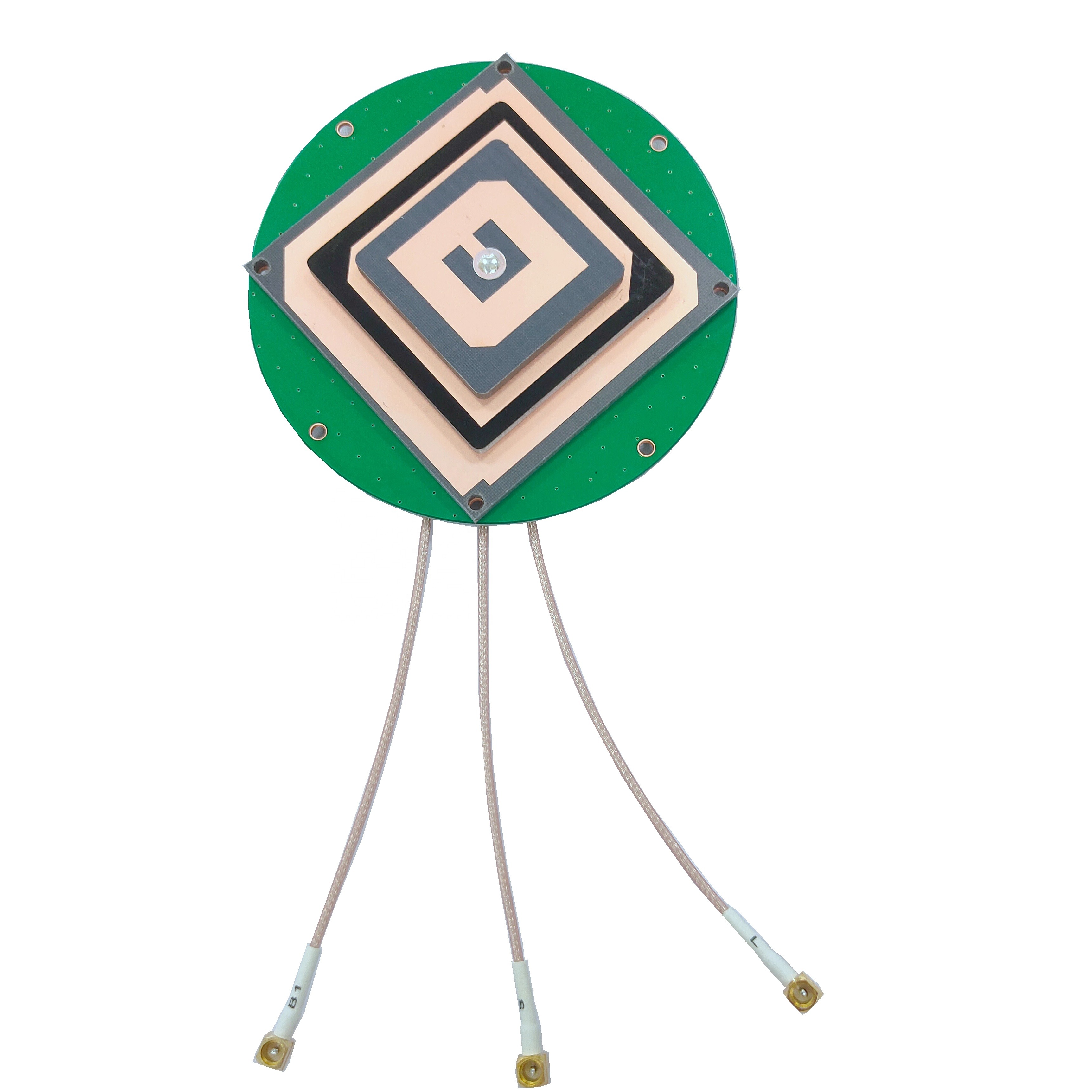
High precision L1 L2 L5 antennas are mainly divided into mushroom antennas, helical antennas, and flat antennas. Mushroom choke ring antennas are suitable for fixed base stations, surveying and mapping reference stations, and high-precision monitoring scenarios, with the strongest multipath suppression performance. Lightweight helical antennas are suitable for UAVs, mobile robots, and vehicle dynamic positioning scenarios, with small size and light weight. Flat antennas are suitable for embedded intelligent equipment and compact industrial terminals, with convenient installation and integration. It is necessary to select the appropriate antenna structure according to the actual installation and operation mode of the equipment.
5.5 Verify Industrial-Grade Environmental Protection Performance
Outdoor application scenarios must select antennas with IP67 or above waterproof and dustproof protection level, with UV resistance, high and low temperature resistance, and vibration resistance. Confirm the working temperature range of the antenna is -40℃ to +85℃ to ensure stable operation in extreme weather environments. For marine and coastal scenarios, priority should be given to corrosion-resistant and salt-spray-resistant antenna models to avoid equipment aging and performance degradation caused by marine environmental erosion.
6. Installation, Calibration and Daily Maintenance of L1 L2 L5 High-Precision Antenna
Excellent antenna performance requires standardized installation, professional calibration, and scientific daily maintenance to ensure long-term stable high-precision operation. Irregular installation and maintenance will directly reduce positioning accuracy and shorten the service life of the antenna.
6.1 Standard Installation Specifications
The antenna should be installed in an open and unobstructed position, avoiding shielding by buildings, trees, metal equipment, and other obstacles, to ensure 360° omnidirectional satellite signal reception. The installation plane should be kept horizontal and fixed firmly to avoid antenna tilt and vibration displacement affecting phase center stability. The antenna feeder cable should be arranged reasonably, avoiding excessive bending and winding, and the cable length should be matched to reduce signal transmission loss. At the same time, avoid installing the antenna near high-power electrical equipment and signal transmitting equipment to prevent electromagnetic interference.
6.2 Regular Professional Calibration
High-precision GNSS antennas need regular phase center calibration and performance testing. It is recommended to conduct a professional calibration every 12 months for long-term working base station antennas and surveying and mapping antennas to correct small phase center offsets and signal attenuation errors generated during use. After the antenna is collided, vibrated or used in extreme environments, unscheduled calibration should be carried out in time to ensure that the positioning accuracy meets the standard requirements.
6.3 Daily Maintenance and Fault Handling
Regularly clean the antenna surface dust, dirt and sundries to avoid affecting signal radiation and reception. Check the antenna shell for aging, cracking and corrosion, and replace the aging equipment in time. Inspect the feeder interface for looseness, water ingress and oxidation, and ensure stable signal connection. In case of positioning jitter, slow signal locking and reduced accuracy, first check whether the antenna is shielded or interfered with, and then test the antenna gain and noise indicators to troubleshoot equipment faults.
7. Future Development Trends of High Precision L1 L2 L5 Antenna
With the continuous iteration of global satellite navigation systems and the rapid development of high-precision intelligent application scenarios, high precision L1 L2 L5 antenna technology is also constantly upgrading, showing the development trends of miniaturization, integration, intelligence, and ultra-high precision.
7.1 Miniaturization and Lightweight Integration
Traditional high-precision choke ring antennas are large in size and heavy, which are not convenient for mobile equipment integration. Future L1 L2 L5 high-precision antennas will realize miniaturization and lightweight design on the premise of maintaining ultra-high positioning accuracy, which is convenient for embedded installation of UAVs, vehicle terminals, and intelligent mobile robots, meeting the high-precision positioning needs of portable and mobile intelligent equipment.
7.2 Intelligent Anti-Interference and Adaptive Optimization
The new generation of high-precision antennas will be equipped with intelligent signal processing modules, which can automatically identify and filter complex electromagnetic interference and multipath signals, and adaptively adjust signal gain and filtering parameters according to the operating environment. It realizes intelligent adaptive optimization of positioning performance in different scenarios, further improving the stability and reliability of high-precision positioning.
7.3 Higher Precision and Multi-Frequency Fusion Upgrade
On the basis of L1 L2 L5 three-band positioning, future antennas will support more satellite navigation frequency bands and realize multi-system and multi-frequency full fusion positioning. With the help of satellite augmentation technology and big data algorithm optimization, the positioning accuracy will be further upgraded to millimeter-level, meeting the ultra-high precision positioning needs of aerospace, high-end manufacturing, and precision scientific research.
7.4 Low Power Consumption and Intelligent Internet of Things
Aiming at the application needs of battery-powered intelligent IoT equipment, high-precision antennas will develop towards low power consumption and ultra-low standby power consumption. Combined with IoT intelligent monitoring technology, it realizes real-time monitoring of antenna operating status, remote fault diagnosis and automatic parameter adjustment, reducing manual operation and maintenance costs and realizing intelligent management of high-precision positioning equipment.
As the core hardware of modern high-precision GNSS positioning systems, high precision L1 L2 L5 antenna breaks through the accuracy and environmental adaptation limitations of traditional single and dual-band antennas. Relying on the collaborative advantages of L1, L2, and L5 triple frequency bands, ultra-stable phase center performance, excellent multipath suppression and anti-interference capabilities, it provides reliable sub-centimeter-level high-precision positioning support for surveying and mapping engineering, autonomous driving, UAV aerial survey, industrial monitoring and other professional scenarios.
With the continuous development of intelligent navigation and industrial intelligence, the market demand for high-precision L1 L2 L5 antennas will continue to grow. Choosing a high-quality professional triple-band high-precision antenna, standardizing installation and maintenance, and matching application scenarios can maximize the performance advantages of GNSS positioning systems, create higher value for high-precision positioning projects, and promote the further popularization and application of high-precision satellite navigation technology in global industrial and intelligent fields.
FAQs About High Precision L1 L2 L5 Antenna
Q1: What is the main difference between L1 L2 L5 antenna and dual-band GNSS antenna?
A1: The biggest difference is the addition of the L5 high-precision wide-band frequency band. Dual-band L1+L2 antennas only realize ionospheric error correction, while L1 L2 L5 triple-band antennas add L5 multipath interference suppression and fast signal locking functions, with higher positioning accuracy, stronger complex scene adaptability and faster initialization speed, which is the mainstream choice for current high-end high-precision positioning.
Q2: What scenarios must use L1 L2 L5 high-precision antenna?
A2: Scenarios requiring centimeter-level/sub-centimeter-level high precision, complex urban and shielded environments, dynamic mobile high-precision positioning, and long-term stable monitoring scenarios must adopt L1 L2 L5 triple-band high-precision antennas, including autonomous driving, UAV aerial survey, urban engineering surveying and mapping, bridge deformation monitoring, and port intelligent scheduling.
Q3: How to judge the accuracy grade of L1 L2 L5 antenna?
A3: It is mainly judged by phase center stability indicators. Surveying-grade high-precision antennas with phase center jitter less than ±0.1mm support sub-centimeter-level positioning; industrial-grade antennas with phase center jitter less than ±0.5mm meet conventional centimeter-level high-precision positioning needs. At the same time, multipath suppression capability and signal-to-noise ratio are important auxiliary judgment indicators.
Q4: Does L1 L2 L5 antenna need regular calibration?
A4: Yes. For professional surveying and mapping base stations, long-term monitoring equipment and high-precision mobile positioning equipment, regular annual calibration is required to eliminate phase center offset and signal attenuation errors generated during long-term operation, ensuring long-term stable positioning accuracy.
Lucy Yang | lucy.y@toxutech.com
Dotty Zhao | sales04@toxutech.com
Global Business Director / Sales Team / Global Operations


 En
En Cn
Cn Korean
 Home >