

-
Products -PCBA Manufacturing RF Connectors RF Cable Assemblys Embedded Antennas External Antennas GNSS Positioning Solutions
RF Connectors

RF Cable Assemblys
Embedded Antennas
External Antennas
GNSS Positioning Solutions































 Language


Language


Time:2026-10-16 Views:0
1. Introduction to GNSS WiFi Combo Antenna
A GNSS WiFi combo antenna is a multi-functional integrated wireless antenna that combines Global Navigation Satellite System (GNSS) positioning reception and WiFi wireless communication functions into a single compact unit. Unlike traditional single-function antennas that require separate installation and wiring for positioning and network transmission, this all-in-one antenna solution integrates high-precision satellite signal reception modules and high-speed WiFi signal transceiving components, perfectly solving the dual demands of device positioning and wireless network connection for modern IoT, intelligent transportation, and smart city devices.
In the current era of intelligent connectivity and Internet of Things (IoT), most smart terminal devices need to achieve two core functions: accurate real-time positioning and stable wireless data transmission. Traditional solutions using independent GNSS antennas and WiFi antennas have prominent drawbacks such as large installation space occupation, complex wiring, high equipment integration costs, and mutual signal interference. The GNSS WiFi combo antenna emerges to address these industry pain points, becoming the mainstream antenna choice for commercial, industrial, and vehicle-mounted intelligent equipment.
This professional guide deeply analyzes the working principle, core advantages, key technical parameters, product types, application scenarios, selection standards, and installation maintenance skills of GNSS WiFi combo antennas, helping global buyers, engineers, and technical practitioners fully understand this core wireless accessory and select the most suitable combo antenna for their equipment projects. All content is optimized for Google SEO, covering high-frequency search keywords such as GNSS WiFi combo antenna, dual-band GNSS WiFi antenna, industrial combo antenna, and IoT integrated antenna.
2. Core Definition & Working Principle of GNSS WiFi Combo Antenna
2.1 Basic Functional Definition
The GNSS WiFi combo antenna supports two independent wireless frequency bands and functional systems simultaneously. The GNSS module is responsible for receiving satellite positioning signals, covering mainstream global navigation systems including GPS (USA), GLONASS (Russia), Galileo (EU), and BeiDou (China), realizing high-precision longitude, latitude, altitude, and speed positioning data acquisition. The WiFi module supports dual-band 2.4GHz and 5.8GHz WiFi signals, compatible with 802.11 b/g/n/ac/ax WiFi protocols, meeting high-speed, low-latency wireless data transmission requirements of smart devices.
Different from single-frequency antennas, the combo antenna adopts an integrated isolation design, which can effectively isolate GNSS satellite receiving signals and WiFi transceiving signals, avoid frequency band crosstalk and signal mutual interference, and ensure that positioning accuracy and network transmission stability are not affected while realizing integrated integration.
2.2 Working Principle
The internal structure of the GNSS WiFi combo antenna is divided into two independent antenna units, a high-isolation shielding structure, and a signal matching circuit. The GNSS antenna unit mostly adopts a high-precision ceramic antenna structure, which is specially tuned for GNSS L1 frequency band (1575.42MHz) and other common positioning frequency points, with high signal sensitivity and low noise coefficient, which can capture weak satellite signals in complex environments and complete positioning signal demodulation and transmission to the device positioning module.
The WiFi antenna unit uses a high-efficiency omnidirectional radiation structure, covering 2.4GHz (2400-2483MHz) and 5.8GHz (5725-5850MHz) dual frequency bands. It realizes omnidirectional coverage of WiFi signals, supports wireless signal sending and receiving, and meets the data interaction needs of device connection to wireless routers, gateways, and cloud platforms. The built-in high-isolation shielding layer and frequency filtering circuit completely separate the two sets of antenna signals, ensuring that the high-power transceiving of WiFi signals will not suppress the weak receiving of GNSS satellite signals, and fundamentally solving the signal interference problem of dual-system coexistence.
3. Key Advantages of GNSS WiFi Combo Antenna
GNSS WiFi combo antennas have completely replaced traditional dual-antenna separate solutions in most intelligent device scenarios by virtue of their unique integrated design and excellent performance, with core advantages covering design, cost, performance, installation, and application scenarios.
3.1 Compact Integrated Design, Save Equipment Space
The integrated all-in-one design greatly reduces the volume of wireless antenna accessories. Compared with installing independent GNSS antenna and WiFi antenna separately, the combo antenna reduces the installation area by more than 50%, which is very suitable for compact intelligent terminals with limited internal space such as vehicle-mounted terminals, drone equipment, portable IoT devices, and smart wearable devices. Ultra-thin and low-profile structural design options further adapt to the miniaturization and lightweight development trend of modern intelligent equipment.
3.2 High Isolation & Stable Signal Performance
Professional industrial-grade combo antennas adopt multi-layer shielding isolation technology and independent frequency band filtering design, with isolation between GNSS and WiFi frequency bands higher than 25dB. This high-isolation design effectively suppresses mutual interference between high-frequency WiFi signals and weak GNSS satellite signals, ensuring that the GNSS positioning accuracy is stable within meter-level or even centimeter-level, and the WiFi network maintains high-speed, low-latency, and anti-interference transmission. In complex environments such as urban high-rise shielding, outdoor electromagnetic interference, and industrial workshop signal clutter, the signal stability of combo antennas is far better than that of ordinary spliced dual antennas.
3.3 Simplify Wiring & Reduce Installation Difficulty
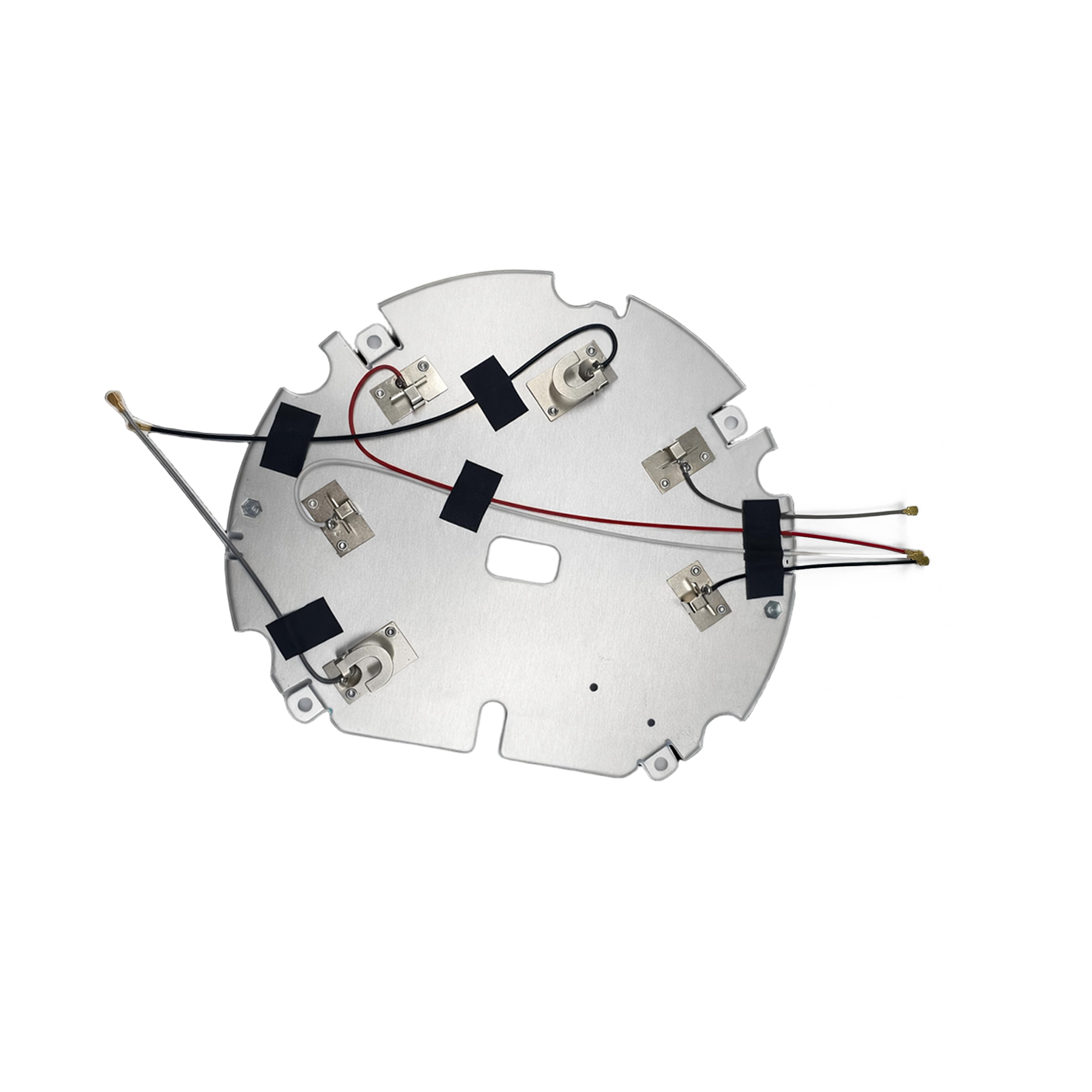
The GNSS WiFi combo antenna usually adopts a dual-wire independent output design, with two independent connectors for GNSS and WiFi signals respectively. The integrated fuselage only needs a single fixed installation, avoiding the tedious operation of positioning and fixing two antennas separately. It greatly simplifies the internal wiring of equipment and on-site construction steps, reduces the failure rate of wiring errors, and shortens the product assembly cycle and on-site installation time. For large-scale batch production and engineering construction, the efficiency improvement is extremely significant.
3.4 Lower Comprehensive Cost & Higher Cost Performance
From the perspective of comprehensive cost, the integrated combo antenna has lower procurement cost, lower assembly labor cost, and lower after-sales maintenance cost than the separate purchase of GNSS antenna and WiFi antenna. The unified structural design and standardized accessories reduce the types of spare parts inventory for enterprises, optimize the supply chain management system, and effectively reduce the overall operating cost of product development and production. In addition, the integrated structure has higher structural strength, lower damage rate, and longer service life, further improving the long-term cost performance of the product.
3.5 Wide Compatibility & Strong Scalability
Standard GNSS WiFi combo antennas are compatible with all mainstream GNSS positioning systems in the world, including GPS, BeiDou, GLONASS, and Galileo, and support full-band dual-band WiFi protocols of WiFi 4, WiFi 5, and WiFi 6. The universal SMA, RP-SMA, and FAKRA connectors are adapted to most industrial control modules, IoT gateways, vehicle-mounted hosts, and intelligent terminal equipment on the market. Some upgraded models also reserve expansion space for Bluetooth and Zigbee functions, which can realize multi-function wireless integration and meet the iterative upgrade needs of equipment.
4. Core Technical Parameters of GNSS WiFi Combo Antenna
When selecting a GNSS WiFi combo antenna, technical parameters are the core basis for judging product performance. The following are the key parameter indicators of mainstream industrial-grade and commercial-grade combo antennas, covering frequency band, gain, isolation, impedance, standing wave ratio, and environmental adaptability, which are suitable for engineer selection and product parameter verification.
4.1 Working Frequency Band
GNSS Frequency Band: Standard L1 frequency band 1575.42MHz (GPS/BeiDou/Galileo), compatible with GLONASS corresponding frequency points, supporting full-system global positioning signal reception.
WiFi Frequency Band: Dual-band 2.4GHz (2400MHz–2483.5MHz) + 5.8GHz (5725MHz–5850MHz), fully compatible with all mainstream WiFi wireless communication protocols.
4.2 Antenna Gain
GNSS Antenna Gain: 25dB ± 2dB (high-gain low-noise design), which can effectively capture weak satellite signals and improve positioning success rate in shielded environments.
WiFi Antenna Gain: 3dBi (2.4GHz) + 5dBi (5.8GHz), omnidirectional high-gain coverage, long transmission distance and strong signal penetration.
4.3 Isolation & Interference Suppression
The isolation between GNSS and WiFi frequency bands is ≥25dB, which can completely isolate the signal crosstalk between the two systems. The built-in low-noise filter reduces environmental electromagnetic noise interference, ensuring stable positioning and network signal quality.
4.4 Impedance & Standing Wave Ratio
Standard impedance 50Ω, matching the impedance of mainstream wireless modules and equipment hosts in the industry. VSWR (Voltage Standing Wave Ratio) ≤ 1.5, with low signal reflection loss and high signal transmission efficiency, avoiding signal energy loss caused by impedance mismatch.
4.5 Environmental Adaptability Parameters
Industrial-grade GNSS WiFi combo antennas support wide temperature operation, with a working temperature range of -40℃ ~ +85℃, adapting to extreme high and low temperature environments such as outdoor high temperature, northern severe cold, and industrial high temperature workshops. Most outdoor models have IP66/IP67 waterproof and dustproof rating, which can resist rain erosion, dust accumulation, and outdoor wind and sun exposure, suitable for long-term outdoor unattended operation.
4.6 Mechanical & Interface Parameters
Common installation methods: screw fixation, adhesive fixation, wall-mounted installation, SMT patch installation, meeting different equipment assembly needs. mainstream interfaces: SMA male/female, RP-SMA, FAKRA Code C/D, with 1-3 meters RG174 high-flexibility low-loss cable, supporting customized cable length and interface types.
5. Main Types of GNSS WiFi Combo Antennas
According to installation methods, application environments, and structural forms, GNSS WiFi combo antennas on the market are mainly divided into four categories, covering commercial civilian, industrial indoor, outdoor engineering, and miniature embedded scenarios.
5.1 Adhesive Mount Low-Profile Combo Antenna
This type of antenna features ultra-thin low-profile design and strong adhesive back glue, which can be pasted on the flat surface of equipment or shells without drilling and fixing. It has the advantages of small size, beautiful appearance, and convenient installation. It is mainly used for vehicle-mounted GPS positioning terminals, smart home devices, portable IoT terminals, and indoor intelligent monitoring equipment. It is the most widely used commercial-grade combo antenna with low cost and stable performance.
5.2 Screw Mount Outdoor Waterproof Combo Antenna
Screw-fixed GNSS WiFi combo antennas adopt a closed waterproof shell, with IP66/IP67 waterproof and dustproof grade. The metal screw fixing structure is firm and anti-loose, resistant to outdoor wind vibration and impact. It is suitable for outdoor engineering scenarios such as smart street lamps, outdoor IoT gateways, fleet management equipment, scenic spot monitoring, and smart agricultural monitoring terminals. It can work stably in harsh outdoor environments for a long time.
5.3 SMT Embedded Mini Combo Antenna
The ultra-compact SMT patch combo antenna is specially designed for miniature intelligent equipment, with a tiny size of only a few millimeters. It can be directly pasted and welded on the PCB board of equipment, completely embedded inside the equipment, without occupying external space. It is widely used in drones, smart wearables, miniature positioning trackers, and compact wireless sensor devices, meeting the miniaturization and high integration design requirements of high-end intelligent equipment.
5.4 High-Gain Industrial-Grade Combo Antenna
Industrial-grade enhanced combo antennas adopt high-gain amplification circuit and multi-layer shielding structure, with stronger signal penetration and anti-interference ability. They support high-speed MIMO WiFi transmission and high-precision differential positioning, and are suitable for high-demand industrial scenarios such as intelligent factory equipment, unmanned driving terminals, intelligent transportation systems, and industrial wireless gateways. They can maintain stable signal output in complex electromagnetic interference environments.
6. Wide Application Scenarios of GNSS WiFi Combo Antenna
With the rapid development of IoT, smart city, intelligent transportation, and smart agriculture industries, GNSS WiFi combo antennas have become essential core accessories for almost all intelligent terminal equipment that needs positioning and network transmission. The main application scenarios cover multiple industries as follows.
6.1 Intelligent Transportation & Fleet Management
Vehicle-mounted intelligent terminals, fleet management trackers, logistics vehicle monitoring equipment, and new energy vehicle intelligent networking systems all rely on GNSS WiFi combo antennas to realize real-time vehicle positioning, driving track recording, and wireless data upload. The high-isolation design ensures that the vehicle's complex electromagnetic environment will not interfere with positioning and network signals, realizing accurate vehicle position monitoring, remote data transmission, and intelligent scheduling management, which greatly improves the operational efficiency of fleet and logistics transportation.
6.2 Smart City & Intelligent Monitoring
Smart street lamps, outdoor monitoring cameras, intelligent traffic monitoring equipment, and urban environmental monitoring terminals all use GNSS WiFi combo antennas. The antennas provide accurate equipment positioning information for urban intelligent management, and realize real-time wireless transmission of monitoring data, video streams, and environmental data. The outdoor waterproof and dustproof design adapts to long-term outdoor operation, helping to build a stable and reliable urban intelligent monitoring system.
6.3 Smart Agriculture & Environmental Monitoring
In the field of smart agriculture, agricultural monitoring sensors, drone plant protection equipment, and intelligent irrigation terminals use combo antennas to realize farmland positioning and wireless data transmission of soil humidity, temperature, and pest monitoring data. In environmental monitoring scenarios, outdoor atmospheric monitoring equipment, water quality monitoring terminals, and meteorological monitoring devices rely on the all-weather stable working performance of combo antennas to complete accurate positioning and real-time data upload, providing data support for agricultural precision planting and environmental protection monitoring.
6.4 Industrial IoT & Intelligent Equipment
Industrial wireless gateways, intelligent control terminals, automated production equipment, and industrial sensor terminals adopt GNSS WiFi combo antennas to realize equipment positioning management and industrial data wireless transmission. The industrial-grade anti-interference and wide-temperature performance adapt to harsh industrial production environments, ensuring the stable operation of industrial IoT systems and realizing intelligent management and remote monitoring of industrial equipment.
6.5 Consumer Smart Electronic Products
Smart wearable devices, portable positioning trackers, smart home gateways, and miniature intelligent terminals all use miniature embedded combo antennas. The ultra-small size and low power consumption design meet the lightweight and portable requirements of consumer electronic products, while realizing accurate positioning and stable WiFi network connection, improving the intelligent experience of terminal products.
7. How to Select the Right GNSS WiFi Combo Antenna? (Professional Selection Guide)
There are many types of GNSS WiFi combo antennas with different performances on the market. Improper selection will lead to problems such as weak signal, inaccurate positioning, unstable network, and short service life. The following professional selection standards help users quickly match the most suitable product.
7.1 Confirm Application Environment & Protection Level
Indoor civilian scenarios such as smart home and indoor monitoring can choose ordinary adhesive mount combo antennas with IP30 ordinary protection level, which is cost-effective. Outdoor scenarios such as street lamps, fleet, and agricultural monitoring must choose IP66/IP67 waterproof and dustproof models to resist rain, dust, and ultraviolet aging. Industrial high-temperature and high-interference environments need to select industrial-grade wide-temperature anti-interference antennas to ensure stable operation in extreme environments.
7.2 Match Frequency Band & Gain Parameters
For conventional positioning and network scenarios, standard L1 GNSS frequency band and dual-band WiFi antennas can meet the demand. For scenarios with serious signal shielding such as urban high-rises and basements, high-gain low-noise combo antennas need to be selected to improve signal reception sensitivity. It is necessary to ensure that the antenna frequency band is completely matched with the equipment module parameters, and avoid signal attenuation and failure caused by frequency band mismatch.
7.3 Select Appropriate Installation Method & Interface
Miniature equipment with limited space chooses SMT embedded antennas; vehicle-mounted and portable equipment chooses adhesive mount antennas; outdoor fixed equipment chooses screw mount waterproof antennas. At the same time, confirm the equipment interface type (SMA/RP-SMA/FAKRA) and cable length to avoid installation and connection failures. Customized cable length and interface services can be selected for special equipment needs.
7.4 Focus on Isolation Performance & Stability
Isolation is the core index to measure the performance of combo antennas. It is necessary to select products with isolation ≥25dB to avoid signal crosstalk. For high-precision positioning and high-speed network transmission scenarios, priority should be given to products with low VSWR, high signal purity, and strong anti-interference ability to ensure long-term stable operation of the equipment.
7.5 Verify Product Quality & Certification
Formal high-quality GNSS WiFi combo antennas need to pass FCC, CE, and RoHS certification, meeting international electrical safety and environmental protection standards. Regular manufacturers have complete production testing systems, with stable product consistency and reliable after-sales service, avoiding the use of inferior products with unstable performance and short service life.
8. Installation & Maintenance Notes for GNSS WiFi Combo Antenna
8.1 Standard Installation Steps
First, select a clean, flat, and unobstructed installation position, avoid metal shielding coverage, because metal objects will seriously shield GNSS satellite signals and WiFi wireless signals. For adhesive mount antennas, clean the installation surface dust and oil stains first, then tear off the back glue and paste firmly, and press for 3-5 minutes to ensure firm fitting. For screw mount antennas, fix the base with matching screws to ensure firm installation and no looseness. Finally, connect the GNSS and WiFi independent cables to the corresponding module interfaces respectively, avoid wrong insertion and mixed connection, and fix the cable arrangement to prevent pulling and damage.
8.2 Installation Taboos
Do not install the antenna in a fully enclosed metal shell or near large metal accessories; do not arrange the antenna cable intertwined with power lines to avoid electromagnetic interference; do not bend the cable sharply or pull it violently to prevent internal wire breakage and signal attenuation; the GNSS receiving antenna should avoid facing tall buildings, trees, and shielded areas to ensure smooth satellite signal reception.
8.3 Daily Maintenance & Fault Troubleshooting
Regularly clean the antenna surface dust and stains for outdoor installed antennas to avoid affecting signal radiation and reception. Check whether the cable interface is loose or oxidized regularly, and tighten and maintain it in time. Common faults include inaccurate positioning (mostly caused by signal shielding or low antenna gain) and unstable WiFi network (caused by interface looseness and cable damage). After eliminating environmental shielding factors, replace the antenna or repair the cable to solve the problem.
9. Market Development Trend of GNSS WiFi Combo Antenna
With the continuous upgrading of IoT technology, smart city construction, and intelligent terminal equipment, the GNSS WiFi combo antenna industry is developing towards miniaturization, high precision, high speed, multi-function integration, and intelligent customization.
First, with the popularization of WiFi 6 and WiFi 6E protocols, combo antennas are gradually upgrading to support ultra-wideband WiFi signals, matching the high-speed and low-latency transmission needs of new intelligent equipment. Second, GNSS positioning technology is developing towards high precision, and combo antennas are iterating to support multi-frequency GNSS positioning, realizing centimeter-level high-precision positioning, which is widely used in unmanned driving, precision agriculture, and industrial precise monitoring.
In addition, multi-function integrated antennas have become a hot trend. On the basis of GNSS+WiFi, more products integrate Bluetooth, Zigbee, 4G/5G and other wireless functions, realizing multi-system wireless integration, further reducing equipment integration costs. At the same time, industrial-grade high-temperature resistance, high anti-interference, and ultra-low power consumption combo antennas will be more widely used in industrial IoT and outdoor intelligent engineering projects, becoming the mainstream development direction of the industry.
As a core integrated wireless accessory in the intelligent connection era, the GNSS WiFi combo antenna perfectly solves the dual functional needs of equipment positioning and wireless network transmission. Compared with traditional single-antenna separate solutions, it has irreplaceable advantages in space saving, cost reduction, signal stability, and convenient installation. It is widely used in intelligent transportation, smart city, smart agriculture, industrial IoT, and consumer electronics industries.
When purchasing and using GNSS WiFi combo antennas, users need to select products with matching protection level, parameters, and installation methods according to actual application scenarios, and standardize installation and maintenance to give full play to the high-performance advantages of integrated combo antennas. With the continuous innovation of wireless communication and positioning technology, GNSS WiFi combo antennas will continue to iterate and upgrade, providing more stable, efficient, and integrated wireless signal support for the global intelligent equipment industry.
Lucy Yang | lucy.y@toxutech.com
Dotty Zhao | sales04@toxutech.com
Global Business Director / Sales Team / Global Operations


 En
En Cn
Cn Korean
 Home >