

-
Products -PCBA Manufacturing RF Connectors RF Cable Assemblys Embedded Antennas External Antennas GNSS Positioning Solutions
RF Connectors

RF Cable Assemblys
Embedded Antennas
External Antennas
GNSS Positioning Solutions































 Language


Language


Time:2026-10-15 Views:0
Precision agriculture has revolutionized modern farming operations by replacing traditional guesswork with data-driven, centimeter-accurate field management. At the core of every automated farming system—including smart tractors, autonomous harvesters, agricultural drones, and variable-rate fertilization systems—lies a high-performanceGNSS antenna for precision agriculture. Unlike standard consumer-grade GPS antennas, professional GNSS agricultural antennas deliver stable, high-precision positioning, reliable satellite signal tracking, and robust environmental resistance, enabling farmers to maximize crop yields, minimize resource waste, and reduce operational costs.
In this comprehensive SEO guide, we will explore the core functions, key features, types, application scenarios, selection criteria, installation tips, and maintenance best practices of GNSS antennas for precision agriculture. This article targets farmers, agricultural equipment manufacturers, agricultural technology engineers, and industry purchasers, covering all critical knowledge to help you understand why high-quality GNSS antennas are indispensable for modern smart farming and how to choose the optimal model for your field operations.
1. What Is a GNSS Antenna for Precision Agriculture?
A GNSS antenna for precision agriculture is a specialized satellite signal receiving device designed exclusively for high-precision agricultural positioning and navigation. GNSS (Global Navigation Satellite System) covers four major global satellite constellations: GPS (USA), GLONASS (Russia), Galileo (EU), and BeiDou (China). Professional agricultural GNSS antennas support multi-constellation and multi-frequency signal reception, different from single-band civilian GPS antennas that only capture basic location data with meter-level accuracy.
The core difference between ordinary GPS antennas and precision agricultural GNSS antennas lies in positioning accuracy, signal stability, and environmental adaptability. Standard GPS antennas only provide 1–5 meter positioning errors, which cannot meet the requirements of automated farming. In contrast, high-grade GNSS agricultural antennas paired with RTK (Real-Time Kinematic) technology achieve centimeter-level (1–3 cm) real-time positioning accuracy, fully supporting automated driving, precise seeding, targeted spraying, and accurate field mapping in complex farmland environments.
Agricultural GNSS antennas are engineered to adapt to harsh farmland conditions, including extreme temperatures, strong wind, rain erosion, dust pollution, and crop canopy signal occlusion. They act as the "eyes" of smart agricultural equipment, ensuring continuous, stable, and accurate satellite signal reception to guarantee the normal operation of all precision farming workflows.
2. Why Precision Agriculture Needs Professional GNSS Antennas?
Traditional farming relies on manual experience and rough field management, leading to serious resource waste, uneven crop growth, and low land utilization. Precision agriculture aims to achieve refined management of farmland, seeds, water, fertilizer, and pesticides through intelligent positioning and data monitoring. The GNSS antenna is the foundational hardware that supports all precision agricultural technologies, and its performance directly determines the efficiency and accuracy of smart farming equipment.
2.1 Achieve Centimeter-Level Automated Farming
Automated tractors, driverless harvesters, and intelligent planters are the core equipment of modern precision agriculture. These machines require real-time high-precision positioning to achieve straight-line driving, fixed-point seeding, and consistent row spacing. Ordinary GPS antennas with meter-level errors will cause repeated seeding, missed planting, and overlapping spraying areas, seriously affecting farming quality. Professional RTK GNSS antenna for agriculture eliminates positioning deviations, ensuring that each farming operation is completed within a 1–3 cm error range, greatly improving the standardization of field operations.
2.2 Reduce Agricultural Resource Waste
Data from modern agricultural technology research shows that precision positioning farming supported by high-precision GNSS antennas can reduce fertilizer, pesticide, and seed waste by 15%–30% annually. Traditional manual spraying and fertilization often lead to excessive chemical usage in overlapping areas and insufficient supply in missed areas. With centimeter-level GNSS positioning, variable-rate fertilization and targeted pesticide spraying systems can accurately adjust the dosage according to field soil conditions and crop growth status. This not only saves agricultural production costs but also reduces chemical residue and soil pollution, realizing green and sustainable farming.
2.3 Improve Crop Yield and Land Utilization
Accurate row spacing, uniform seeding depth, and standardized field management create a balanced growth environment for crops, ensuring sufficient light, water, and fertilizer for each plant. Precision farming based on high-performance GNSS antennas effectively avoids crop crowding and sparse planting, increasing land utilization by 8%–15% and comprehensively boosting crop yields. For large-scale commercial farms, this yield improvement brings substantial economic benefits and enhances overall farm profitability.
2.4 Adapt to Complex Farmland Environmental Interference
Farmland environments are full of signal interference factors: tall crop canopies, field trees, terrain undulations, dust storms, and rainy weather can all block and weaken satellite signals. Professional GNSS antennas for precision agriculture are equipped with advanced multipath suppression technology, low phase center variation (PCV) design, and out-of-band interference rejection functions. They can filter out environmental noise signals, resist signal attenuation caused by crop occlusion and terrain changes, and maintain stable positioning performance in complex field conditions, which is impossible for ordinary civilian antennas.
2.5 Support Long-Term Farmland Data Monitoring and Analysis
Modern precision agriculture is data-driven. GNSS antennas continuously collect high-precision location data during farming operations, which is uploaded to agricultural cloud platforms for big data analysis. Farmers can obtain field growth maps, soil fertility distribution maps, and farming operation track records through positioning data, realizing scientific field management, precise crop growth monitoring, and accurate yield prediction. This long-term data accumulation helps farmers formulate more scientific planting plans year by year.
3. Core Technical Features of High-Precision Agricultural GNSS Antennas
Excellent GNSS antennas for precision agriculture have strict technical parameters and professional design standards, which are the key to distinguishing them from ordinary GPS antennas. When purchasing and configuring agricultural GNSS antennas, you need to focus on the following core technical features that directly determine positioning accuracy and operational stability.
3.1 Multi-Constellation and Multi-Frequency Signal Support
Top-tier agricultural GNSS antennas support full-band reception of GPS L1/L2/L5, GLONASS G1/G2, Galileo E1/E5, and BeiDou B1/B2/B3 multi-constellation and multi-frequency signals. Compared with single-band antennas, multi-frequency and multi-constellation antennas can track more satellites simultaneously, effectively solving the problem of insufficient satellite signals in blocked farmland areas. More satellite tracking sources mean stronger signal stability, faster fixed positioning speed, and higher positioning accuracy, ensuring normal operation even in field edge areas with poor signal conditions.
3.2 Ultra-Low Phase Center Variation (PCV)
Phase center variation is one of the main factors affecting GNSS positioning accuracy. The phase center is the actual signal receiving center of the antenna. When the antenna posture changes with the tilt and vibration of farming equipment, the phase center offset will cause positioning errors. Professional agricultural GNSS antennas adopt precision calibration technology to achieve ultra-low phase center variation, with errors controlled within millimeter levels. This design adapts to the frequent vibration, tilt, and bump of tractors and harvesters during field operation, maintaining consistent positioning accuracy in dynamic working conditions.
3.3 Excellent Multipath Suppression Capability
Farmland ground, crop leaves, and field buildings will reflect satellite signals to form multipath interference, which is a major hidden danger of positioning drift and accuracy reduction. High-quality agricultural GNSS antennas are equipped with professional choke ring structures and optimized antenna radiation patterns, which can effectively suppress reflected multipath signals, filter interference noise, and ensure that the received satellite signals are direct and effective. This function greatly improves the stability of RTK fixed solutions in complex farm environments.
3.4 High Gain and Low Noise Figure
Agricultural GNSS antennas adopt active amplification design with high signal gain and ultra-low noise figure. They can capture weak satellite signals in low-signal environments such as dense crop canopies and valley farmland, amplify effective signals, and filter background noise. This ensures that the equipment can quickly complete RTK fixed positioning and maintain centimeter-level accuracy without positioning drift or signal loss during long-term field operation.
3.5 Industrial-Grade Rugged and Weather Resistance
Farming equipment works outdoors all year round, facing extreme weather such as high temperature, low temperature, heavy rain, snow, and strong wind, as well as harsh working conditions such as dust erosion and mechanical vibration. Professional precision agricultural GNSS antennas adopt IP67/IP68 high waterproof and dustproof grade design, industrial-grade high and low temperature resistance (-40℃ to +85℃), and vibration resistance structure. They can work stably all day and all year round without failure, adapting to the harsh outdoor working environment of farmland.
4. Common Types of GNSS Antennas for Precision Agriculture
According to structural design, functional characteristics, and application scenarios, GNSS antennas used in precision agriculture are mainly divided into three categories: ceramic patch GNSS antennas, mushroom-head geodetic GNSS antennas, and integrated multi-functional GNSS antennas. Each type has unique advantages and applicable farming scenarios.
4.1 Ceramic Patch GNSS Antennas
Ceramic patch GNSS antennas are lightweight, compact, and low-profile, featuring low cost and high integration. They are mostly used in small and medium-sized precision agricultural equipment, including agricultural drones, unmanned lawn mowers, and small intelligent planters. High-quality ceramic patch antennas support multi-frequency RTK positioning, with stable basic performance and strong shock resistance. They are suitable for light-duty precision farming scenarios with limited installation space and low vibration intensity, and are the most cost-effective choice for small-scale smart agricultural equipment.
4.2 Mushroom-Head Geodetic GNSS Antennas
Mushroom-head geodetic GNSS antennas are high-end professional antennas for precision agriculture, belonging to survey-grade positioning equipment. They are equipped with choke ring multipath suppression structures, with ultra-low phase center variation and super strong signal anti-interference ability. This type of antenna has high positioning accuracy, strong stability, and durable structure, and is widely installed on large agricultural machinery such as large automated tractors, heavy-duty harvesters, and RTK base stations of farmland monitoring systems. It can maintain centimeter-level high-precision positioning in long-term high-vibration and complex field environments, meeting the high-standard operation requirements of large-scale modern farms.
4.3 Integrated Multi-Functional GNSS Antennas
Integrated multi-functional GNSS antennas integrate GNSS positioning, 4G/5G communication, WiFi, and Bluetooth functions into one. While realizing high-precision satellite positioning, they support real-time data transmission and remote equipment monitoring. This type of antenna is mostly used in intelligent agricultural IoT systems, large farm cluster management equipment, and remote-controlled automated farming machinery. It realizes the integration of positioning, communication, and data transmission, facilitating farmers to remotely monitor equipment operation status and field positioning data, and improving the intelligent management level of farms.
5. Key Application Scenarios of GNSS Antennas in Precision Agriculture
With the continuous popularization of smart agriculture technology,GNSS antenna precision agriculture solutions have covered all links of modern farming, from field mapping, seeding, fertilization, spraying to harvesting and post-production management. The following are the core application scenarios with the highest market demand and the most prominent effect.
5.1 Automated Agricultural Machinery Navigation and Driving
Automatic navigation is the most mature and widely used scenario of GNSS antennas in precision agriculture. Large tractors, harvesters, rotary tillers, and sowing machines are equipped with RTK GNSS antennas and navigation systems, realizing full-automatic straight-line driving, fixed-path operation, and automatic turning. Centimeter-level positioning accuracy completely eliminates manual driving errors, avoids repeated walking and missed operations, improves mechanical operation efficiency by more than 30%, and greatly reduces labor intensity and labor costs. For large farms with continuous field operation, automatic navigation based on GNSS antennas has become a standard configuration.
5.2 Precision Seeding and Transplanting
Precision seeding technology relies on high-precision GNSS positioning to realize fixed-point, fixed-distance, and fixed-depth intelligent seeding. The GNSS antenna provides real-time accurate position data for the seeder, ensuring consistent row spacing and plant spacing of crops, uniform seeding depth, and standardized seeding density. This avoids the problems of dense seedling clusters and sparse seedling gaps caused by manual seeding, ensures uniform crop growth, and lays a foundation for later field management and yield increase. It is widely used in corn, wheat, rice, and vegetable precision seeding scenarios.
5.3 Variable-Rate Fertilization and Targeted Pesticide Spraying
Variable-rate fertilization and precise pesticide spraying are key technologies for green and efficient agriculture. Combined with field soil data and crop growth data, the GNSS positioning system can accurately locate each field area, and the intelligent equipment automatically adjusts the fertilization and spraying dosage according to regional differences. For barren soil areas, increase fertilizer dosage; for areas with sufficient fertility, reduce dosage; for crop disease and pest areas, conduct targeted spraying. This precise operation mode reduces chemical waste, lowers agricultural production costs, reduces environmental pollution, and improves the quality and safety of agricultural products.
5.4 Agricultural Drone High-Precision Operation
Agricultural plant protection drones, mapping drones, and seeding drones are important equipment for modern precision agriculture. The high-precision GNSS antenna mounted on the drone realizes centimeter-level flight positioning, fixed-point spraying, fixed-area scanning and mapping. It ensures uniform spraying of pesticides and fertilizers, no repeated spraying or missing spraying, and high-precision acquisition of farmland terrain and crop growth data. GNSS antennas help agricultural drones adapt to complex field terrain and large-area farmland operation, greatly improving the efficiency and accuracy of aerial plant protection and field monitoring.
5.5 Farmland Topographic Mapping and Field Data Monitoring
Before planting every year, farmers need to conduct detailed mapping and data collection of farmland terrain, area, and soil conditions. The RTK GNSS antenna provides high-precision geographic coordinate data for farmland mapping equipment, realizing accurate measurement of farmland area, terrain undulation, and boundary range. Combined with sensor data, it can form a complete farmland digital information map, providing data support for scientific planting planning, field drainage design, and refined farmland management.
5.6 Autonomous Unmanned Farm Equipment Operation
With the development of agricultural unmanned technology, unmanned mowers, unmanned watering machines, and fully autonomous harvesting robots have begun to be popularized in modern farms. These fully intelligent devices rely entirely on GNSS antennas for real-time positioning and path planning, realizing 24-hour unattended operation. High-precision and high-stability GNSS positioning is the core guarantee for the safe and efficient operation of unmanned agricultural equipment, promoting the agricultural industry to move towards full intelligence and automation.
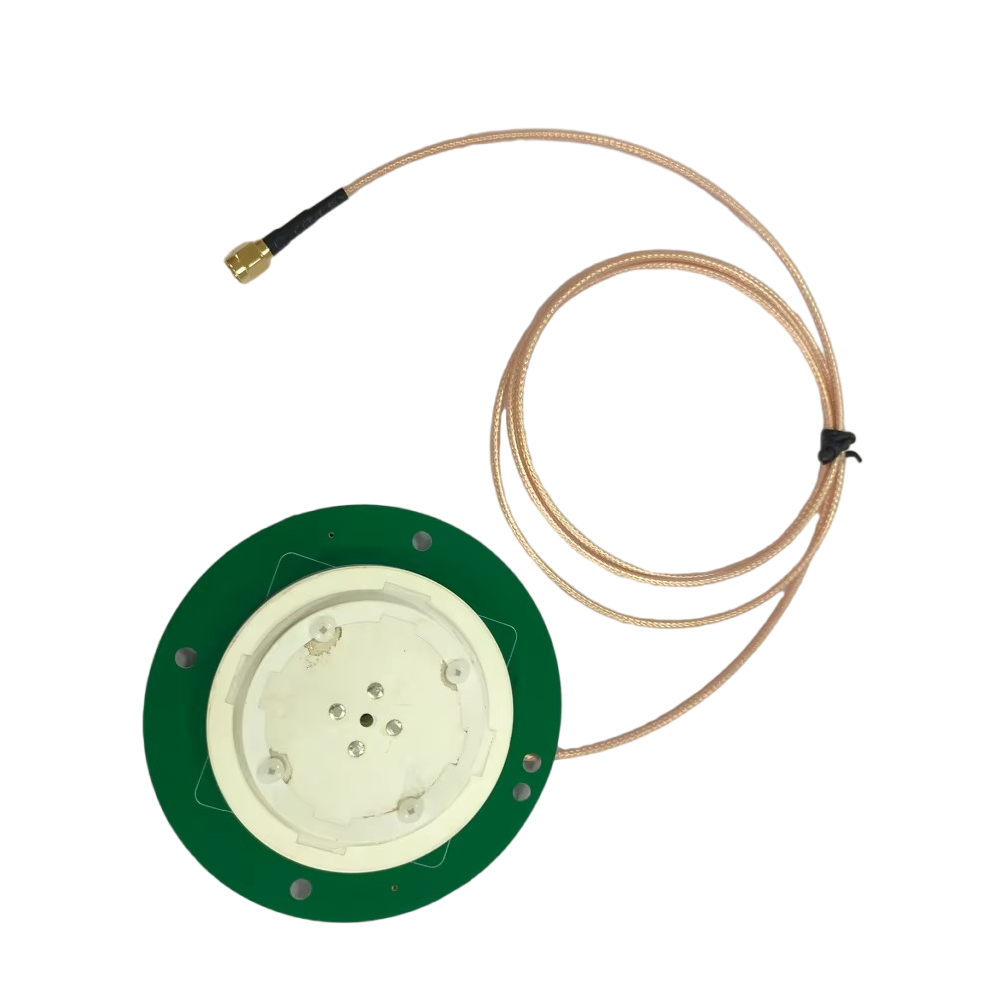
6. How to Choose the Right GNSS Antenna for Precision Agriculture? (2026 Buying Guide)
Selecting a suitable agricultural GNSS RTK antenna is crucial to ensure the stability and accuracy of precision farming equipment. Many farmers and equipment purchasers blindly pursue low prices, resulting in poor positioning accuracy, frequent signal loss, and unstable equipment operation, which seriously affects farming efficiency. The following professional selection criteria help you accurately match the best antenna model according to your application scenarios.
6.1 Match Positioning Accuracy Requirements
Different farming scenarios have different accuracy requirements: ordinary field navigation and rough mapping can choose low-cost dual-band GNSS antennas with 3–5 cm accuracy; high-precision precision seeding, variable-rate fertilization, and drone plant protection need multi-band geodetic antennas with 1–2 cm ultra-high accuracy; farmland RTK base stations need high-stability choke ring antennas to ensure long-term fixed-point positioning accuracy. Do not over-purchase high-end antennas to waste costs, nor choose low-precision antennas that cannot meet operational needs.
6.2 Prioritize Multi-Constellation and Multi-Frequency Support
It is recommended to choose antennas that support GPS, GLONASS, Galileo, and BeiDou four-system full-frequency reception. Multi-constellation antennas can receive more satellite signals, effectively avoiding signal blind areas caused by crop occlusion and terrain blocking, improving positioning success rate and fixed speed. In remote farmland areas with weak single-system signals, multi-constellation antennas can still maintain stable positioning performance, which is far more reliable than single-band single-system antennas.
6.3 Focus on Phase Center Stability and Multipath Suppression
Phase center stability directly determines dynamic positioning accuracy during equipment operation. For vibrating machinery such as tractors and harvesters, ultra-low phase center variation antennas must be selected to avoid positioning drift caused by equipment jitter. At the same time, excellent multipath suppression technology is essential to eliminate signal interference from farmland ground and crop reflection, ensuring long-term stable RTK fixed solutions.
6.4 Check Environmental Adaptability and Protection Grade
Agricultural antennas work outdoors for a long time, so protection grade and environmental adaptability are key indicators. It is recommended to select antennas with IP67 or above waterproof and dustproof grade, which can resist heavy rain flushing and farmland dust erosion. In addition, check the working temperature range to ensure normal operation in extreme high temperature in summer and low temperature in winter, and select vibration-resistant and drop-resistant structural designs to adapt to bumpy field road conditions.
6.5 Match Equipment Interface and Installation Method
Different agricultural equipment has different antenna interface types (SMA, TNC, N-type) and installation methods (magnetic adsorption, screw fixation, fixed bracket). Before purchasing, confirm the interface compatibility and installation space of the original equipment to avoid inability to install or poor signal contact. For mobile frequently used equipment such as drones and small machinery, lightweight and portable antennas are preferred; for large fixed machinery and base stations, high-stability fixed installation antennas are selected.
6.6 Consider Cost Performance and After-Sales Service
On the premise of meeting technical parameters, comprehensively evaluate the cost performance of products. Avoid inferior antennas with low prices and unstable performance, which will cause frequent equipment failures and increase later maintenance costs. It is recommended to choose professional agricultural GNSS antenna manufacturers with mature technology and complete after-sales service system, to ensure product quality stability and timely technical support and after-sales maintenance.
7. Installation and Calibration Tips for Agricultural GNSS Antennas
Even high-performance GNSS antennas will have reduced accuracy and unstable signals due to incorrect installation and calibration. Standard installation and regular calibration are important prerequisites to ensure the long-term stable operation of precision agricultural positioning systems.
7.1 Standard Installation Position
The GNSS antenna should be installed in the highest and most open position of the equipment, avoiding occlusion by metal structures, equipment shells, and crop canopies. Keep the antenna horizontal to ensure vertical upward signal reception, avoid long-term tilt leading to phase center offset and positioning errors. For vehicle-mounted machinery, keep the antenna away from signal interference sources such as vehicle-mounted radio and power equipment to prevent electromagnetic signal interference.
7.2 Reasonable Cable Layout
Use matched low-loss GNSS signal cables for connection, avoid excessive cable length causing signal attenuation, and do not bend the cable sharply to prevent internal wire damage. Fix the cable firmly to avoid cable loosening and signal interruption caused by equipment vibration during operation.
7.3 Regular Precision Calibration
Agricultural GNSS antennas need regular phase center calibration and positioning accuracy correction, especially before the annual planting season. Long-term vibration and outdoor aging will cause slight parameter deviation of the antenna. Regular calibration can restore centimeter-level positioning accuracy and avoid slow signal drift affecting farming operations.
7.4 Daily Inspection and Fixation
Check the antenna fixation status regularly before field operation to prevent loosening and falling off caused by equipment vibration. Clean the dust, crop residues, and rainwater stains on the antenna surface in time to avoid affecting satellite signal reception efficiency.
8. Maintenance and Fault Solution of Agricultural GNSS Antennas
Scientific daily maintenance can effectively extend the service life of GNSS antennas for precision agriculture and maintain stable working performance. The following are common maintenance methods and typical fault solutions for agricultural antennas.
8.1 Daily Maintenance Guidelines
First, avoid long-term exposure to strong corrosive environments such as farmland chemical fog and fertilizer dust, and clean the antenna surface regularly. Second, avoid artificial collision and extrusion to prevent antenna structural deformation and internal circuit damage. Third, store the equipment in a dry and ventilated environment when it is idle in the off-season to avoid moisture and mildew causing circuit failure. Fourth, regularly check the cable interface for looseness and oxidation, and keep the interface clean and dry.
8.2 Common Faults and Solutions
Fault 1: Slow RTK fixed speed and frequent floating points. Solutions: Check whether the antenna is blocked, confirm multi-constellation signal reception is normal, clean surface dust, and calibrate antenna phase center parameters.
Fault 2: Positioning drift and large operation error. Solutions: Check whether the antenna is installed horizontally, eliminate surrounding electromagnetic interference, replace aging signal cables, and perform professional accuracy calibration.
Fault 3: No signal or weak signal reception. Solutions: Check interface looseness and cable damage, confirm normal antenna power supply, replace severely aging antennas, and adjust installation position to avoid signal occlusion.
9. Future Development Trends of GNSS Antennas for Precision Agriculture
With the rapid development of agricultural intelligence, IoT technology, and unmanned equipment, GNSS antenna for precision agriculture is evolving towards higher accuracy, higher integration, stronger anti-interference, and intelligent multi-functionalization. In the future, millimeter-level ultra-high precision GNSS antennas will be gradually popularized, meeting the ultra-precise operation requirements of intelligent micro-farming and fine crop management.
At the same time, integrated antennas integrating GNSS positioning, 5G communication, IoT sensing, and edge computing will become the mainstream, realizing real-time integration of positioning data, environmental monitoring data, and equipment operation data, and building a fully intelligent digital farm system. In addition, low-power and miniaturized GNSS antennas will be widely used in micro unmanned agricultural equipment and portable farm monitoring devices, further expanding the application scope of precision agriculture technology.
The GNSS antenna is the core foundational hardware of precision agriculture, determining the positioning accuracy, operational efficiency, and intelligent level of all smart farming equipment. High-quality professional GNSS antennas for precision agriculture can provide stable centimeter-level positioning support for automated machinery navigation, precision seeding, green fertilization and spraying, drone operations, and farmland data monitoring, helping farmers save resources, reduce costs, increase yields, and realize scientific and refined farmland management.
When purchasing and using agricultural GNSS antennas, enterprises and farmers should select products according to actual farming scenarios, focus on core parameters such as multi-constellation compatibility, phase center stability, anti-interference ability, and environmental adaptability, and standardize installation, calibration, and maintenance. With the continuous upgrading of GNSS antenna technology, precision agriculture will develop towards higher efficiency, greener and more intelligent direction, bringing greater economic and ecological value to modern agricultural production.
FAQs About GNSS Antenna for Precision Agriculture
Q1: What is the difference between GPS antenna and GNSS antenna for agriculture?
GPS antenna only supports single GPS satellite system with meter-level accuracy, while professional agricultural GNSS antenna supports four major global satellite constellations with multi-frequency reception, realizing centimeter-level RTK positioning. GNSS antennas have stronger anti-interference ability, more stable performance, and are more suitable for complex farmland environments.
Q2: Do all precision agricultural machines need RTK GNSS antennas?
Yes. Automated tractors, harvesters, agricultural drones, and precision seeding equipment all require RTK centimeter-level positioning to avoid operational errors. Ordinary low-precision antennas cannot meet the refined operation requirements of modern precision agriculture.
Q3: How long is the service life of agricultural GNSS antennas?
Industrial-grade waterproof and dustproof GNSS antennas have a service life of 3–5 years under normal use and scientific maintenance. Regular cleaning, calibration, and avoiding violent collision can effectively extend the service life.
Q4: Can GNSS antennas work normally in rainy and cloudy days?
Professional agricultural GNSS antennas have strong environmental adaptability and signal penetration ability. They can work stably in rainy days, cloudy days, and light fog weather, and will not have obvious signal attenuation, ensuring continuous field operation.
Lucy Yang | lucy.y@toxutech.com
Dotty Zhao | sales04@toxutech.com
Global Business Director / Sales Team / Global Operations


 En
En Cn
Cn Korean
 Home >