

-
Products -PCBA Manufacturing RF Connectors RF Cable Assemblys Embedded Antennas External Antennas GNSS Positioning Solutions
RF Connectors

RF Cable Assemblys
Embedded Antennas
External Antennas
GNSS Positioning Solutions































 Language


Language


Time:2026-10-16 Views:0
Why Custom Length FAKRA Cables Matter
In the rapidly evolving world of automotive electronics and industrial automation, signal integrity is not a luxury—it is a necessity. As vehicles become increasingly sophisticated with advanced driver assistance systems (ADAS), autonomous driving capabilities, and high-speed infotainment platforms, the demand for reliable, high-frequency coaxial cable assemblies has never been greater. Among these, the FAKRA cable stands out as the industry-standard solution for automotive RF connectivity. However, standard off-the-shelf cable lengths rarely meet the precise requirements of modern vehicle architectures. This is where custom length FAKRA cables become indispensable.
A FAKRA (Fachkreis Automobil) connector is a specialized SMB-based automotive-grade connector capable of operating up to 6 GHz, sometimes reaching 9 GHz in Mini-FAKRA variants. These connectors are embedded within plastic housings featuring a locking mechanism that produces an audible clicking sound to confirm secure mating. They are available in 14 different mechanical layouts with color-coded housings for easy identification and mismatch prevention. When combined with precision-cut coaxial cable at a specified length, a custom FAKRA cable assembly ensures optimal signal transmission, minimal insertion loss, and seamless integration into virtually any automotive or industrial system.
This comprehensive guide explores every aspect of custom length FAKRA cables—from technical specifications and cable selection to applications, ordering considerations, and manufacturer evaluation. Whether you are an engineer designing a next-generation ADAS platform or a procurement specialist sourcing reliable RF connectivity solutions, this article provides the actionable insights you need.
Understanding FAKRA Connectors: The Foundation of Custom Cable Assemblies
What Is a FAKRA Connector?
FAKRA connectors are SMB-style electrical terminals standardized under USCAR-17 and ISO 20860, designed specifically for the automotive industry. They operate across a frequency range from DC to 6 GHz, with characteristic impedance of 50 ± 3 Ω. The connector system features a plastic housing with a primary locking mechanism (audible click) and an optional secondary lock, ensuring robust connection even under severe vibration and temperature fluctuations.
The FAKRA connector family encompasses 14 distinct mechanical layouts, each color-coded to prevent mismating during installation. These color codes include neutral, black, brown, red, orange, yellow, green, blue, violet, and others, each corresponding to a specific application or frequency band. This color-coded system is particularly critical in automotive assembly lines, where rapid and error-free connections are essential.
Mini-FAKRA and High-Speed Variants
As automotive data rates continue to climb, the Mini-FAKRA (also known as HFM or High-Speed FAKRA Mini) has emerged as a compact, high-performance alternative. Mini-FAKRA connectors support frequencies up to 9 GHz and data transmission rates reaching 20 Gbps, making them ideal for ADAS sensor links, autonomous driving systems, and high-resolution display connections. Molex's HFM system, for instance, is specifically designed for automotive camera, antenna, and display applications where space is at a premium but performance cannot be compromised.
The Case for Custom Length FAKRA Cables
Why Standard Lengths Fall Short
Off-the-shelf FAKRA cables typically come in fixed lengths such as 12 inches, 24 inches, 36 inches, or 5 meters. While these standard options work for many applications, they often result in excess cable that must be coiled, bundled, or routed inefficiently. In the confined spaces of a modern vehicle—behind dashboards, within door panels, or along the roofline—excess cable creates several problems:
Signal degradation: Longer-than-necessary cables introduce additional insertion loss and return loss, potentially compromising signal integrity.
Installation complexity: Excess cable requires additional routing, clipping, and securing, increasing assembly time and cost.
Weight penalty: In electric vehicles where every gram counts toward range optimization, unnecessary cable length adds avoidable weight.
Electromagnetic interference (EMI) risks: Longer cable runs are more susceptible to EMI pickup, particularly in the electromagnetically noisy automotive environment.
The Advantages of Custom Length FAKRA Cables
Custom length FAKRA cables address these challenges directly. By specifying the exact length required for each connection point, engineers can achieve:
Optimized signal performance: Minimized insertion loss and optimized return loss characteristics.
Simplified installation: Precisely cut cables drop directly into place without excess slack.
Reduced weight and cost: Less copper, less insulation, and fewer cable management accessories.
Improved reliability: Fewer potential failure points from cable stress, bending, or chafing.
ZOMWAVE, a leading FAKRA cable manufacturer, emphasizes that matched 50 Ohm builds with custom lengths, straight or right-angle terminations, and color-coded housings can significantly reduce mismatch risk, EMI, and costly rework. Their custom FAKRA cable assemblies undergo 100 percent continuity testing with optional RF verification and batch traceability, ensuring that every cable meets the exact specifications required.
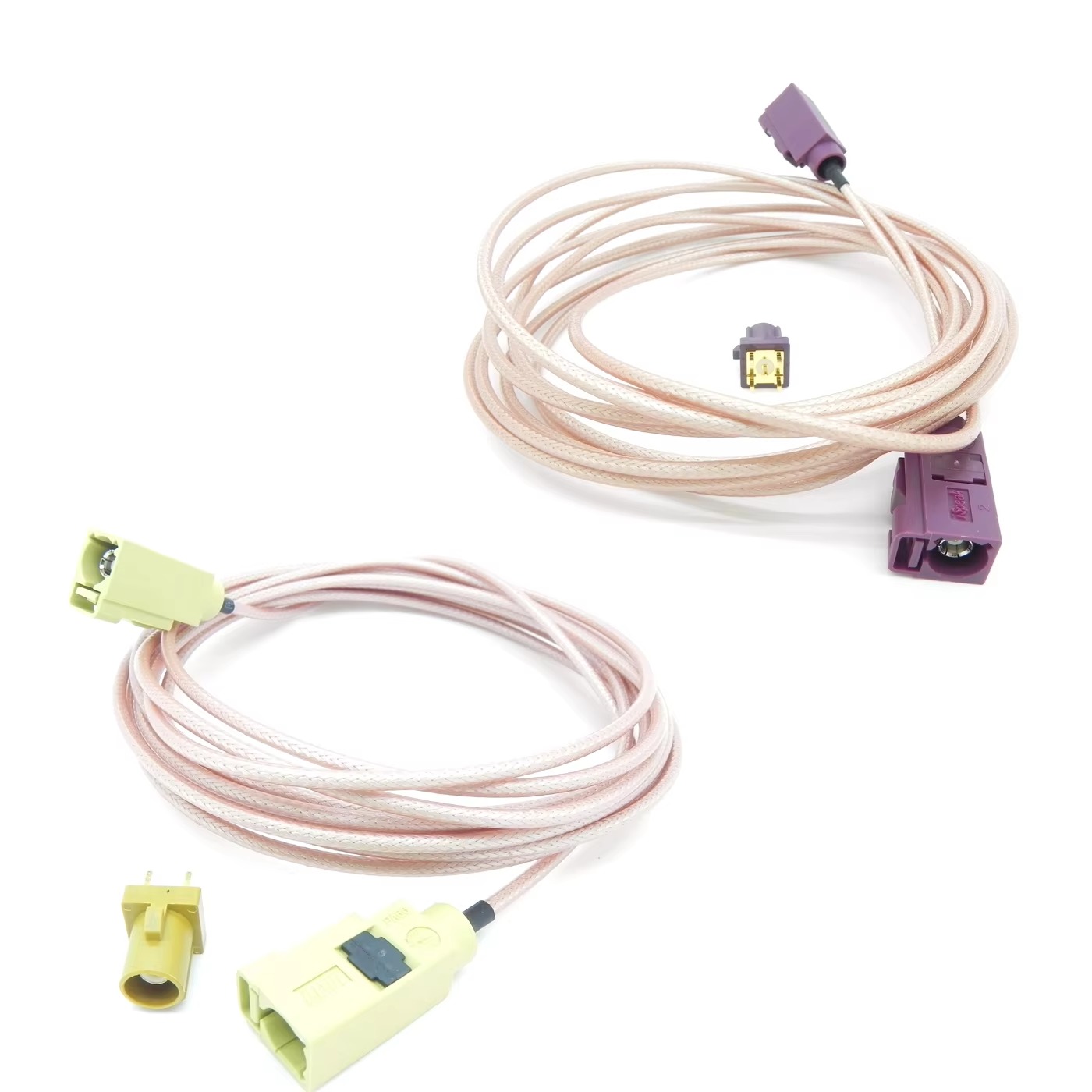
Technical Specifications of Custom Length FAKRA Cables
Impedance and Frequency Characteristics
The characteristic impedance of a FAKRA cable assembly is nominally 50 Ω ± 2 Ω, which must be maintained consistently regardless of cable length. This impedance matching is critical because any deviation causes signal reflections, standing waves, and increased insertion loss. The frequency range typically extends from DC to 6 GHz for standard FAKRA and up to 9 GHz for Mini-FAKRA variants.
Insertion loss is one of the most important parameters affected by cable length. For FAKRA cable assemblies, insertion loss is typically specified as ≤ 0.1 × √f (GHz) dB or < 0.3 dB maximum from DC to 3 GHz. Return loss, which measures the amount of signal reflected back toward the source, is specified as < 12 dB @ 6 GHz under VW LAH V03 825 standards.
Length Tolerance and Measurement Standards
One of the most overlooked aspects of custom FAKRA cable ordering is length tolerance. Unlike consumer-grade cables where approximate lengths suffice, automotive and industrial FAKRA cables demand precise dimensional control. Industry standards typically specify length tolerances of 1.5% or ±3/8 inch, whichever is greater.
However, the measurement basis is equally important. When specifying a custom length, engineers must clearly define whether the dimension refers to:
End-to-end length including connector bodies
Cable-only length between connector interfaces
Nominal overall length with specific reference points
As Dosin Hardware Electronics, a professional FAKRA cable manufacturer, advises: "Do not just write '1 meter or so.' The drawing or purchase order should explicitly specify finished product length, measurement basis, and length tolerance". This precision ensures that the cable will fit perfectly in the intended installation space without issues related to insufficient reach or excess slack.
Cable Type Selection: RG174, RG58, RG316, and Beyond
The choice of coaxial cable type significantly impacts the performance, flexibility, and cost of a custom FAKRA cable assembly. FAKRA connectors are compatible with cables ranging from 2.5 mm diameter (RG174, RG316) to 5 mm diameter (RG58, RG59). Each cable type offers distinct advantages:
RG174 is a flexible, small-diameter cable ideal for short-distance applications where frequent bending or tight routing is required. Its maximum recommended length is typically ≤ 5 meters for GMSL2 applications. RG174 offers a good balance of flexibility and performance for camera and sensor connections.
RG58 is a thicker, lower-loss cable suitable for longer transmission distances—up to 15 meters in GMSL2 applications. Its superior insertion and return loss characteristics make it ideal for fixed installations requiring long cable runs, such as roof antenna connections or rear camera systems. Amphenol RF has recently introduced high-flex RG-58 FAKRA cable assemblies specifically designed to withstand repeated movement, vibration, and limited installation space.
RG316 is a high-temperature, small-diameter cable often used in applications requiring enhanced thermal performance. It shares similar dimensions with RG174 but offers improved temperature resistance, making it suitable for under-hood or engine-adjacent installations.
Dacar 302 is a specialized automotive-grade cable designed for high-speed data transmission. It supports longer transmission distances than RG174 while maintaining excellent signal integrity, making it a preferred choice for GMSL2 and FPD-Link III applications.
Environmental and Mechanical Specifications
Custom length FAKRA cables must withstand the harsh automotive environment. Key mechanical and environmental specifications include:
Temperature range: -40°C to +105°C, depending on cable type
Mating cycles: Typically 25 or more, depending on connector generation
Cable retention force: ≥ 110 N, depending on cable type
Mating forces: ≤ 25 N
Vibration resistance: Compliant with USCAR-2 and ISO 20860 standards
Sealing: IP67 and IP69K options available for camera and exterior applications
For custom length cables, the mechanical stress distribution along the cable becomes particularly important. A cable that is too short may experience tension at the connector interface, while a cable that is too long may suffer from excessive bending or coiling. Custom length engineering ensures that the cable operates within its optimal bend radius specifications—typically 3× cable OD for static applications and 10× cable OD for dynamic applications with RG174.
Applications of Custom Length FAKRA Cables
ADAS and Autonomous Driving Systems
Advanced driver assistance systems represent one of the fastest-growing applications for custom length FAKRA cables. Modern vehicles incorporate multiple cameras—front, rear, side, and surround-view—each requiring a reliable RF connection between the camera module and the central processing unit. FAKRA-SMB solutions provide a stable interface between camera modules and vehicle coaxial networks, ensuring signal integrity for next-generation ADAS applications.
Molex's high-speed FAKRA-Mini (HFM) cable assemblies support ADAS sensor links, autonomous driving, and high-performance infotainment systems, with data transmission rates up to 20 Gbps. Custom lengths are essential in these applications because camera positions vary significantly across vehicle models and platforms, and standard cable lengths would either be too long or too short.
GNSS/GPS and Telematics
FAKRA connectors are widely used throughout the automotive sector for GNSS/GPS, telematics, infotainment platforms, and other RF-based vehicle technologies. A typical roof antenna connection may require a cable running from the headliner down through the A-pillar to the dashboard or trunk-mounted telematics unit. The exact routing distance varies by vehicle model, making custom length cables the only practical solution for efficient, reliable installation.
V2X Communication Systems
Vehicle-to-everything (V2X) communication is a cornerstone of intelligent transportation systems. FAKRA cable assemblies are designed for environments with high vibration and temperature fluctuation, making them ideal for telematics, V2X communication, and in-vehicle infotainment systems. Custom lengths ensure that V2X antenna modules located on the roof or windshield can be connected to the onboard unit without signal-degrading cable excess.
In-Vehicle Infotainment and Display Systems
Modern vehicles feature multiple high-resolution displays—instrument clusters, center stacks, rear-seat entertainment, and head-up displays. Mini-FAKRA and HFM cable assemblies support the high-speed data transmission required by these systems, with custom lengths ensuring clean, professional installations that minimize EMI and maximize signal quality.
Industrial and Robotics Applications
Beyond automotive, custom length FAKRA cables serve critical roles in autonomous mobile robots (AMRs), automated guided vehicles (AGVs), and industrial wireless communication systems. JPC Connectivity's AMR FAKRA Cable solutions support FAKRA/SMA connector options with customizable cable configurations for reliable high-frequency signal transmission in robotic systems. These applications often require cables that are shorter or longer than standard offerings, with precise length control to accommodate specific robot geometries.
How to Specify and Order Custom Length FAKRA Cables
Step 1: Define Connector Configuration
The first step in ordering a custom length FAKRA cable is specifying the connector configuration. This includes:
Connector type: FAKRA or Mini-FAKRA
Gender: Male (plug) or female (jack)
Body style: Straight or right-angle
Coding: Color and mechanical keying (Z-code, A-code, etc.)
Mounting: Free-hanging or bulkhead
FAKRA connectors are available in straight and right-angle configurations, with support for frequencies up to 6 GHz depending on the connector and cable combination.
Step 2: Select Cable Type
Choose the appropriate coaxial cable based on:
Required transmission distance
Frequency and data rate requirements
Flexibility and bend radius needs
Environmental conditions
Cost considerations
As Dosin's engineering team emphasizes, the cable type is not merely an accessory—it directly impacts the electrical and mechanical performance of the entire assembly.
Step 3: Specify Exact Length and Tolerance
Provide the finished cable length with precision. Rather than stating "1 meter," specify "1000 mm ± 10 mm, measured from connector interface to connector interface." This level of precision eliminates ambiguity and ensures the cable fits perfectly on the first try.
Pasternack, a leading RF cable assembly supplier, notes that custom cable assembly lengths can be obtained by specifying the desired length on their website at the time of order, with lengths rounded to the nearest quarter inch or centimeter. For critical applications, engineers should confirm the measurement basis and tolerance with the manufacturer before production.
Step 4: Specify Testing and Documentation Requirements
Custom FAKRA cables should undergo comprehensive testing to verify performance. Standard tests include:
Continuity testing (100% of production)
Insertion loss measurement
Return loss (VSWR) verification
Impedance matching report
ZOMWAVE offers engineering support with CAD models and prequalified test data, shortening prototype cycles and easing harness integration. For automotive customers, batch traceability and lot documentation are essential for quality management and regulatory compliance.
Step 5: Consider Additional Options
Custom length FAKRA cables can be enhanced with:
Overmolding: For vibration and moisture resistance
Cable markers and labeling: For easy identification during assembly
Protective conduit: For abrasion resistance in high-wear areas
Ground connections and cable taping: For specialized installations
Choosing the Right Custom FAKRA Cable Manufacturer
Key Evaluation Criteria
Selecting a reliable custom FAKRA cable manufacturer is critical to the success of any project. Consider the following factors:
Technical capability: Look for manufacturers with experience in high-frequency RF cable assembly, not just general wire harness production. FAKRA cable assembly requires specialized knowledge of impedance control, shield termination, and connector crimping.
Quality certification: ISO 9001:2015 certification, IATF 16949 for automotive, and compliance with USCAR-17, USCAR-18, and ISO 20860 standards are essential credentials.
Testing infrastructure: The ability to perform 100% continuity testing, RF verification, and batch traceability ensures that every cable meets specification.
Customization flexibility: The manufacturer should support custom lengths, connector combinations, cable types, and overmolding options. MD ELEKTRONIK, for example, offers sealed and non-sealed variants, 90° and 180° configurations, and 13 mechanical and colored codings, all from a single source.
Production capacity and lead time: For automotive programs, the ability to scale from prototype to mass production while maintaining consistent quality is essential. Automated assembly with process monitoring ensures repeatable results.
Leading Manufacturers in the FAKRA Cable Market
The global FAKRA cable market includes several key players:
Amphenol RF: A leading manufacturer of FAKRA cable assemblies, offering fixed-length and custom options with RG-58 and RG-174 cables. Amphenol RF recently introduced high-flex RG-58 FAKRA cable assemblies for demanding automotive applications.
Rosenberger: Known for high-precision FAKRA, HFM, and H-MTD connectors covering frequencies up to 12 GHz for demanding automotive camera systems.
Molex: Offers off-the-shelf and custom Mini-FAKRA (HFM) cable assemblies supporting data rates up to 20 Gbps for ADAS, camera, and display applications.
TE Connectivity: Provides FAKRA, Mini-FAKRA, and MATE-AX cable assemblies suitable for IoT, V2X, and telematics applications, supporting data rates up to 12 Gbps.
Pasternack: Offers extensive custom length FAKRA cable assembly options with same-day shipping for many configurations.
Dosin Hardware Electronics: A Chinese manufacturer specializing in FAKRA, HSD, Mini-FAKRA, and automotive camera harnesses, providing custom cable assembly services with engineering support.
The global FAKRA cable market was valued at a significant figure in 2024 and is forecast to grow substantially through 2031, driven by increasing vehicle electrification, ADAS adoption, and connectivity requirements. North America, Europe, and Asia-Pacific are all expected to experience healthy growth rates during this period.
Common Pitfalls to Avoid When Ordering Custom Length FAKRA Cables
Pitfall 1: Ignoring the Measurement Basis
As discussed, different measurement bases yield different finished lengths. Always specify whether the length includes connectors or refers to cable-only dimensions. Ambiguity here leads to rework, delays, and increased costs.
Pitfall 2: Under-Specifying the Cable Type
Simply stating "FAKRA cable" is insufficient. The cable type (RG174, RG58, RG316, Dacar 302, etc.) determines electrical performance, flexibility, and environmental resistance. Engineers should specify the exact cable model or provide detailed electrical requirements that allow the manufacturer to recommend the optimal cable.
Pitfall 3: Overlooking Impedance Matching
A 50 Ω FAKRA connector mated to a 75 Ω cable will produce significant signal reflections and insertion loss. Verify that both connector and cable maintain consistent 50 Ω impedance, and request an impedance matching report for critical applications.
Pitfall 4: Neglecting Bend Radius Requirements
Custom length cables that are too short may be forced into tight bends that violate minimum bend radius specifications. RG174, for example, requires a static bend radius of 3× cable OD and a dynamic bend radius of 10× cable OD. Always account for routing constraints when specifying length.
Pitfall 5: Skipping Prototype Validation
Even with precise specifications, prototype validation is essential. Request samples and test them in the actual installation environment before committing to mass production. Many manufacturers offer fast prototyping services with CAD models and test data to accelerate the validation process.
In an era where automotive connectivity demands are expanding exponentially, custom length FAKRA cables represent far more than a simple wire assembly. They are precision-engineered components that directly influence signal integrity, system reliability, and overall vehicle performance. From ADAS camera links to V2X communication modules, from GNSS antenna connections to high-resolution infotainment displays, the right cable at the right length ensures that every RF signal reaches its destination with minimal loss and maximum clarity.
The decision to specify custom length FAKRA cables rather than standard offerings is ultimately a strategic one. It reflects a commitment to engineering excellence, manufacturing efficiency, and long-term reliability. By working closely with experienced FAKRA cable manufacturers and following the specification guidelines outlined in this guide, engineers and procurement teams can achieve optimal results in every installation—whether on the assembly line or in the field.
As the automotive industry continues its transformation toward electrification, autonomy, and ubiquitous connectivity, the demand for precision RF interconnect solutions will only grow. Custom length FAKRA cables will remain at the heart of this transformation, enabling the seamless, high-speed communication that defines the vehicles of tomorrow.
Lucy Yang | lucy.y@toxutech.com
Dotty Zhao | sales04@toxutech.com
Global Business Director / Sales Team / Global Operations


 En
En Cn
Cn Korean
 Home >