

-
Products -PCBA Manufacturing RF Connectors RF Cable Assemblys Embedded Antennas External Antennas GNSS Positioning Solutions
RF Connectors

RF Cable Assemblys
Embedded Antennas
External Antennas
GNSS Positioning Solutions































 Language


Language


Time:2026-10-16 Views:0
Automotive FAKRA Z Plug is a universal, industry-standard RF coaxial connector designed specifically for automotive wireless communication systems. As the only neutral-keyed variant in the entire FAKRA connector family, the FAKRA Z plug (also known as water blue FAKRA connector, RAL 5021) delivers unmatched compatibility, flexibility, and automotive-grade durability for vehicle antenna connections, prototype testing, aftermarket upgrades, and industrial automotive RF applications. Unlike other keyed FAKRA connectors (A, B, C, D codes) with fixed mechanical locking positions, the FAKRA Z plug features zero mechanical key restrictions, enabling seamless mating with all standard FAKRA female jacks across all color codes and key types. This comprehensive guide explores every detail of the automotive FAKRA Z plug, including core features, technical specifications, key advantages, real-world applications, installation standards, selection tips, and common FAQs, helping automotive engineers, installers, and procurement teams leverage this versatile connector for reliable vehicle RF connectivity.
1. What Is an Automotive FAKRA Z Plug? Core Definition & Key Identification
The automotive FAKRA Z plug is a male coaxial RF connector compliant with global automotive FAKRA industry standards, derived from the classic SMB connector structure but optimized exclusively for harsh vehicular environments. Classified as the universal “neutral” connector in the FAKRA color-coding system, it is easily identifiable by its distinct water blue (RAL 5021) housing, which differentiates it from color-specific FAKRA plugs used for dedicated single-signal applications.
The most defining feature of the FAKRA Z plug is its key-free mechanical design. All other FAKRA connector types adopt unique mechanical keying patterns to prevent cross-mating and signal misconnection in mass production vehicle systems. In contrast, the FAKRA Z plug eliminates keying limitations entirely, making it the only all-compatible FAKRA variant. It can reliably connect with every FAKRA female jack from code A to code N, covering all standard automotive RF interface specifications.
Engineered for automotive RF signal transmission, this plug supports high-frequency wireless signals used in modern vehicles, including GPS navigation, AM/FM radio, DAB digital radio, 4G LTE/5G cellular telematics, Wi-Fi, Bluetooth, vehicle backup cameras, and V2X communication systems. Its compact structure, vibration resistance, and weatherproof performance make it a staple component for both original equipment manufacturer (OEM) testing and aftermarket automotive electronic modifications.
2. Core Technical Specifications of Automotive FAKRA Z Plug
Automotive FAKRA Z plugs strictly follow international automotive electronic and RF connector standards, ensuring consistent electrical performance, mechanical stability, and environmental adaptability across all usage scenarios. Below are the standardized technical parameters that define its industrial-grade performance:
2.1 Electrical Performance Parameters
Frequency Range: 0 GHz to 6 GHz, fully covering all mainstream automotive wireless frequency bands including GPS L1/L2, GSM, LTE, 5G NR, Wi-Fi 2.4G/5G, and DAB radio
Characteristic Impedance: 50 Ohms, matching standard automotive coaxial cable impedance to minimize signal reflection and loss
VSWR (Voltage Standing Wave Ratio): ≤ 1.5:1 within the full frequency range, ensuring stable signal transmission with minimal interference
Insertion Loss: Extremely low loss coefficient, less than 0.3dB at 6GHz, guaranteeing high-fidelity RF signal output
Insulation Resistance: ≥ 1000 MΩ, providing excellent electrical insulation and anti-leakage performance
Contact Resistance: ≤ 5 mΩ, ensuring stable current conduction and long-term electrical connectivity
2.2 Mechanical & Structural Specifications
Interface Type: Male plug (plug-in type), compatible with all FAKRA female jack connectors
Keying Design: Zero-key neutral structure, universal cross-compatibility with all FAKRA key codes
Housing Color: Water blue (RAL 5021), exclusive color marking for FAKRA Z universal connectors
Mating Cycles: ≥ 1000 times, supporting repeated plugging and unplugging for testing and maintenance scenarios
Cable Compatibility: Adaptable to RG174, RG316, RG58 and other common automotive coaxial cables, with standard crimping and soldering structure
Bending Radius: Minimum 10.5mm, flexible installation for narrow vehicle internal spaces
2.3 Environmental & Automotive Grade Standards
Operating Temperature Range: -40°C to +85°C, adapting to extreme high and low temperature environments in vehicle operation
Vibration Resistance: Compliant with ISO 16750-3 automotive vibration standards, resisting long-term road vibration and mechanical impact
Waterproof & Dustproof Grade: IP67 optional, effectively preventing dust, rainwater, and condensate from invading the connector interface
Corrosion Resistance: Gold-plated contact pins and zinc-alloy metal shell, anti-oxidation and anti-corrosion for long-term outdoor and under-hood use
Anti-aging Performance: High-temperature resistant engineering plastic shell, resisting ultraviolet aging and thermal degradation in vehicle environments
3. FAKRA Z Plug vs. Standard Keyed FAKRA Plugs: Key Differences
Most automotive FAKRA connectors adopt dedicated keying and color coding to achieve one-to-one matching in mass production, avoiding signal channel confusion. The FAKRA Z plug is a special universal variant with fundamental differences from conventional FAKRA plugs. Understanding these differences is critical for correct connector selection in engineering and installation.
3.1 Keying & Compatibility Differences
Standard FAKRA connectors (Code A to Code N) are designed with unique mechanical key protrusions and grooves. For example, Code C (blue) is dedicated to GPS systems, Code D (green) for DAB radio, and Code A (beige) for cellular signals. These keyed structures physically prevent mismating, ensuring fixed signal channel matching in formal vehicle production lines.
In contrast, the FAKRA Z plug has no mechanical keying structure. Its neutral design allows it to mate perfectly with any keyed FAKRA female jack regardless of color or code. This universal compatibility is its core advantage, but also determines its application scenarios: it is not suitable for mass production vehicle assembly where anti-mismating is required, but excels in flexible testing and aftermarket scenarios.
3.2 Application Scenario Differences
Keyed FAKRA Plugs (A-N Codes): Exclusive for OEM mass production vehicles, fixed signal configuration, strict one-to-one interface matching, ensuring production standardization and avoiding assembly errors
FAKRA Z Universal Plug: Dedicated for R&D prototype testing, laboratory signal debugging, vehicle maintenance, aftermarket refitting, and multi-functional adaptive cable assemblies
3.3 Color Identification Rules
Each standard FAKRA code corresponds to a fixed color for visual identification, while the FAKRA Z plug uses a unified water blue (RAL 5021) color as the universal identification mark. Professional installers and engineers can quickly distinguish universal Z-code connectors from dedicated signal connectors through visual color judgment, improving operation efficiency.
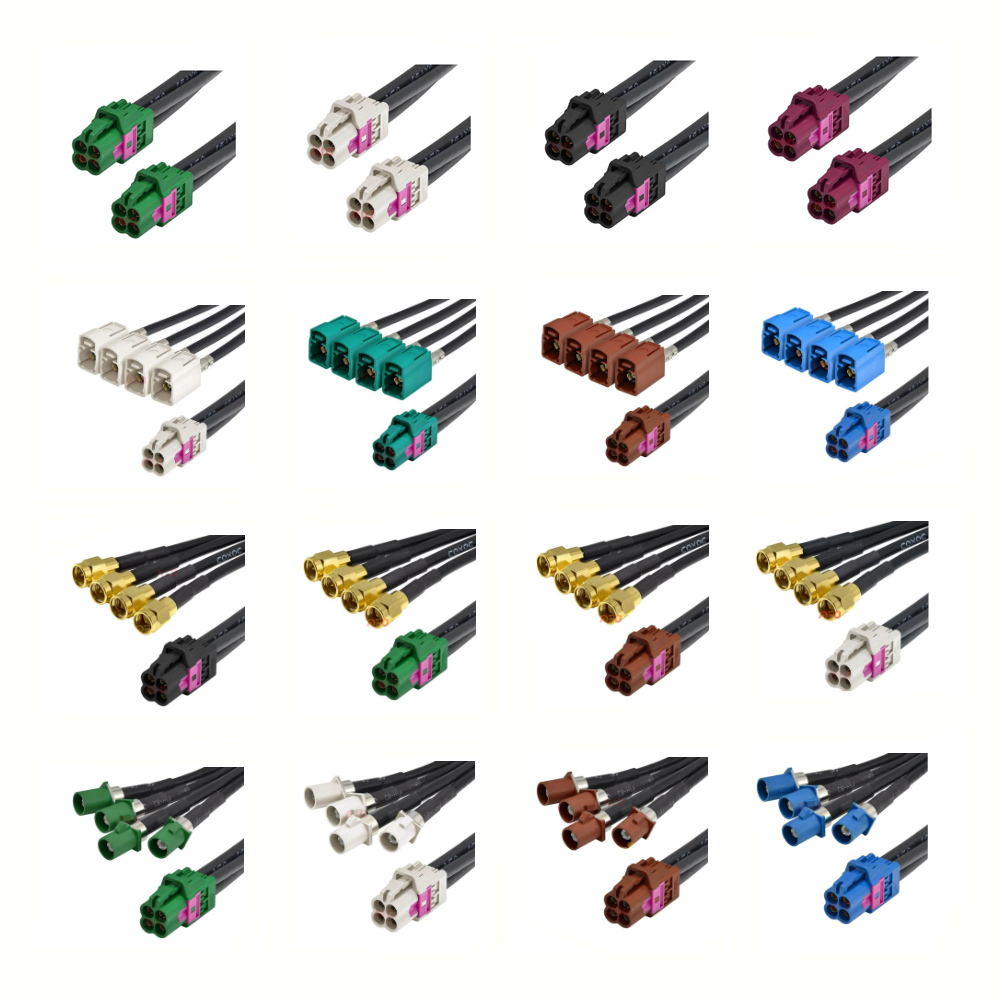
4. Core Advantages of Automotive FAKRA Z Plug
The automotive FAKRA Z plug has become an indispensable component in automotive RF testing, maintenance, and refitting fields by virtue of its unique structural design and automotive-grade performance. Its core advantages are summarized as follows:
4.1 100% Universal Cross-Compatibility
As the only fully compatible FAKRA connector, the Z-code plug eliminates the trouble of frequent connector replacement caused by different interface codes. Engineers only need one FAKRA Z plug cable to complete the testing and debugging of all vehicle RF systems, greatly reducing equipment inventory costs and improving R&D and testing efficiency. For aftermarket installers, it can adapt to different vehicle models and different original FAKRA interfaces, realizing one-size-fits-all flexible installation.
4.2 Automotive-Grade Durability & Stability
Although it is a universal adaptive connector, the FAKRA Z plug fully inherits the high-reliability characteristics of standard FAKRA connectors. It passes strict automotive environmental tests including high and low temperature cycling, vibration impact, salt spray corrosion, and dust waterproofing. The gold-plated contact structure ensures stable RF signal transmission without attenuation or interference even in harsh vehicle operating environments, avoiding signal loss, disconnection, and noise problems caused by poor connector contact.
4.3 Cost-Effective & Multi-Scenario Adaptability
For automotive R&D laboratories, maintenance factories, and aftermarket modification shops, equipping various keyed FAKRA connectors requires high procurement and management costs. The FAKRA Z plug replaces dozens of single-code FAKRA plugs, effectively reducing equipment and inventory investment. Meanwhile, its compact size and flexible cable matching design adapt to narrow installation spaces inside vehicles, including instrument panels, roof antenna bases, and vehicle-mounted equipment cabins.
4.4 Reusable & Easy to Operate
The FAKRA Z plug supports more than 1000 repeated plugging and unplugging cycles, with a tight locking structure that is not easy to loose after multiple uses. The plug-and-play design requires no professional tools for quick assembly and disassembly, greatly improving the efficiency of vehicle fault detection, signal debugging, and equipment replacement. The foolproof installation structure also reduces the error rate of manual operation.
5. Main Applications of Automotive FAKRA Z Plug
Due to its universal compatibility and automotive-grade reliability, the FAKRA Z plug is widely used in automotive R&D, testing, maintenance, aftermarket modification, and industrial vehicle RF connection scenarios. The main application fields are as follows:
5.1 Automotive R&D & Prototype Testing
In the vehicle electronic R&D stage, engineers need to repeatedly test and verify the performance of navigation, car networking, infotainment, and communication systems. The FAKRA Z plug’s universal compatibility allows it to connect with all FAKRA interface devices, supporting signal testing of GPS, 5G, Wi-Fi, and Bluetooth modules. It is the preferred connector for vehicle electronic prototype debugging, performance verification, and functional testing, effectively shortening product R&D cycles.
5.2 Vehicle Maintenance & Fault Detection
When vehicle wireless communication failures occur (such as weak GPS signal, unstable car network connection, and no radio signal), maintenance personnel need to quickly detect and troubleshoot RF line faults. The FAKRA Z plug can adapt to all vehicle models and all FAKRA interface specifications, realizing rapid line detection, signal measurement, and fault positioning. It avoids the problem of unable to test due to interface mismatch, greatly improving maintenance efficiency.
5.3 Aftermarket Automotive Electronic Modification
Vehicle owners often modify automotive electronic equipment such as high-precision navigation, panoramic reversing cameras, car Wi-Fi, and 5G car networking modules. Different original vehicle interfaces have different FAKRA key codes, bringing great trouble to modification construction. The FAKRA Z plug’s universal adaptation perfectly solves the interface mismatch problem, suitable for cross-model equipment installation and multi-functional RF line refitting, and is widely used in automotive after-sales modification markets.
5.4 Laboratory & Industrial Automotive RF Testing
Professional automotive testing laboratories use FAKRA Z plug cable assemblies for long-term signal monitoring, equipment calibration, and data acquisition. Its stable electrical performance and environmental adaptability ensure the accuracy and consistency of test data. In addition, it is also applicable to RF connection of engineering vehicles, new energy commercial vehicles, and special industrial vehicles, meeting the flexible connection needs of non-mass-produced vehicle equipment.
5.5 Temporary Signal Connection & Equipment Debugging
In vehicle factory production testing, pre-delivery equipment debugging, and temporary vehicle signal access scenarios, the FAKRA Z plug provides reliable temporary connection functions. Its reusable and quick-plug features are very suitable for non-fixed, temporary RF signal transmission scenarios, avoiding waste caused by using dedicated connectors for temporary use.
6. Installation & Wiring Guidelines for FAKRA Z Plug
To ensure the best signal transmission performance and service life of the automotive FAKRA Z plug, standardized installation and wiring operations must be followed. The professional installation steps and precautions are as follows:
6.1 Pre-Installation Inspection
Before installation, check whether the FAKRA Z plug shell is intact, whether the contact pins are oxidized, deformed or contaminated, and whether the matching coaxial cable has broken cores or damaged insulation layers. Confirm that the plug model and cable specification meet the equipment frequency and impedance requirements to avoid performance degradation caused by mismatched parameters.
6.2 Standard Mating Operation
Align the FAKRA Z plug with the target FAKRA female jack, push it horizontally and firmly until a clear “click” sound is heard, indicating that the internal locking structure is completely engaged. After insertion, gently pull the cable to confirm that the connection is firm and not loose. Due to the key-free design, no key position alignment is required, realizing foolproof quick installation.
6.3 Wiring & Layout Precautions
Avoid excessive bending of the cable, ensure the bending radius is greater than 10.5mm, and prevent internal core wire breakage and signal attenuation
Keep the RF cable away from vehicle power lines and high-power electronic components to avoid electromagnetic interference affecting signal stability
For outdoor and under-hood installation, select IP67 waterproof FAKRA Z plug models, and do a good job in interface fixing and waterproof sealing
Avoid long-term tension and extrusion on the connector and cable to prevent structural damage and poor contact
6.4 Disassembly & Maintenance
When disassembling, pinch the plug shell firmly and pull it horizontally outward. Do not pull the cable hard to avoid damaging the internal contact structure. Regularly clean the plug interface dust and stains with dry non-woven fabric to keep the contact surface clean. For long-term unused connectors, store them in a dry and dustproof environment to prevent oxidation and corrosion.
7. How to Select High-Quality Automotive FAKRA Z Plug
The quality of FAKRA Z plug directly affects vehicle RF signal stability and service life. Inferior connectors are prone to signal loss, loose contact, oxidation failure, and poor vibration resistance, which will cause problems such as vehicle navigation delay, car network disconnection, and blurred camera signals. The key selection criteria are as follows:
7.1 Strictly Comply with Automotive-Grade Standards
Prioritize products that comply with ISO 16750 automotive electronic standards and FAKRA international industry specifications. Ensure that the product has passed high and low temperature testing, vibration testing, and waterproof and dustproof testing to adapt to complex vehicle working environments. Avoid ordinary industrial-grade RF connectors that cannot withstand vehicle environmental changes.
7.2 Check Material & Craftsmanship
High-quality FAKRA Z plugs adopt gold-plated brass contact pins with good conductivity and anti-oxidation performance; the shell is made of high-strength engineering plastic and zinc alloy metal bracket, with strong impact resistance and anti-aging ability. Inferior products use tin-plated contacts and recycled plastics, which are easy to oxidize and age, leading to rapid performance degradation.
7.3 Verify Electrical Performance Parameters
Confirm that the product’s frequency range, VSWR, insertion loss, and impedance parameters meet automotive RF system requirements. For high-frequency 5G and Wi-Fi signal scenarios, it is necessary to select FAKRA Z plugs with low insertion loss and low standing wave ratio to ensure high-speed and stable signal transmission.
7.4 Match Cable Specifications & Structural Design
Select supporting RG174, RG316 and other automotive coaxial cables according to actual installation needs. For scenarios requiring frequent plugging and unplugging, prioritize products with reinforced locking structures to ensure long-term use stability. For outdoor and wet environments, choose IP67 waterproof enhanced models.
8. Frequently Asked Questions (FAQs) About Automotive FAKRA Z Plug
Q1: Can FAKRA Z plug be used for mass production OEM vehicles?
A: It is not recommended. The FAKRA Z plug adopts a key-free universal design, which cannot prevent interface mismating. In mass-produced vehicles, different RF signal channels require strict one-to-one keyed matching to avoid signal crosstalk and assembly errors. The Z-code plug is only suitable for testing, maintenance, and aftermarket scenarios, while keyed FAKRA connectors are used for formal OEM production.
Q2: Is the signal performance of FAKRA Z plug worse than keyed FAKRA plugs?
A: No. The FAKRA Z plug has the same electrical performance, signal transmission accuracy, and environmental resistance as standard keyed FAKRA plugs. The only difference is the mechanical keying structure, with no difference in RF signal transmission quality. It can fully meet the high-precision signal transmission needs of automotive wireless systems.
Q3: What is the difference between FAKRA Z male plug and female jack?
A: The FAKRA Z male plug is the plug-in terminal, which can be inserted into all FAKRA female jacks; the FAKRA Z female jack is the socket terminal, which can accept all FAKRA male plugs. Both have universal compatibility, and users can select male or female models according to actual interface matching needs.
Q4: Does FAKRA Z plug support 5G automotive signal transmission?
A: Yes. The standard FAKRA Z plug has a frequency range of up to 6GHz, which fully covers the 5G automotive communication frequency band, and can stably support 5G telematics, V2X vehicle networking, and high-speed Wi-Fi signal transmission, meeting the latest intelligent vehicle electronic configuration requirements.
Q5: How to distinguish genuine automotive-grade FAKRA Z plug from fake products?
A: Genuine products have standard water blue RAL 5021 color, clear product specifications and automotive-grade certification marks, gold-plated smooth contact pins, and tight locking structure. Fake products have dark and uneven color, rough shell workmanship, easy-to-oxidize tin-plated contacts, and loose locking, which are easy to cause signal failure after installation.
The automotive FAKRA Z plug is an irreplaceable universal RF connector in the automotive industry, with core advantages of full compatibility, automotive-grade reliability, flexible application, and cost savings. Its unique key-free neutral design breaks the interface restriction of traditional keyed FAKRA connectors, providing efficient and reliable connection solutions for automotive R&D testing, daily maintenance, aftermarket modification, and temporary signal debugging. With the rapid development of intelligent connected vehicles, automotive wireless communication systems such as 5G, V2X, and high-precision navigation are constantly upgraded, and the demand for high-performance and multi-adaptive RF connectors is increasing day by day. As a universal automotive RF connector, the FAKRA Z plug will continue to play an important role in the field of vehicle electronic testing and after-sales service, becoming a basic high-quality component to ensure stable operation of vehicle wireless systems.
For automotive engineers, maintenance technicians, and aftermarket installers, selecting standard automotive-grade FAKRA Z plugs can effectively improve work efficiency, reduce equipment costs, and ensure long-term stable transmission of vehicle RF signals. When purchasing and using, it is necessary to strictly follow automotive industry standards, select high-quality compliant products, and standardize installation and maintenance operations to maximize the service performance and service life of the connector.
Lucy Yang | lucy.y@toxutech.com
Dotty Zhao | sales04@toxutech.com
Global Business Director / Sales Team / Global Operations


 En
En Cn
Cn Korean
 Home >