

-
Products -PCBA Manufacturing RF Connectors RF Cable Assemblys Embedded Antennas External Antennas GNSS Positioning Solutions
RF Connectors

RF Cable Assemblys
Embedded Antennas
External Antennas
GNSS Positioning Solutions































 Language


Language


Time:2026-10-16 Views:0
Why Rugged Screw Mount Combination Antennas Matter
In the rapidly expanding world of the Internet of Things (IoT), the reliability of wireless connectivity often determines the success or failure of an entire deployment. From fleet telematics systems traversing harsh highways to smart utility meters exposed to years of weather, the antenna is the critical link between the physical world and the digital network. Among the many antenna form factors available, rugged screw mount combination antennas have emerged as the gold standard for applications where durability, multi-band performance, and secure installation are non-negotiable.
A rugged screw mount combination antenna is a single, integrated unit that houses multiple antenna elements—typically covering cellular (4G/5G), Wi-Fi, GNSS (GPS/GLONASS/Galileo/BeiDou), and sometimes additional bands like TETRA or ISM—within a single weatherproof housing that is mounted through a panel or enclosure using a threaded screw or stud mechanism. This design eliminates the need for multiple separate antennas, reducing installation complexity, cable clutter, and potential points of failure, while providing the mechanical strength required to withstand vibration, shock, and environmental exposure.
This comprehensive guide explores every facet of rugged screw mount combination antennas: their technical architecture, the performance benefits they deliver, the industries and applications they serve, the critical selection criteria for engineers and procurement teams, installation best practices, relevant industry standards, and the future trends shaping this technology. By the end, you will have the knowledge needed to specify and deploy these antennas with confidence in even the most demanding environments.
What Is a Rugged Screw Mount Combination Antenna?
Definition and Core Concept
A rugged screw mount combination antenna is, at its core, a multi-element RF antenna system integrated into a single, environmentally sealed enclosure that is secured to a mounting surface via a threaded screw or stud. The term “combination” refers to the antenna’s ability to support multiple frequency bands and communication protocols simultaneously—for example, a 5-in-1 antenna might include one GNSS element, two cellular MIMO elements, and two Wi-Fi elements, all within a single radome.
The “rugged” designation signifies that the antenna’s housing and internal construction have been engineered to survive conditions that would destroy a conventional antenna: extreme temperatures, high-pressure water jets, dust ingress, mechanical vibration, impact, and even vandalism attempts. These antennas are typically rated to industry standards such as IP67, IP69K, and IK09 or IK10, which quantify their resistance to water, dust, and impact, respectively.
Mounting Mechanism: Screw Mount vs. Other Mounting Types
The screw mount mechanism distinguishes these antennas from magnetic, adhesive, or pole-mounted alternatives. A screw mount antenna is installed by drilling a hole through the mounting surface (typically a metal panel, vehicle roof, or equipment enclosure), inserting the antenna’s threaded stud or boss through the hole, and securing it from the underside with a nut. This creates a permanent, mechanically robust connection that cannot be accidentally dislodged by vibration or wind loading—a critical advantage in mobile and outdoor applications.
Many rugged screw mount antennas incorporate an anti-rotation feature, such as a keyed washer or a hexagonal base, which prevents the antenna from twisting out of alignment during installation or in service. Some designs also use a split nut that can be fitted over the cable and threaded onto the stud, simplifying installation when cables are pre-terminated.
Key Technical Features of Rugged Screw Mount Combination Antennas
Multi-Band Frequency Coverage
The most striking feature of a modern combination antenna is its frequency breadth. Leading products cover an ultra-wide band from 600 MHz to 6000 MHz, encompassing all major cellular bands from 2G through 5G, as well as legacy bands for backward compatibility. Wi-Fi coverage extends across 2.4 GHz, 5 GHz, and the newly opened 6 GHz band (Wi-Fi 6E and Wi-Fi 7), while GNSS elements support L1 and increasingly L5 frequencies for enhanced positional accuracy with GPS, GLONASS, Galileo, and BeiDou constellations.
This wide-band capability means a single antenna can serve as the sole wireless gateway for a complex device, supporting cellular backhaul, local Wi-Fi connectivity, and satellite-based positioning simultaneously. The antenna’s internal elements are carefully designed to minimize interference between bands—a critical engineering challenge that separates premium combination antennas from mediocre ones.
Ruggedized Construction and Environmental Ratings
The ruggedness of these antennas is quantified through internationally recognized ingress protection (IP) and impact protection (IK) ratings. An IP67 rating means the enclosure is dust-tight and can withstand immersion in water up to 1 meter for 30 minutes. IP69K is an even more demanding standard, certifying resistance to high-pressure (100 bar) and high-temperature (80°C) water jets—essential for applications in food processing, mining, and heavy vehicle wash-down environments.
IK ratings measure resistance to mechanical impact. An IK09 rating, common in heavy-duty antennas, indicates protection against a 5-joule impact, roughly equivalent to a 1.7 kg object dropped from 30 cm. IK10, found in the most robust designs, withstands 20 joules—the equivalent of a 5 kg object dropped from 40 cm. These ratings ensure that the antenna can survive accidental impacts from tools, debris, or even deliberate vandalism attempts.
Materials also play a crucial role in ruggedness. High-quality screw mount antennas use UV-resistant ASA (Acrylonitrile Styrene Acrylate) housings that resist long-term degradation from sunlight, temperature cycling, and chemical exposure. Internal components are often potted or sealed to prevent moisture ingress even if the outer housing is compromised.
Ground Plane Independence
Many rugged screw mount combination antennas are designed to be ground plane independent. In conventional antenna design, the antenna relies on a conductive ground plane—typically the metal body of the device or vehicle—to function optimally. When mounted on non-metallic surfaces such as fiberglass, plastic, or wood, performance can degrade significantly.
Ground plane independence means the antenna includes internal counterpoise structures that substitute for the external ground plane, ensuring consistent performance regardless of the mounting surface. This feature is particularly valuable for antennas installed on composite-bodied vehicles, plastic equipment enclosures, or non-metallic building materials. However, even ground-plane-independent antennas generally perform best when mounted on a metal surface of at least 300 mm × 300 mm, which enhances their radiation efficiency.
Applications Across Industries
Industrial IoT and Smart Infrastructure
Rugged screw mount combination antennas are the backbone of industrial IoT deployments. In factory automation, these antennas enable reliable communication between robotic machinery, conveyor systems, and central control rooms, even in environments filled with electromagnetic noise from motors and welding equipment. Smart city infrastructure—including connected streetlights, traffic management systems, and environmental monitoring stations—relies on these antennas for cellular backhaul and local mesh networking.
Smart metering is another major application. Electricity, gas, and water meters deployed in outdoor cabinets or underground vaults require antennas that can survive decades of exposure while maintaining reliable NB-IoT or LTE Cat-M connectivity. The screw mount design ensures the antenna remains firmly attached despite vibration from nearby machinery or traffic.
Fleet Management and Telematics
Fleet telematics is perhaps the most demanding application for combination antennas. A single vehicle may require simultaneous cellular connectivity for real-time tracking and diagnostics, Wi-Fi for onboard cameras and passenger internet, and GNSS for precise location and route optimization. A multi-element screw mount antenna installed on the vehicle roof or trunk lid provides all these functions through a single, low-profile unit.
The screw mount is essential in this context because magnetic mounts can be dislodged at highway speeds, and adhesive mounts may fail after prolonged exposure to vibration and temperature extremes. Screw-mounted antennas are also less vulnerable to theft and vandalism, an important consideration for commercial fleets.
Public Safety and Critical Communications
Emergency responder vehicles—police cars, ambulances, fire trucks—depend on robust communication systems that never fail. Rugged screw mount combination antennas support TETRA, P25, and other public safety radio standards alongside cellular and GNSS functions. The anti-rotation and anti-vibration features of these antennas are critical when vehicles are driven at high speeds over rough terrain.
Agriculture, Mining, and Construction
Off-highway vehicles in agriculture, mining, and construction operate in some of the harshest conditions imaginable: extreme temperatures, heavy vibration, dust, mud, and constant exposure to the elements. Combination antennas with IP69K and IK10 ratings are specifically designed for these environments, providing reliable connectivity for autonomous vehicle guidance, telemetry, and remote diagnostics.
EV Charging Stations
Electric vehicle charging stations represent a rapidly growing application for rugged screw mount antennas. These stations require cellular connectivity for payment processing and remote monitoring, Wi-Fi for user connectivity, and GNSS for location services—all in an outdoor enclosure that must withstand years of weather and potential vandalism. The MA58x Series from Taoglas, for example, is specifically engineered to maintain stable performance when mounted on metal enclosures, a common configuration for EV chargers.
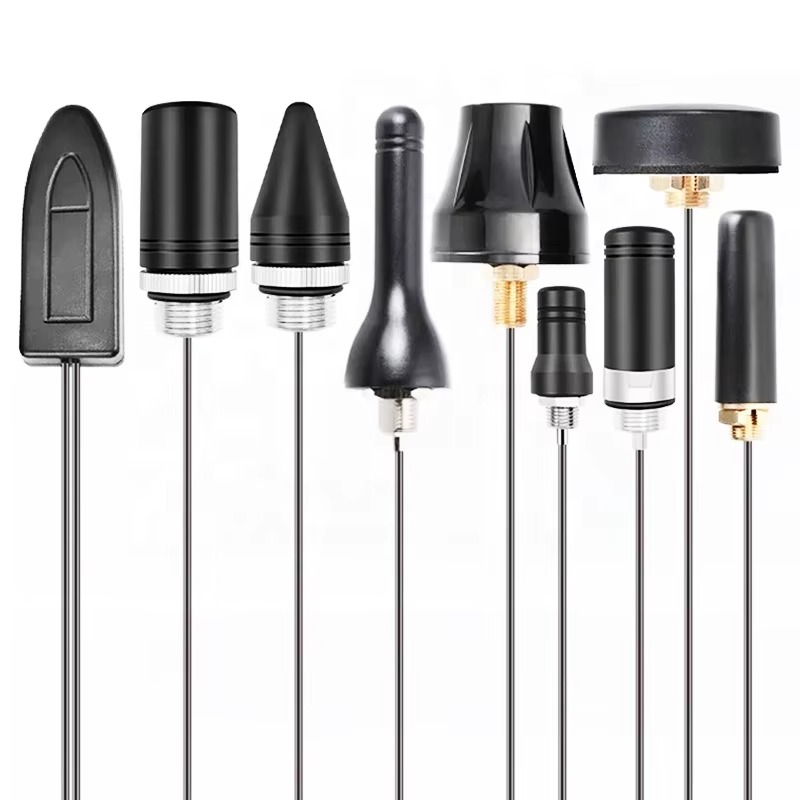
How to Select the Right Rugged Screw Mount Combination Antenna
Selecting the optimal antenna for a given application requires careful consideration of several interrelated factors. The following sections outline the key criteria that engineers and procurement specialists should evaluate.
Element Count and Band Configuration
The first decision is how many antenna elements are required and which frequency bands each must cover. Common configurations include:
2-in-1: Typically 2× cellular MIMO or 1× cellular + 1× GNSS.
3-in-1: Often 2× cellular MIMO + 1× GNSS, or 1× cellular + 1× Wi-Fi + 1× GNSS.
5-in-1: 4× cellular MIMO + 1× GNSS, or 2× cellular + 2× Wi-Fi + 1× GNSS.
7-in-1 and beyond: Up to 4× cellular MIMO, 4× Wi-Fi MIMO, and 1× GNSS, plus optional additional elements for TETRA, AM/FM, or other services.
The element count should be driven by the specific communication requirements of the device. For a simple tracking device, a 2-in-1 (cellular + GNSS) may suffice. For a sophisticated telematics gateway supporting multiple carriers, Wi-Fi hotspot functionality, and precise positioning, a 7-in-1 or 9-in-1 configuration may be appropriate.
Frequency Band Coverage
Not all combination antennas cover the same frequency ranges. Key considerations include:
Cellular bands: Ensure coverage of all bands used in the target deployment region. Global deployments require support for 600 MHz to 6000 MHz to cover low-band (600–960 MHz), mid-band (1400–2690 MHz), and high-band (3300–6000 MHz) 5G frequencies.
Wi-Fi bands: 2.4 GHz, 5 GHz, and 6 GHz (Wi-Fi 6E/7) support should be verified if the application requires high-throughput local connectivity.
GNSS constellations: L1-only antennas support GPS, GLONASS, Galileo, and BeiDou with moderate accuracy. L1/L5 dual-band antennas provide significantly improved positional accuracy and faster lock times, essential for precision applications.
Additional bands: TETRA (380–470 MHz), ISM (915 MHz, 2.4 GHz), and AM/FM may be required for specific vertical markets.
Environmental and Mechanical Specifications
The operating environment dictates the minimum environmental ratings:
IP rating: IP67 is the baseline for outdoor use. IP69K is required for applications involving high-pressure wash-down or steam cleaning.
IK rating: IK09 for general industrial use; IK10 for high-vandalism-risk or heavy-impact environments.
Operating temperature: Most rugged antennas operate from -40°C to +85°C, suitable for virtually all outdoor environments.
Vibration and shock: Screw mount designs inherently resist vibration better than magnetic or adhesive mounts. For extreme vibration environments, verify that the antenna has been tested to relevant standards such as IEC 60068-2-6 (vibration) and IEC 60068-2-27 (shock).
Mounting and Installation Considerations
Thread type and size: Common thread sizes include M18, M22, and custom studs. Verify that the thread matches the mounting hole and that sufficient stud length is available for the panel thickness. The Taoglas Synergy, for example, accommodates panels up to 6 mm thick with an M22 thread.
Cable and connector options: Most manufacturers offer customizable cable lengths and connector types. Longer cable runs may require low-loss cable to maintain signal integrity. SMA male connectors are standard for most cellular and GNSS feeds, while RP-SMA is common for Wi-Fi.
Ground plane requirements: Even ground-plane-independent antennas benefit from a metal mounting surface. For non-metallic panels, consider adding a conductive ground plane underneath.
Performance Metrics
Gain and efficiency: Peak gain typically ranges from 0.6 dBi for compact cellular elements to 6.8 dBi for high-performance Wi-Fi elements. Efficiency (the percentage of input power radiated) is a better indicator of real-world performance than gain alone; premium antennas achieve 50% to 89% efficiency.
VSWR (Voltage Standing Wave Ratio): A VSWR below 2:1 across the operating bands indicates good impedance matching and minimal signal reflection.
Isolation between elements: In multi-element antennas, high isolation between elements (typically >15 dB) is essential to prevent interference between cellular, Wi-Fi, and GNSS functions.
Installation Best Practices for Rugged Screw Mount Combination Antennas
Proper installation is critical to achieving the performance and longevity that these antennas are designed to deliver. The following best practices apply to most screw mount combination antennas.
Site Selection and Surface Preparation
The antenna should be mounted on a flat, level surface, ideally in a central location on the mounting panel. Mounting near the edge of a roof or panel can distort the radiation pattern and reduce performance. Keep the antenna away from other roof-mounted accessories such as air conditioning units, light bars, and other antennas, which can cause reflections and interference.
Before drilling, mask the area around the intended hole to protect the surface finish. Drill a pilot hole and then enlarge it to the required diameter (typically 19–24 mm for standard screw mount designs). Deburr the hole and remove all metal shavings. Remove paint and primer from the underside of the panel around the hole to ensure good electrical contact with the mounting nut and washer.
Sealing and Weatherproofing
Even antennas with high IP ratings require proper sealing at the mounting interface. Most rugged screw mount antennas include a rubber O-ring or gasket that compresses against the mounting surface. After installation, inspect the O-ring for proper compression. If there is any doubt about the seal, apply a small bead of neutral-cure silicone sealant around the periphery of the mounting boot.
The mounting nut on the underside of the panel should be tightened to the manufacturer’s specified torque—typically around 6 Nm for M22 threads. Over-tightening can damage the threads or crack the mounting surface; under-tightening can lead to water ingress and vibration-induced loosening.
Cable Routing and Connector Protection
Route cables away from sharp edges and heat sources. Use grommets or cable clips to secure cables and prevent strain on the connectors. Unused connectors should be fitted with 50-ohm terminators to prevent signal reflections. Ensure that all connectors are properly mated and, for outdoor installations, consider wrapping them with self-amalgamating tape or heat-shrink tubing for additional weather protection.
Industry Standards and Certifications
Ingress Protection (IP) Ratings
The IP rating system, defined by IEC 60529, is the global standard for classifying the degree of protection provided by an enclosure against dust and water. For rugged screw mount antennas, the relevant ratings are:
IP67: Dust-tight; protected against temporary immersion in water (1 m for 30 minutes).
IP68: Dust-tight; protected against continuous immersion in water (depth specified by manufacturer).
IP69K: Dust-tight; protected against close-range high-pressure, high-temperature water jets (DIN 40050-9).
Impact Protection (IK) Ratings
The IK rating, defined by IEC 62262, classifies the degree of protection against mechanical impact. For antennas, the relevant ratings are:
IK08: Protected against 5-joule impact (1.7 kg dropped from 30 cm).
IK09: Protected against 10-joule impact.
IK10: Protected against 20-joule impact (5 kg dropped from 40 cm).
Environmental and Regulatory Compliance
Rugged antennas intended for global deployment must comply with RoHS (Restriction of Hazardous Substances) and REACH (Registration, Evaluation, Authorisation and Restriction of Chemicals) directives. For automotive applications, compliance with ECE-R118 (burning behaviour of materials) may be required. Cellular and Wi-Fi antennas must also meet the RF exposure requirements of the relevant regulatory bodies (FCC in the United States, CE in Europe, and equivalent agencies in other regions).
Comparative Analysis: Rugged Screw Mount vs. Other Antenna Types
| Feature | Screw Mount | Magnetic Mount | Adhesive Mount | Pole Mount |
|---|---|---|---|---|
| Vibration resistance | Excellent | Poor | Moderate | Good |
| Water/dust sealing | Excellent (IP67–IP69K) | Moderate (IP65–IP67) | Moderate (IP65–IP67) | Good (IP65–IP67) |
| Theft/vandalism resistance | High | Low | Low | Moderate |
| Installation complexity | Moderate (requires drilling) | Low | Low | Moderate |
| Permanence | Permanent | Temporary | Semi-permanent | Semi-permanent |
| Performance on metal | Excellent | Good | Good | Varies |
| Typical applications | Fleet, industrial, outdoor infrastructure | Temporary setups, rental vehicles | Consumer devices, indoor | Fixed outdoor installations |
This comparison underscores why screw mount antennas dominate in applications where reliability and longevity are paramount. The requirement to drill a mounting hole is a small price to pay for the security and performance that screw mounting provides.
Market Trends and Future Developments
Integration of Wi-Fi 6E and Wi-Fi 7
The opening of the 6 GHz band for unlicensed Wi-Fi use has created new requirements for combination antennas. Forward-looking products now include 6 GHz elements alongside 2.4 GHz and 5 GHz coverage, ensuring compatibility with the latest Wi-Fi 6E and Wi-Fi 7 standards. As enterprises upgrade their wireless infrastructure, demand for antennas that support these bands will grow.
Dual-Band GNSS for Precision Applications
The availability of L5 GNSS signals is transforming positioning accuracy. Dual-band L1/L5 antennas can achieve centimeter-level accuracy when paired with RTK corrections, enabling applications such as autonomous vehicle guidance, precision agriculture, and survey-grade mapping. Rugged screw mount combination antennas with L1/L5 GNSS are becoming increasingly common.
Higher Levels of Integration
Manufacturers continue to push the boundaries of integration, packing more elements into smaller form factors. The Taoglas Raptor X series, for example, offers up to 10 connections—one GNSS, four cellular, and five Wi-Fi—in a package measuring just 350 × 70 × 39 mm. This trend toward higher integration reduces installation complexity and cost while maintaining performance.
Smart Antennas with Integrated Electronics
Some next-generation combination antennas incorporate active electronics such as GNSS low-noise amplifiers (LNAs) with pre-filters to improve signal reception in weak-signal environments. Future developments may include integrated RF switching, beamforming, and even software-defined antenna tuning, allowing a single antenna to adapt its performance to changing conditions.
Frequently Asked Questions (FAQ)
What is the difference between a combination antenna and a single-band antenna?
A combination antenna integrates multiple antenna elements for different frequency bands or services into a single housing. A single-band antenna covers only one frequency range. Combination antennas reduce installation complexity, save space, and minimize cable runs, but they require careful design to prevent interference between elements.
Can a rugged screw mount antenna be installed on a plastic enclosure?
Yes, but with caveats. Many combination antennas are ground-plane independent, meaning they do not require a metal surface to function. However, performance is generally enhanced by a metal ground plane. For plastic enclosures, consider adding an internal metal plate of at least 300 mm × 300 mm beneath the antenna.
How do I know if an antenna is truly “rugged”?
Look for third-party certifications: IP67 or IP69K for water and dust ingress, IK09 or IK10 for impact resistance, and an operating temperature range of at least -40°C to +85°C. Reputable manufacturers provide datasheets with test data from certified laboratories.
What is the maximum cable length for a screw mount combination antenna?
Cable length depends on the frequency and cable type. For GNSS, longer cables can attenuate the weak satellite signal; active GNSS antennas with built-in LNAs can tolerate cables up to 5 meters or more. For cellular and Wi-Fi, low-loss cables such as TGC-302 or LMR-200 can support runs of several meters. Consult the manufacturer’s specifications for guidance.
How do I seal the mounting hole to prevent water ingress?
Most rugged antennas include an O-ring or gasket that compresses against the mounting surface. For additional protection, apply a neutral-cure silicone sealant around the periphery of the mounting boot after installation. Ensure the mounting surface is flat and clean before installation, as curvature or debris can prevent a proper seal.
Rugged screw mount combination antennas represent the convergence of advanced RF engineering, materials science, and mechanical design. They solve a fundamental challenge in IoT and industrial connectivity: how to deliver reliable, multi-band wireless performance in environments where failure is not an option. From the factory floor to the highway to the remote utility cabinet, these antennas provide the secure, weatherproof, and vibration-resistant connection that modern systems demand.
When selecting a rugged screw mount combination antenna, engineers must carefully weigh element count, frequency coverage, environmental ratings, mounting characteristics, and performance metrics against the specific requirements of their application. With a thorough understanding of these factors—and the installation best practices outlined in this guide—organizations can deploy wireless infrastructure that remains robust and reliable for years, even under the most punishing conditions. As IoT deployments continue to proliferate and connectivity requirements grow ever more demanding, the rugged screw mount combination antenna will remain an indispensable component of the connected world.
Lucy Yang | lucy.y@toxutech.com
Dotty Zhao | sales04@toxutech.com
Global Business Director / Sales Team / Global Operations


 En
En Cn
Cn Korean
 Home >