

-
Products -PCBA Manufacturing RF Connectors RF Cable Assemblys Embedded Antennas External Antennas GNSS Positioning Solutions
RF Connectors

RF Cable Assemblys
Embedded Antennas
External Antennas
GNSS Positioning Solutions































 Language


Language


Time:2026-10-16 Views:0
Why Mini IoT GNSS WiFi Antennas Matter
The Internet of Things has undergone a remarkable transformation over the past decade, evolving from simple sensor networks into sophisticated ecosystems of connected devices that demand seamless, multi-protocol wireless connectivity. At the heart of this evolution lies a deceptively small yet critically important component: the mini IoT GNSS WiFi antenna. These compact antennas enable devices to simultaneously determine their precise geographic location through satellite navigation while maintaining robust wireless data connections through Wi-Fi networks—all within a footprint that continues to shrink with each new product generation.
The convergence of GNSS positioning and Wi-Fi connectivity into a single miniature antenna solution represents one of the most significant engineering achievements in modern RF design. Whether you are developing asset trackers, wearable health monitors, smart agriculture sensors, or industrial IoT gateways, understanding the capabilities, trade-offs, and selection criteria for mini GNSS WiFi combo antennas is essential for successful product development.
This comprehensive guide explores every aspect of mini IoT GNSS WiFi antennas, from fundamental operating principles and key technical specifications to practical selection advice, integration best practices, and emerging trends that will shape the next generation of connected devices.
What Is a Mini IoT GNSS WiFi Antenna?
A mini IoT GNSS WiFi antenna is a compact, multi-band antenna solution designed to support both Global Navigation Satellite System (GNSS) positioning and Wi-Fi wireless communication within a single integrated component. These antennas are specifically engineered for space-constrained IoT devices where traditional, separate antennas for each wireless technology would be impractical or impossible to accommodate.
The fundamental concept behind combo antennas is frequency coexistence. GNSS signals operate in the L-band spectrum, typically around 1559–1610 MHz for GPS L1, Galileo E1, GLONASS L1, and BeiDou B1, while Wi-Fi operates across 2.4 GHz (2400–2483.5 MHz), 5 GHz (5150–5850 MHz), and increasingly 6 GHz (5925–7125 MHz) bands. A well-designed combo antenna must efficiently receive and transmit across these disparate frequency ranges without significant mutual interference. This requires careful attention to antenna isolation, impedance matching, and radiation pattern optimization.
Modern mini GNSS WiFi antennas come in several form factors. Flexible printed circuit (FPC) antennas offer ultra-thin profiles and the ability to conform to curved surfaces, making them ideal for wearables and devices with irregular internal geometries. Rigid FR4 PCB antennas provide mechanical stability and are suitable for standard PCB mounting. Ceramic chip antennas, such as the Taoglas GWLA.01, measure as little as 3.2 × 1.6 × 0.5 mm and support both GPS/GALILEO and 2.4 GHz Wi-Fi or Bluetooth in a single surface-mount package.
The integration of multiple wireless technologies into one antenna brings substantial benefits: reduced component count, simplified RF design, lower bill-of-materials costs, faster assembly times, and accelerated time-to-market for connected products. For IoT engineers facing the challenge of fitting cellular, GNSS, and Wi-Fi capabilities into increasingly smaller device enclosures, combo antennas represent a practical and proven solution.
Key Technical Specifications of Mini GNSS WiFi Combo Antennas
Frequency Coverage and Band Support
The frequency coverage of a mini IoT GNSS WiFi antenna determines which wireless standards and regional networks the device can support. GNSS coverage typically includes:
GPS L1: 1575.42 MHz
GLONASS L1: 1598–1606 MHz
Galileo E1: 1559–1591 MHz
BeiDou B1I: 1561.098 MHz
QZSS L1: 1575.42 MHz
Multi-constellation support is now standard in most modern combo antennas, enabling devices to achieve faster time-to-first-fix (TTFF) and more reliable positioning even in challenging urban or indoor environments.
For Wi-Fi, the frequency requirements have expanded considerably with each new generation. While early combo antennas covered only 2.4 GHz, contemporary designs must support:
2.4 GHz band: 2400–2483.5 MHz for Wi-Fi 4/5/6/7, Bluetooth, and BLE
5 GHz band: 5150–5850 MHz for Wi-Fi 5/6
6 GHz band: 5925–7125 MHz for Wi-Fi 6E and Wi-Fi 7
Quectel's YEMD302L1A 3-in-1 combo antenna exemplifies this comprehensive frequency coverage, operating across 2400–2500 MHz, 5150–5850 MHz, and 5925–7125 MHz for Wi-Fi 7 compatibility, while simultaneously supporting 4G bands at 700–960 MHz and 1710–2690 MHz, and GNSS at 1565–1606 MHz.
Taoglas has pushed frequency coverage even further with its FXP30x and PC30x series, which support cellular frequencies from 600 MHz to 8000 MHz, covering a remarkably broad spectrum of global wireless standards while integrating GNSS and Wi-Fi capabilities into a single antenna solution.
Gain, Efficiency, and Radiation Patterns
Antenna gain measures the antenna's ability to direct radio energy in a particular direction, typically expressed in dBi (decibels relative to an isotropic radiator). For compact IoT antennas, gain values typically range from 1.5 dBi to 5 dBi depending on the frequency band and antenna design.
The Taoglas GWLA.01, for instance, achieves a gain of 1.5 dBi with an efficiency of 58.94% to 67.63% across its operating bands. More advanced designs like the Taoglas GVLB208 series achieve peak gain of up to 1.5 dBi with approximately 50% efficiency across L1 and L5 GNSS bands.
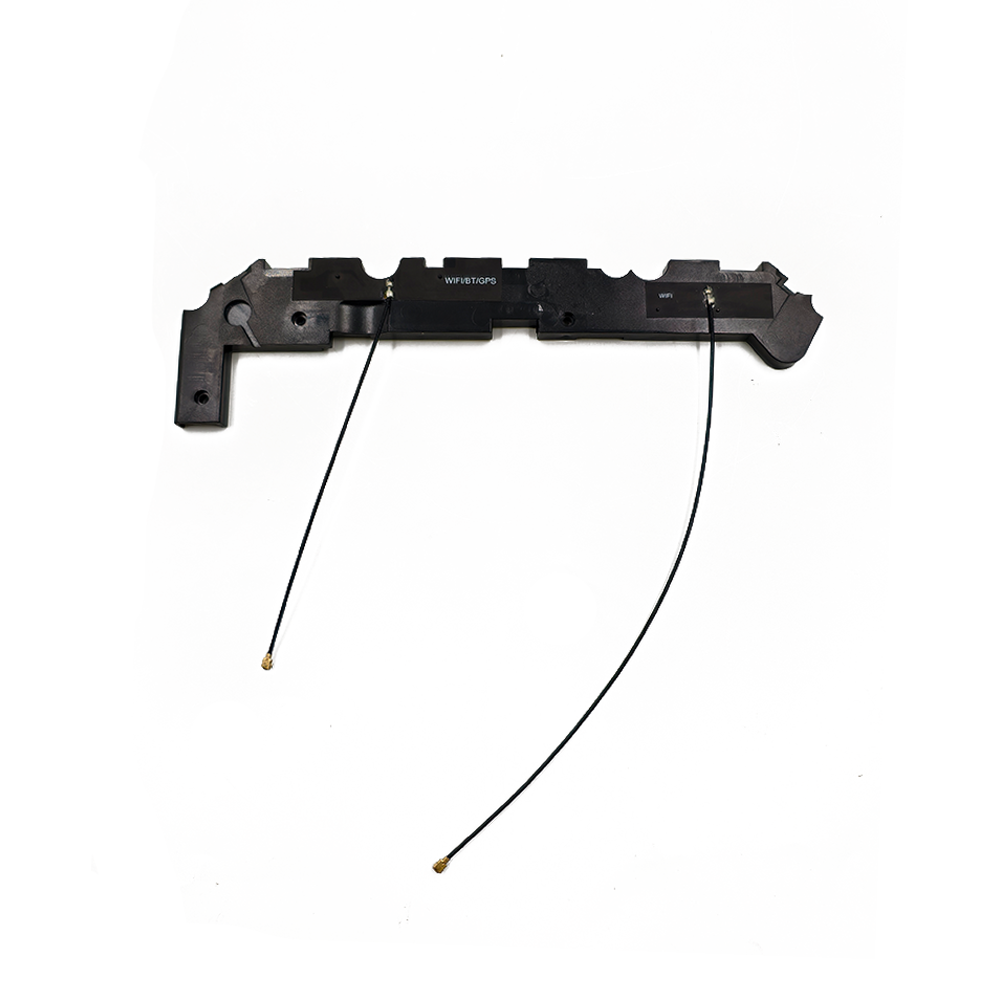
Radiation pattern is equally critical. For GNSS applications, a stable right-hand circular polarization (RHCP) pattern with a broad upper hemisphere coverage is essential for receiving signals from satellites positioned at various elevation angles. Circular polarization helps mitigate multipath interference—the phenomenon where satellite signals reflect off buildings, terrain, and other surfaces before reaching the antenna, causing positioning errors.
VSWR and Impedance Matching
Voltage Standing Wave Ratio (VSWR) is a measure of how well the antenna is impedance-matched to the transmission line. For IoT products, a VSWR below 2:1 is generally considered acceptable, though higher-performance designs target VSWR below 1.5:1 to minimize signal reflection and power loss.
Precise impedance matching is particularly challenging in combo antennas because the antenna must maintain good VSWR across multiple frequency bands simultaneously. Matching circuits using lumped elements (capacitors and inductors) are typically employed to optimize performance across the GNSS and Wi-Fi bands. Engineers should verify that the antenna's VSWR performance is specified in the final assembled enclosure, not just under ideal bench conditions, as the proximity of other components and the device housing can significantly affect impedance characteristics.
Isolation Between GNSS and Wi-Fi Elements
Antenna isolation is arguably the most critical parameter in combo antenna design. Poor isolation between the GNSS and Wi-Fi elements can lead to several problems: Wi-Fi transmission signals can desensitize the GNSS receiver, reducing positioning accuracy or preventing satellite acquisition altogether; conversely, GNSS signals can interfere with Wi-Fi data throughput.
Achieving high isolation in a compact form factor requires sophisticated design techniques. A recent study published in ETRI Journal demonstrated a novel decoupling loop structure that achieves minimum isolation of less than −20 dB between Wi-Fi antennas and a Bluetooth antenna operating in the 2.4 GHz band. The decoupling network consists of transmission lines and lumped elements (capacitors and inductors) that can be tuned to compensate for electromagnetic coupling between antenna elements.
In practical terms, designers should target at least −20 dB isolation between GNSS and Wi-Fi elements. Some high-performance designs achieve isolation better than −24 dB between GPS and Wi-Fi antenna structures at their respective operating frequencies. When isolation below approximately −20 dB, strong LTE-M/NB-IoT transmissions can raise the noise floor, forcing the modem to increase transmit power while simultaneously reducing GNSS receiver sensitivity.
Power Consumption and Active vs. Passive Design
Mini IoT GNSS WiFi antennas are available in both passive and active configurations. Passive antennas contain only the radiating element and rely on the receiver's front-end circuitry for signal amplification. They consume no additional power, making them ideal for battery-operated devices with strict power budgets.
Active antennas incorporate a low-noise amplifier (LNA) and often additional filtering within the antenna assembly. The LNA amplifies weak GNSS signals before they reach the receiver, improving sensitivity and enabling reliable positioning even in challenging signal environments. The trade-off is increased power consumption and cost.
Power consumption in active GNSS antenna modules varies considerably. The YIC51513PGMGGB GNSS antenna module, for example, consumes only 12 mA at 3.3 V, making it highly suitable for battery-powered wearable and tracking applications. For comparison, the Maxtena MEA-GNSS-LTE active antenna requires 3–5 V DC supply and consumes less than 9 mA, demonstrating that even active solutions can achieve excellent power efficiency.
Leading Mini IoT GNSS WiFi Antenna Solutions
Taoglas FXP30x and PC30x Series
Taoglas has established itself as a leading innovator in compact multi-radio antenna solutions. The FXP30x and PC30x series represent the company's latest achievement in integrating cellular, GNSS, and Wi-Fi connectivity into a single antenna component.
The series offers six antenna models across two form factors. The FXP30x series uses flexible polymer antenna technology with peel-and-stick adhesive backing, suitable for mounting on non-metal surfaces such as plastic or glass—ideal for tight or curved internal spaces in compact devices. The PC30x series employs a rigid FR4 substrate for mechanically stable mounting using adhesive or screws.
Three configuration variants are available in each family. The FXP301 and PC301 support cellular and GNSS, including L1, B1I, G1, and L-Band positioning. The FXP302 and PC302 combine cellular with Wi-Fi across 2.4 GHz, 5.8 GHz, and 7.125 GHz bands. The FXP303 and PC303 integrate cellular, GNSS, and Wi-Fi into a single antenna for fully connected devices.
These antennas are designed for space-constrained applications including asset tracking, telematics, electric mobility, smart agriculture, medical devices, industrial IoT, and wearables—all scenarios where multiple wireless standards must coexist within a limited footprint.
Quectel YEMD302L1A 3-in-1 Combo Antenna
Quectel's YEMD302L1A represents another compelling option for mini IoT GNSS WiFi antenna solutions. This versatile 3-in-1 combo antenna integrates 4G, Wi-Fi, and GNSS capabilities into a compact and durable design with flexible mounting options including magnetic, adhesive, or screw mounts.
The antenna supports 4G coverage across 700–960 MHz and 1710–2690 MHz bands for reliable mobile connectivity. Its Wi-Fi compatibility spans 2400–2500 MHz, 5150–5850 MHz, and 5925–7125 MHz, enabling full compatibility with Wi-Fi 7 for faster data transfer rates and stable connections. GNSS precision is provided through support for GPS, BeiDou, and GLONASS across the 1565–1606 MHz band.
Durability is a key strength of this antenna. It meets REACH, RoHS, POPs, and CE standards, with an IP67 waterproof rating, flame retardant UL 94 V-0 certification, and UV resistance per UL 746c f1. Applications include public safety, smart cities, fleet management, automotive vehicle tracking, and high-definition video streaming.
YIC51513PGMGGB Ultra-Low-Power GNSS Antenna Module
For applications where power efficiency is paramount, the YIC51513PGMGGB from Yuechung International Corp. offers an ultra-compact, low-power GNSS antenna module specifically optimized for wearable devices and IoT tracking applications. Measuring just 15.2 × 13 mm, this module integrates both a GNSS chipset and antenna into a single package, simplifying design for battery-powered projects.
The module supports GPS, GLONASS, BeiDou, Galileo, SBAS, and QZSS, delivering reliable multi-constellation GNSS performance with power consumption of only 12 mA at 3.3 V. Its cable soldering design provides greater flexibility for PCB layout and efficient assembly, making it an ideal choice for next-generation wearable and IoT devices.
Taoglas GVLB208 Series for High-Precision Positioning
When centimeter-level positioning accuracy is required, the Taoglas GVLB208 series delivers exceptional performance in an ultra-compact 20 × 20 × 8 mm footprint. This active and passive dual-band GNSS L1/L5 stacked patch antenna combines concurrent L1/L5 support with stable right-hand circular polarization, significantly reducing the impact of multipath interference for more reliable positioning in complex RF environments.
The single-feed architecture enables dual-band L1/L5 performance without the complexity of multi-feed designs, while its pin-mount configuration simplifies RF layout and integration. The antenna achieves peak gain of up to 1.5 dBi, approximately 50% efficiency across both bands, and an axial ratio of around 4 dB. Applications include autonomous delivery robots requiring seamless sidewalk navigation, UAVs, telematics systems, fleet and asset tracking, precision agriculture, and industrial IoT deployments.
How to Select the Right Mini GNSS WiFi Antenna for Your IoT Project
Defining Your Requirements
Selecting the optimal mini IoT GNSS WiFi antenna begins with a thorough assessment of your project requirements. Consider the following factors:
Frequency band requirements depend on your target markets and the wireless standards your device must support. If deploying globally, ensure the antenna covers all relevant GNSS constellations (GPS, GLONASS, Galileo, BeiDou) and Wi-Fi bands used in your target regions. For Wi-Fi 7 deployments, verify 6 GHz band support.
Form factor and mounting constraints will narrow your options significantly. Flexible FPC antennas offer the thinnest profiles and conformability for curved surfaces, while rigid PCB and ceramic antennas provide mechanical robustness for standard mounting. Surface-mount ceramic chip antennas like the Taoglas GWLA.01 are ideal when PCB real estate is at an absolute premium.
Power budget determines whether passive or active antenna configurations are appropriate. Battery-powered devices with limited energy capacity may benefit from passive antennas, while active antennas with integrated LNAs are necessary for reliable GNSS reception in challenging signal environments.
Environmental requirements including operating temperature range, ingress protection rating, and UV resistance must be considered for outdoor or industrial deployments. IP67-rated antennas are essential for applications exposed to moisture, dust, or harsh weather conditions.
Key Selection Criteria
When comparing candidate antennas, evaluate the following parameters carefully:
Isolation performance between GNSS and Wi-Fi elements should be at least −20 dB, with higher isolation values providing better coexistence and reduced interference. This is particularly important for devices that transmit Wi-Fi data frequently while maintaining continuous GNSS tracking.
VSWR should be specified as below 2:1 across all operating bands, with premium designs achieving below 1.5:1 for minimal signal reflection and maximum power transfer efficiency.
Gain and efficiency values should be sufficient for your link budget calculations. Remember that antenna gain measured in free space will be reduced by 1–2 dBi or more when installed inside a device enclosure, so select antennas with slightly higher gain specifications than your minimum requirements.
Ground plane requirements vary significantly between antenna types. Some ceramic chip antennas are designed to operate without a dedicated clearance area on the ground plane, simplifying PCB layout in extremely size-constrained designs. Others may require specific ground plane dimensions for optimal performance, typically at least a quarter-wavelength in the primary direction.
Connector type and cable length affect integration flexibility. Common options include I-PEX MHF I connectors with pre-attached micro-coax cables, or direct solder connections for SMD antennas. Cable routing is particularly important for FPC antennas with cables, as the cable itself acts as part of the antenna and must be routed carefully to avoid performance degradation.
Integration Best Practices
Successful antenna integration begins early in the design process—not as an afterthought. Follow these best practices to maximize performance:
Position antennas at the edge of the PCB with the ground plane extending away from the antenna. For chip antennas, ideally mount them at the center edge of the ground plane for optimal radiation characteristics.
Maintain adequate spacing between antennas if using multiple antenna elements. The distance between elements directly affects isolation performance. For GNSS and Wi-Fi antennas operating in close proximity, consider using decoupling structures or isolation enhancement techniques.
Keep the antenna close to the wireless module to minimize connecting trace length and reduce pick-up noise. Use a coplanar waveguide with sufficient ground vias along the transmission line length to maintain signal integrity and 50-ohm impedance.
Avoid placing antennas near metal components, batteries, or other conductive materials that can detune the antenna and degrade radiation efficiency. If metal components are unavoidable, choose antenna designs specifically optimized for operation near metallic surfaces.
Test and verify performance in the final assembled enclosure, not just on the bench. Antenna performance can shift significantly when the device housing, battery, display, and other internal components are present. Conduct passive and active testing using a network analyzer and anechoic chamber to confirm that VSWR, gain, efficiency, and isolation meet specifications.
Applications of Mini IoT GNSS WiFi Antennas
Asset Tracking and Fleet Management
Asset tracking represents one of the largest application segments for mini IoT GNSS WiFi antennas. These antennas enable tracking devices to report their precise location via GNSS while transmitting position data over Wi-Fi networks when available, reducing reliance on cellular connectivity and lowering operational costs. For fleet management, combo antennas support vehicle tracking, route optimization, and real-time logistics monitoring.
Quectel's YEMD302L1A, with its IP67 rating and support for 4G, Wi-Fi 7, and multi-constellation GNSS, is specifically designed for fleet management and automotive vehicle tracking applications.
Wearable Devices
Wearables including smartwatches, fitness trackers, and pet trackers demand the smallest possible antenna solutions with minimal power consumption. The YIC51513PGMGGB, measuring just 15.2 × 13 mm with 12 mA power consumption, exemplifies the type of solution required for these applications. Ultra-compact ceramic chip antennas like the Taoglas GWLA.01, at just 3.2 × 1.6 × 0.5 mm, enable GNSS and Wi-Fi connectivity in even the most space-constrained wearable designs.
Smart Agriculture and Environmental Monitoring
Precision agriculture relies on GNSS positioning for autonomous tractors, drones, and soil sensors, while Wi-Fi connectivity enables data upload from field-deployed devices to farm management systems. The Taoglas GVLB208 series, with its dual-band L1/L5 support and centimeter-level positioning capability, is well-suited for precision agriculture applications where accuracy is critical.
Industrial IoT and Smart Cities
Industrial IoT deployments often require robust, reliable connectivity in harsh environments. Combo antennas with IP67 ratings, wide operating temperature ranges, and high isolation between elements support applications ranging from factory automation and predictive maintenance to smart city infrastructure including intelligent lighting, traffic management, and environmental sensing.
Autonomous Vehicles and Robotics
Autonomous delivery robots, drones, and other robotic systems require precise positioning and reliable communication links. Dual-band GNSS antennas with L1/L5 support reduce multipath interference in urban environments, while Wi-Fi connectivity enables real-time telemetry and remote operation. The Taoglas GVLB208 series is specifically highlighted for autonomous delivery robots requiring seamless sidewalk navigation and precise drop-offs.
Emerging Trends and Future Developments
Wi-Fi 7 and Wi-Fi 6E Compatibility
The transition to Wi-Fi 7 (IEEE 802.11be) and Wi-Fi 6E introduces new frequency bands in the 6 GHz spectrum (5925–7125 MHz), requiring antennas to cover even broader frequency ranges. Quectel's YEMD302L1A already supports this expanded spectrum, demonstrating that combo antenna technology is keeping pace with evolving wireless standards.
Dual-Band GNSS for Enhanced Accuracy
The adoption of dual-band GNSS (L1/L5 or L1/L2) is accelerating, driven by the need for higher positioning accuracy in autonomous systems, precision agriculture, and advanced driver assistance systems (ADAS). Dual-band operation significantly reduces ionospheric delay errors and multipath interference, enabling decimeter-to-centimeter level accuracy.
Integration of Cellular Connectivity
The next frontier in mini antenna design is the integration of cellular connectivity alongside GNSS and Wi-Fi. Taoglas's FXP30x and PC30x series already demonstrate this capability, supporting cellular frequencies from 600 MHz to 8000 MHz while simultaneously providing GNSS and Wi-Fi connectivity. This three-in-one approach further reduces component count and simplifies RF front-end design for IoT devices that require ubiquitous connectivity.
Advanced Materials and Manufacturing
Emerging materials and manufacturing techniques are enabling even smaller and more efficient antenna designs. Low-Temperature Co-fired Ceramic (LTCC) technology allows the integration of antenna structures, matching networks, and even RF circuits into compact multilayer packages. Flexible polymer substrates enable conformal antennas that can be integrated into curved surfaces without performance degradation.
AI-Assisted Antenna Design
Artificial intelligence and machine learning are beginning to play a role in antenna design optimization. Tools like Ignion's Oxion™ AI-powered antenna integration platform help engineers achieve optimal performance with fewer design iterations by simulating and optimizing antenna placement, matching networks, and ground plane configurations.
The mini IoT GNSS WiFi antenna represents a critical enabling technology for the next generation of connected devices. By combining satellite positioning and wireless data connectivity in a single compact component, these antennas empower engineers to create smaller, more efficient, and more capable IoT products across virtually every industry vertical.
As wireless standards continue to evolve and device form factors shrink further, the demand for high-performance mini combo antennas will only intensify. Success in this domain requires careful attention to frequency coverage, isolation performance, power efficiency, and integration best practices from the earliest stages of product design.
Whether you are building asset trackers, wearables, smart agriculture sensors, or industrial IoT gateways, selecting the right mini GNSS WiFi antenna and integrating it properly within your device will determine the reliability, accuracy, and overall user experience of your connected product. By understanding the key technical specifications, evaluating leading solutions from manufacturers like Taoglas, Quectel, and YIC, and following proven integration guidelines, you can ensure that your IoT device achieves the robust, multi-protocol connectivity that modern applications demand.
Lucy Yang | lucy.y@toxutech.com
Dotty Zhao | sales04@toxutech.com
Global Business Director / Sales Team / Global Operations


 En
En Cn
Cn Korean
 Home >