

-
Products -PCBA Manufacturing RF Connectors RF Cable Assemblys Embedded Antennas External Antennas GNSS Positioning Solutions
RF Connectors

RF Cable Assemblys
Embedded Antennas
External Antennas
GNSS Positioning Solutions































 Language


Language


Time:2026-10-16 Views:0
Why Low Loss Custom FAKRA Assemblies Matter More Than Ever
Modern vehicles are no longer just mechanical systems—they are rolling data centers. A single premium automobile today can contain 8 to 12 FAKRA connections, each responsible for carrying a distinct RF service ranging from GPS navigation and satellite radio to 4G/5G cellular, V2X communication, and ADAS camera feeds. As the density of these high-frequency signals increases, the margin for signal degradation shrinks dramatically.
This is where low loss custom FAKRA assemblies become critical. A standard, off-the-shelf cable assembly may work on a bench test, but in the real world of engine vibration, temperature cycling, and tight routing constraints, even a fraction of a decibel of excess insertion loss can translate into dropped connections, degraded camera resolution, or warranty claims that surface months after installation.
This article provides a comprehensive technical guide to low loss custom FAKRA assemblies—covering cable selection, connector configurations, customization options, performance validation, and supplier evaluation—written for RF engineers, purchasing managers, and product designers working on automotive, telematics, and industrial RF systems.
What Is a FAKRA Connector? A Quick Technical Primer
FAKRA stands for Fachkreis Automobil, a German automotive standards body that developed this interface standard. A FAKRA connector is essentially a standardized coaxial connector comprising an SMB-style RF interface embedded within a color-coded plastic housing. The push-on coupling mechanism and mechanical keying system prevent mismating in dense harness environments, while the color codes provide instant visual identification of the signal type being carried.
FAKRA connectors operate at 50 Ohm impedance with a frequency range from DC up to 6 GHz for standard versions, and up to 15 GHz for Mini-FAKRA variants. The system meets or exceeds ISO 20860-1, SAE/USCAR-17, SAE/USCAR-18, and SAE/USCAR-2 specifications, making it the de facto RF interface standard for the global automotive industry.
Key performance characteristics of a well-designed FAKRA connection include:
Impedance: 50 Ohm nominal
Frequency range: DC to 6 GHz (standard FAKRA), DC to 15 GHz (Mini-FAKRA)
VSWR: Typically ≤ 1.4:1 to 2 GHz, with tighter specifications available
Operating temperature: -40°C to +125°C (connector-dependent)
Maximum current: 1 A per contact
However, the connector alone does not determine system performance. The cable assembly—the combination of connector, cable, and termination method—is what ultimately delivers (or destroys) signal integrity.
Low Loss: What It Actually Means in a FAKRA Assembly
“Low loss” is not a marketing buzzword—it is a quantifiable engineering parameter. Insertion loss in a FAKRA assembly has two components: cable attenuation and connector loss.
Cable Attenuation
Cable attenuation depends on the dielectric material, conductor construction, and cable diameter. For a typical PE-C100-LSZH low loss coaxial cable, the insertion loss at 1 GHz is approximately 0.24 dB per foot, rising to 0.87 dB per foot at higher frequencies. This is significantly lower than standard RG-174 or RG-316 cables, which exhibit higher loss per unit length due to their smaller conductor cross-sections and higher-loss dielectrics.
Connector Loss
Each FAKRA connector contributes approximately 0.1 dB to 0.2 dB of insertion loss. In a typical FAKRA-to-FAKRA assembly with two connectors, the total connector loss is therefore around 0.2 dB to 0.4 dB. While this may seem negligible, in a system with multiple in-line connections—common in automotive harness routing—these losses accumulate.
Why the Total Matters
A 0.5 dB insertion loss increase at the connector level translates to a reduced signal-to-noise ratio, which can manifest as video flickering in ADAS cameras, GPS positioning errors, or dropped cellular connections. For safety-critical applications such as autonomous driving and V2X communication, the stakes are even higher. Signal integrity is not a “nice-to-have”—it is a functional requirement.
A properly designed low loss custom FAKRA assembly minimizes both cable attenuation and connector loss through careful material selection, precision termination, and rigorous testing.
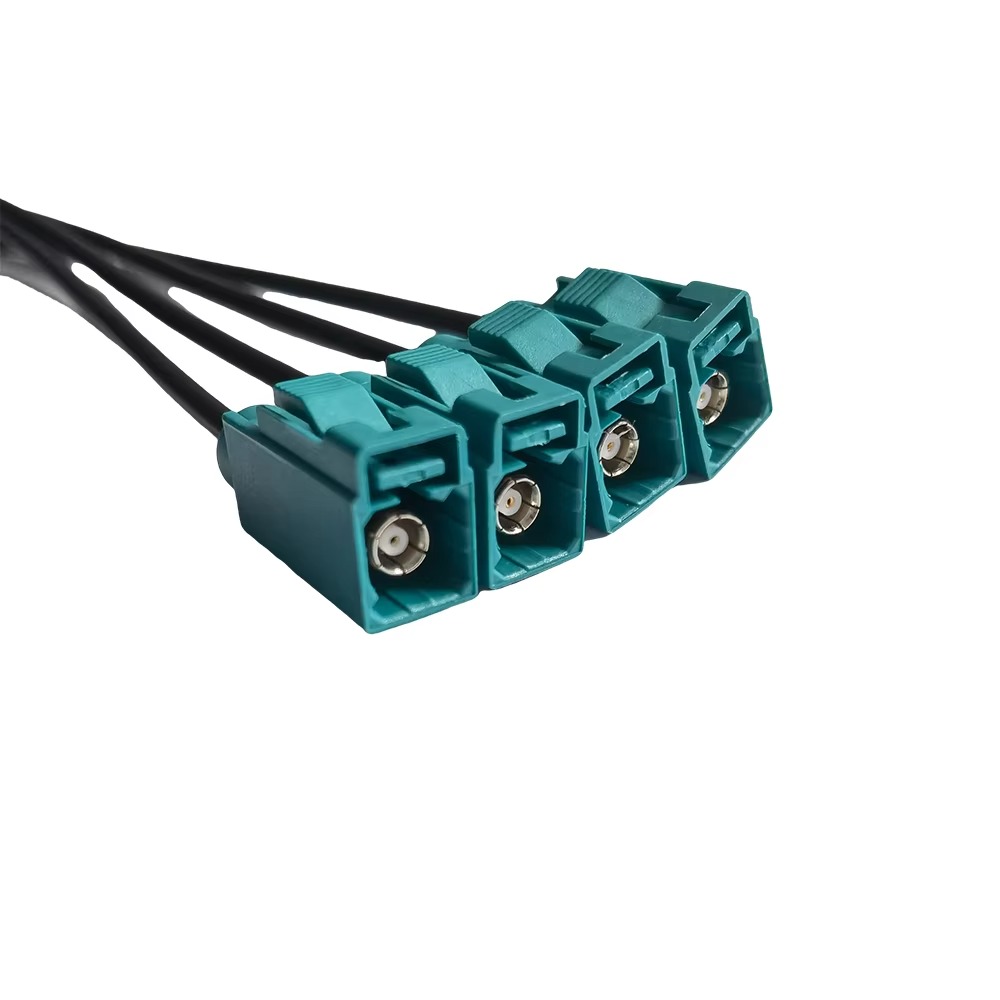
Cable Selection for Low Loss Custom FAKRA Assemblies
The cable you choose is the single largest determinant of your assembly’s insertion loss performance. Several cable types are commonly used in FAKRA assemblies, each with distinct trade-offs between loss, flexibility, cost, and durability.
RG-174 / RG-316: The Flexible Workhorses
RG-174 and RG-316 are the most common cables for short, flexible FAKRA runs. RG-174 is thinner and more flexible, making it suitable for tight routing in space-constrained areas such as behind dashboard panels. RG-316 offers better temperature resistance and slightly lower loss, making it a better choice for engine-adjacent applications.
However, both cables have relatively high attenuation compared to low loss alternatives. For runs longer than 1 meter, or for frequencies above 3 GHz, their performance becomes a limiting factor.
PE-C100-LSZH: The Low Loss Standard
PE-C100-LSZH is a low loss 50 Ohm coaxial cable that has become a preferred choice for high-performance FAKRA assemblies. Its construction features a solid copper-clad steel center conductor, PE dielectric, aluminum tape, and tinned copper braid, with a LSZH (Low Smoke Zero Halogen) jacket.
Key advantages include:
Double shielding for excellent RF isolation
66% velocity of propagation
RF shielding effectiveness exceeding 90 dB
Flexible with a bend radius suitable for automotive routing
At 1 GHz, PE-C100-LSZH exhibits insertion loss of approximately 0.24 dB/ft; at higher frequencies up to 4 GHz, this rises to 0.87 dB/ft.
LMR-100A: The High-Performance Option
LMR-100A is a low loss cable that offers even better attenuation characteristics than PE-C100-LSZH, particularly at higher frequencies. Its larger center conductor and improved dielectric construction reduce resistive and dielectric losses. FAKRA assemblies using LMR-100A coax are commonly specified for applications requiring maximum signal integrity, such as high-resolution camera links and radar sensor connections.
Custom Low Loss Corrugated Cables
For long antenna feeds or applications requiring extremely low loss over extended distances, custom low loss corrugated cables may be necessary. These cables feature a corrugated copper outer conductor and a low-density dielectric, achieving attenuation figures significantly below those of standard flexible cables. However, they are less flexible and require careful bend radius management during installation.
Selection Guide Summary
| Cable Type | Loss at 1 GHz | Flexibility | Best For |
|||||
| RG-174 | High | Excellent | Short camera links, tight routing |
| RG-316 | Medium | Good | Engine-adjacent, temperature-critical |
| PE-C100-LSZH | Low | Good | General low loss, high-frequency |
| LMR-100A | Very Low | Moderate | High-resolution video, radar |
| Custom low loss | Lowest | Limited | Long antenna feeds, critical links |
The right cable choice depends on your specific frequency range, routing distance, bend radius requirements, and environmental conditions. A reputable custom FAKRA assembly supplier will help you navigate these trade-offs.
Customization Options: Beyond Off-the-Shelf
The phrase “custom FAKRA assembly” encompasses far more than simply cutting a cable to length. True customization involves engineering the entire signal path—from the connector interface to the cable, the termination, and the environmental protection—to meet your specific system requirements.
Connector Configuration
FAKRA assemblies can be configured in several connector arrangements:
FAKRA plug to FAKRA jack (male to female): The most common configuration for extending an existing harness or connecting two modules
FAKRA plug to FAKRA plug: Used when both ends need to interface with panel-mount receptacles
FAKRA jack to FAKRA jack: For connecting two cable runs together
FAKRA to SMA, TNC, or other RF interfaces: For test equipment, lab setups, or hybrid systems
Each connector is available in straight or right-angle (90°) configurations. Right-angle connectors are essential when routing space is limited, such as behind head units or in camera modules.
Color Coding and Keying
FAKRA connectors are available in 14 different mechanical keying codes, each associated with a specific color and application. This prevents mismating in dense harness environments. Common codes include:
Code A (Black): Radio without phantom supply
Code B (Cream White): Radio with phantom supply
Code C (Signal Blue): GPS telematics or navigation
Code D (Claret Violet): GSM/cellular
Code E (Leaf Green): TV1/SDARS
Code Z (Water Blue): Neutral coding
When specifying a custom assembly, the correct keying code must be matched to the signal service. A GPS feed connected to an LTE port—caused by a color code error—will result in a system that appears functional on the bench but fails in the field.
Cable Length
Standard FAKRA assemblies are available in fixed lengths (typically 12 inches to 3 meters), but custom lengths are where the real engineering value lies. Whether you need a 47 mm jumper for a tightly packed module or a 4.5-meter antenna feed, custom length allows you to eliminate excess cable slack, reduce insertion loss, and optimize routing.
Environmental Protection
For exterior and underhood applications, IP67 overmolding is a critical customization option. Polyurethane or PVC overmold encapsulation seals the connector-cable junction against water, dust, and vibration, meeting ISO 20653 IP6K9K standards for automotive exterior mounting.
Additional customization options include:
Heat shrink booting for strain relief and identification
Custom labeling with part numbers, length, and date codes
Connector orientation/clocking for specific mating angles
Phase and delay matching for differential signal pairs
Performance Specifications and Standards
A low loss custom FAKRA assembly must meet stringent performance specifications to ensure reliability over the vehicle’s lifetime.
Electrical Performance
The key electrical parameters for FAKRA assemblies are:
VSWR (Voltage Standing Wave Ratio): A measure of impedance matching. Standard FAKRA assemblies achieve VSWR ≤ 1.4:1 to 2 GHz, with tighter specifications (≤ 1.3:1) available for high-performance assemblies
Insertion Loss: The signal power lost through the assembly. This is frequency-dependent and must be specified across the operating band
Return Loss: The inverse measure of VSWR, expressed in dB. FAKRA assemblies typically achieve return loss ≥ 18 dB
RF Shielding Effectiveness: Minimum 90 dB for double-shielded assemblies, ensuring minimal interference from external sources
Mechanical and Environmental Standards
FAKRA assemblies must comply with:
SAE/USCAR-17: Performance specification for automotive RF connector systems, including 14 mechanical keying codes
SAE/USCAR-18: Specification for high-speed data connectors
ISO 20860-1/2: International standard for 50 Ohm RF connection systems
USCAR-2: Performance specifications for automotive connector systems
IATF 16949: Quality management standard for automotive supply chains
Operating temperature range for the complete assembly is typically -40°C to +125°C, though the maximum temperature may be cable-dependent. Assemblies must withstand vibration, thermal cycling, and humidity exposure without degradation.
Custom FAKRA Assembly Manufacturing: What to Look For
Not all custom FAKRA assembly suppliers are created equal. The difference between a reliable 15-year harness and one that fails after six months often comes down to manufacturing precision and testing rigor.
Precision Crimping
The crimp connection between the cable center conductor and the connector contact is the most critical mechanical interface in the assembly. A poorly executed crimp introduces impedance discontinuity, which manifests as increased VSWR and insertion loss.
Leading manufacturers use automated crimping systems with real-time pull-force monitoring, achieving crimp height tolerances of ±0.02 mm and pull-force tolerances of ±0.01 mm. Every crimp is logged with force-displacement data for full traceability. This level of precision is not achievable with manual crimping tools.
100% RF Testing
Every custom FAKRA assembly should undergo 100% RF testing—not batch sampling. This means VSWR and insertion loss testing on every single assembly using calibrated vector network analyzers. The test should be performed to your frequency specification, not just a generic pass/fail criterion.
Typical VSWR targets for standard RG-174/RG-316 builds are < 1.5:1 at 1 GHz and < 2.0:1 at 6 GHz. For low loss PE-C100 or LMR-100A builds, tighter specifications are achievable.
Documentation and Traceability
Each assembly should ship with:
Test data: VSWR plot, insertion loss measurement, hi-pot result
Material certificates: Confirming compliance with RoHS, REACH, and automotive material specifications
Certificate of conformity: Documenting compliance with USCAR-17 or your specified standard
Serial-level traceability: From raw cable lot to finished assembly
This documentation is not bureaucratic overhead—it is your insurance policy. When a field failure occurs, traceability allows you to identify the root cause and implement corrective action quickly.
IP67 Overmolding Capability
If your application requires exterior or underhood mounting, your supplier must offer IP67 overmolding. This involves tooling investment (typically $1,500–$3,000 NRE) and specialized injection molding equipment. Not all custom FAKRA assembly manufacturers have this capability in-house. Verify before specifying.
Applications: Where Low Loss Custom FAKRA Assemblies Are Essential
ADAS and Autonomous Driving
Advanced Driver Assistance Systems rely on high-resolution cameras, radar, and LiDAR sensors that transmit large volumes of data in real time. A 4K surround-view camera generates data rates that demand exceptional signal integrity. Low loss FAKRA assemblies ensure that video feeds reach the processing unit without degradation.
Applications include front-view cameras, interior driver monitoring cameras, surround-view systems, night vision, and e-mirror systems.
Connected Vehicle and Telematics
Telematics Control Units (TCUs) manage 4G/5G cellular, V2X (Vehicle-to-Everything), Wi-Fi, Bluetooth, GPS/GNSS, and SDARS (satellite radio) connectivity. Each of these services requires its own FAKRA connection, and each has different loss and interference requirements. A custom FAKRA assembly tailored to each service ensures optimal performance.
Infotainment Systems
FM/DAB radio, gesture control, and in-vehicle entertainment systems all rely on FAKRA connections for antenna feeds. While infotainment is less safety-critical than ADAS, poor signal quality leads directly to customer dissatisfaction. Low loss assemblies ensure clear reception even in fringe coverage areas.
Industrial and Agricultural Equipment
FAKRA connectors are increasingly used in industrial wireless communication systems, AGVs (Automated Guided Vehicles), AMRs (Autonomous Mobile Robots), and agricultural equipment. In these environments, vibration, temperature extremes, and EMI are even more severe than in passenger vehicles.
The Future: Mini-FAKRA and Beyond
As automotive systems demand higher data rates and smaller form factors, Mini-FAKRA is emerging as the next-generation interface. Mini-FAKRA connectors support data transmission rates up to 20 Gbps and frequencies up to 9 GHz, while requiring 80% less installation space than standard FAKRA.
Mini-FAKRA assemblies achieve insertion loss ≤ 0.75 dB at 9 GHz and return loss ≥ 17 dB to 6 GHz. For applications requiring multiple high-speed links in a compact footprint—such as 4K camera modules and high-resolution displays—Mini-FAKRA is becoming the preferred solution.
However, standard FAKRA will remain relevant for years to come. The installed base of vehicles using standard FAKRA is enormous, and the connector’s proven reliability, broad availability, and cost-effectiveness ensure continued demand. Mini-FAKRA to standard FAKRA adapter assemblies are available to bridge the two generations.
Frequently Asked Questions
Q: What is the typical insertion loss of a low loss FAKRA assembly?
A: For a PE-C100-LSZH cable assembly, insertion loss is approximately 0.24 dB/ft at 1 GHz, plus about 0.1–0.2 dB per connector. A 1-meter FAKRA-to-FAKRA assembly with PE-C100-LSZH typically achieves < 1.0 dB total insertion loss at 1 GHz.
Q: Can I get a custom FAKRA assembly in a non-standard length?
A: Yes. Most reputable manufacturers offer custom lengths from a few centimeters to several meters. Custom length allows you to optimize routing and minimize excess cable loss.
Q: What is the difference between FAKRA and Mini-FAKRA?
A: Mini-FAKRA is approximately 80% smaller than standard FAKRA, supports higher frequencies (up to 15 GHz), and enables data rates up to 20 Gbps. It is designed for next-generation ADAS and high-resolution display applications.
Q: How do I choose the right color code for my application?
A: The color code corresponds to the signal service. Code C (blue) is for GPS, Code D (violet) is for cellular, Code A (black) is for radio without phantom power, and Code Z (water blue) is neutral. Your system architecture documentation should specify the correct code for each connection point.
Q: What testing should I require from my custom FAKRA assembly supplier?
A: Require 100% VSWR and insertion loss testing on every assembly, with test data shipped alongside the product. For automotive applications, insist on IATF 16949-compliant traceability and documentation.
A low loss custom FAKRA assembly is not merely a cable with connectors on both ends. It is a precision-engineered signal path that must deliver reliable RF performance across a wide frequency range, survive harsh automotive environments, and maintain integrity for the lifetime of the vehicle.
The key factors that determine assembly quality are cable selection, connector configuration, termination precision, environmental protection, and testing rigor. By understanding these factors and working with a manufacturer who demonstrates capability across all of them, you can specify a custom FAKRA assembly that meets your exact requirements—whether you are building ADAS camera systems, telematics modules, or industrial RF equipment.
As vehicle connectivity continues to advance toward higher frequencies and data rates, the demand for low loss, high-reliability FAKRA assemblies will only grow. Investing in the right assembly design and supplier partnership today will pay dividends in system performance, customer satisfaction, and long-term reliability tomorrow.
Lucy Yang | lucy.y@toxutech.com
Dotty Zhao | sales04@toxutech.com
Global Business Director / Sales Team / Global Operations


 En
En Cn
Cn Korean
 Home >