

-
Products -PCBA Manufacturing RF Connectors RF Cable Assemblys Embedded Antennas External Antennas GNSS Positioning Solutions
RF Connectors

RF Cable Assemblys
Embedded Antennas
External Antennas
GNSS Positioning Solutions































 Language


Language


Time:2026-10-15 Views:0
Why Industrial Custom Cable Harnesses Matter
Industrial custom cable harnesses are the nervous systems of modern manufacturing. They bundle conductors, connectors, terminals, and protective materials into a single engineered assembly that transmits power, control signals, and data between motors, sensors, actuators, controllers, and machine subsystems. Unlike consumergrade wiring, industrial harnesses must survive continuous vibration, extreme temperatures, chemical exposure, electromagnetic interference, and mechanical abrasion—often simultaneously, and often for decades.
The stakes are high. A failed harness in a robotic welding cell can halt an entire production line. In mining equipment, a single compromised connector can create a safety hazard in a confined underground environment. This is why industrial buyers increasingly move away from generic cables toward purposebuilt, drawingcontrolled harnesses that are validated against the specific demands of their application.
The global industrial wire harness market reflects this shift. Valued at US$13.52 billion in 2025, the market is projected to reach US$23.21 billion by 2034, growing at a CAGR of 6.2% during 2026–2034. Growth is driven by rising adoption of automation, robotics, connected machinery, and digitally controlled production systems across manufacturing, construction, mining, logistics, and process industries. Asia Pacific holds the dominant share, supported by manufacturing ecosystems in China, Japan, South Korea, India, and Taiwan, while North America and Europe see steady demand from smart manufacturing investments and industrial IoT deployments.
Industrial Cable Harness vs. Standard OfftheShelf Cables
The decision between an offtheshelf cable assembly and a custom industrial harness is not merely a cost calculation—it is a question of who controls the build specification and, by extension, the quality, traceability, and longterm supply security of the component.
Offtheshelf (OTS) cables offer speed and low unit cost. They are readily available, require no engineering involvement, and work well for standardized, lowcomplexity connections. However, their limitations become apparent in demanding industrial settings: they cannot accommodate custom routing, they offer limited environmental protection, and they may not meet the electrical or mechanical requirements of specialized equipment.
Custom industrial cable harnesses are engineered from a controlled drawing to match the exact routing, connector types, wire gauges, and labeling requirements of a specific machine or system. The engineering rule of thumb is straightforward: decide by drawing ownership. If you own or can create the control drawing, source the harness as a custom build. If you cannot, you are buying an inferredfit product, and incoming inspection becomes your only quality gate.
The comparison below captures the practical tradeoffs that procurement and engineering teams weigh when selecting a sourcing model for industrial harnesses:
| Attribute | Off‑the‑Shelf Cable | Custom Industrial Harness |
|---|---|---|
| Build Print | Manufacturer's catalog spec | Your controlled drawing |
| Components | Fixed catalog parts | Specified connectors, wire, terminals |
| Environmental Protection | Standard jacket, limited IP | Application‑specific (PUR, XLPE, IP67/69K) |
| Traceability | Minimal to none | Full lot traceability under IPC/WHMA‑A‑620 |
| Lead Time | Immediate | 2–6 weeks depending on complexity |
| Unit Cost | Lower at low volumes | Higher upfront NRE; competitive at volume |
| Best For | Simple, standardized connections | OEM equipment, legacy replacement, harsh environments |
Custom harnesses deliver several advantages that become decisive in industrial contexts: superior electrical performance through applicationspecific conductor and shielding selection, reduced installation complexity via prerouted and labeled assemblies, and improved reliability through validated crimp and termination processes.
Applications Across Industrial Sectors
Factory Automation and Robotics
Robotics and automation represent one of the fastestgrowing application segments for custom harnesses. Multiple sensors, motors, and controllers require consistent, highquality wiring under continuous motion. Preassembled harnesses with labeled connectors ensure fast installation, reliable routing along robot arms, and reduced wiring errors. Robot arm harnesses specifically combine multiple electrical wires, connectors, and protective materials into structured assemblies that transmit power, control signals, and data between controllers, motors, sensors, and endeffectors while withstanding continuous bending.
Factory floor environments suffer from intense electromagnetic interference (EMI), making shielded routing essential for sensors and automated actuators. Highamperage power and signal routing inside industrial control cabinets demands rugged construction, while servo motor feedback and encoder routing for multiaxis robotics requires precision data transmission under dynamic conditions.
Industrial Control Cabinets and PLC Systems
Programmable logic controller (PLC) systems, encoders, and industrial serial communication networks rely on harnesses with goldplated machined pins to ensure low contact resistance and reliable data transmission. Vibrationresistant connectivity—using secure stainless steel thumb screws and locking mechanisms—maintains stable electrical contact in highvibration manufacturing environments and automated machinery cells.
Heavy Machinery and Construction Equipment
Construction equipment, mining machinery, and heavy industrial vehicles operate in environments where dust, moisture, chemicals, and mechanical shock are constant threats. Industrial harnesses for these applications are designed to withstand vibration, heat, moisture, abrasion, chemicals, dust, and harsh operating conditions while maintaining machine uptime and simplifying maintenance.
Energy and Renewable Systems
From plant machinery to renewable energy installations, custom harnesses support power distribution and control across solar arrays, wind turbine systems, and energy storage infrastructure. Demand for harnessing solutions in these sectors is growing alongside the broader push toward electrification and energyefficient production infrastructure.
Key Components of an Industrial Cable Harness
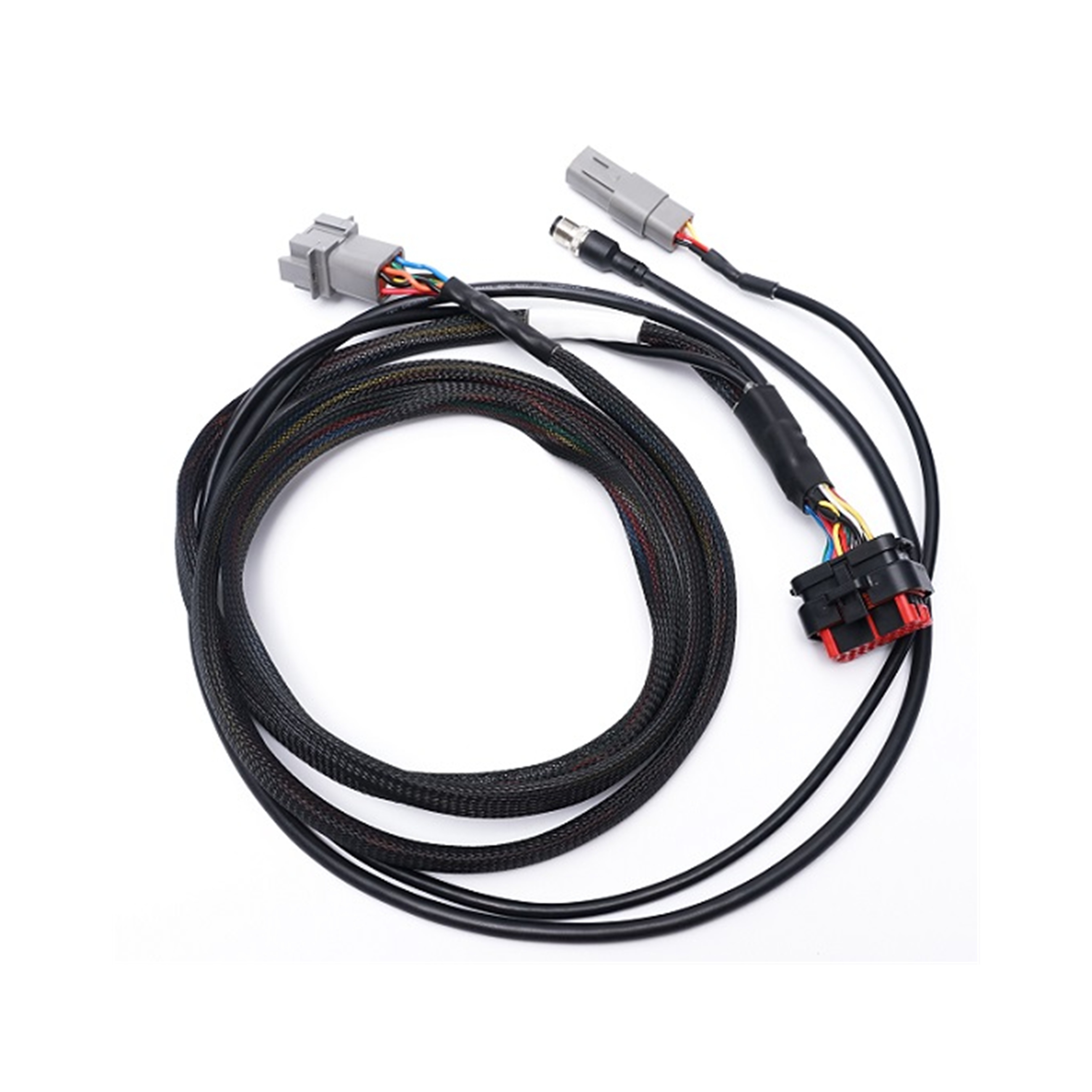
A wellengineered industrial harness comprises five core component categories, each selected based on the electrical, mechanical, and environmental demands of the application.
Conductors form the current and signalcarrying backbone. Bare copper or tinned copper is standard, with highpurity stranded copper preferred for flexibility in dynamic applications. Wire gauge selection follows the current load: AWG 18–30 for signal circuits, AWG 10–16 for power circuits in typical industrial applications. For applications requiring weight reduction, aluminum conductors are increasingly adopted, while optical fiber serves highspeed data transmission needs.
Terminals create the critical electrical interface between conductor and connector. The crimp quality determines longterm reliability. A properly executed crimp—validated through pullforce testing and crosssection analysis—prevents the two primary failure modes: excessive resistance (heat generation) and mechanical separation under vibration. Premium terminals use brass with gold plating (≥0.76 μm) to maintain contact resistance below 5 mΩ.
Connectors provide modularity, serviceability, and environmental sealing. Industrial connectors must match the application's IP rating, temperature range, and vibration profile. Common series include JST, Molex, and custom configurations; the selection must specify series, pin count, and locking mechanism. Connector housings are typically constructed from PBT, nylon, PTFE, or metal for heat, oil, and corrosion resistance.
Protective materials include insulation, jacketing, and shielding. PVC remains the most costeffective insulation for general industrial use, but XLPE (crosslinked polyethylene) is preferred for hightemperature applications, and PTFE (Teflon) is specified for chemical resistance. For EMI protection, foil shielding adds 10–15% to cost while braided copper shielding adds 20–30%. External protection options include PET braid sleeve, corrugated conduit, and heatshrink tubing.
Auxiliary components — cable ties, grommets, labels, and strain relief — ensure proper routing, identification, and mechanical protection. These elements are often overlooked but contribute significantly to installation efficiency and longterm reliability.
The Custom Harness Design Process
Designing an industrial custom harness follows a structured engineering workflow that begins with requirements and ends with a validated production drawing.
Step 1: Requirements Analysis
Engineers assess electrical and mechanical requirements, considering voltage, current loads, temperature ranges, and environmental constraints. This phase must explicitly define the "Big Three" specifications: electrical (voltage/current), mechanical (length/connectors), and environmental (temperature/IP rating). Vague requirements at this stage lead to either "No Bid" responses from manufacturers or inflated pricing to cover unknown risks.
Step 2: Component Selection
Based on the requirements analysis, engineers select conductors, connectors, terminals, and insulation materials. A critical consideration is avoiding singlesource niche components that require custom manufacturing runs. The practical rule: before designing in a connector, check distributor stock depth. If fewer than 1,000 units are available globally, the component poses a supply chain risk.
Step 3: Schematic and Wiring Diagram Development
A detailed schematic provides the conceptual electrical layout, while the wiring diagram specifies physical connections and integration points. Every drawing must include a Bill of Materials (BOM), a pinout table (netlist), and dimensional specifications. The pinout table should explicitly show every connection—never assume a 1to1 mapping unless stated.
Step 4: Harness Layout and Routing Design
The physical arrangement of wires and branches ensures optimal routing, flexibility, ease of installation, and proper strain relief. For dynamic applications, the minimum bend radius must be specified, and highflex cable constructions should be selected where continuous motion is expected. Length tolerances should be realistic: standard industry tolerance is ±1% for cables over 1 foot, with tighter tolerances (e.g., ±0.5 inches for cables under 1 foot) reserved for applications where physical fit truly demands it.
Step 5: Prototyping and Validation
A prototype is built and subjected to rigorous testing: electrical continuity, insulation resistance, highpotential (hipot) testing, pullforce testing on terminations, and environmental validation as required. For industrial applications, this may include vibration testing, temperature cycling, and IP rating verification.
Step 6: Production and Quality Control
Once the design is validated, production begins under strict quality controls. Automated wire processing ensures length tolerances as tight as ±0.5mm and consistent strip quality without nicking copper strands—a critical IPC620 requirement. Automated crimping stations apply 1 to 5 tons of force with sensormonitored crimp height, and every finished unit undergoes 100% electrical testing for continuity and correct pintopin mapping.
Quality Standards Governing Industrial Harnesses
IPC/WHMAA620: The Benchmark Workmanship Standard
IPC/WHMAA620 is the international standard prescribing practices and requirements for the manufacture of wiring harnesses and cable assemblies. It covers the methods, tests, and acceptability criteria for crimped, mechanically secured, and soldered interconnections, as well as related assembly activities including cable ties, measurement, and appearance. The current revision (Revision F, October 2025) supersedes Revision E and incorporates updated pullforce tables from UL, SAE, and IEC.
For industrial applications, IPC/WHMAA620 Class 2 is the standard for generalpurpose commercial and industrial products, while Class 3 applies to highreliability applications where continued performance is critical and equipment downtime cannot be tolerated.
ISO 9001 and ISO 14001
ISO 9001:2015 certification provides assurance that the manufacturer operates a documented quality management system subject to regular surveillance audits. ISO 14001 certification demonstrates environmental management commitment across material sourcing, production, and waste management.
UL Recognition
UL Recognized Component status for wiring harnesses (typically under a file number such as ZPFW2.E101874) indicates that the manufacturer's assemblies have been assessed for use in ULListed end products. UL assessors conduct unannounced quarterly inspections to verify ongoing compliance. For industrial equipment destined for the US or Canadian market, ULrecognized harness components may be a procurement requirement.
Environmental and Ingress Protection Ratings
Industrial harnesses must be specified with appropriate IP ratings that match the actual operating environment. IP67 provides protection against dust and temporary immersion, while IP69K is required for highpressure steam washdown applications common in food and beverage processing and pharmaceutical manufacturing. The rating must cover not just the operating environment but also the cleaning protocol the harness will experience.
Manufacturing Process: From Spool to Validated Assembly
Automated Wire Processing
Production begins with wire processing through fully automated machines (e.g., Komax or Schleuniger systems). The machine pulls wire from a master spool through a straightener, prints circuit identification markers directly onto the insulation, cuts to precise length, and strips the insulation with sensormonitored precision. A machine can process approximately 4,000 wires per hour with ±0.5mm length tolerance, compared to roughly 100 wires per hour with ±5mm tolerance for manual processing.
Termination and Crimping
Termination is the most critical step for electrical reliability. Semiautomatic crimp presses apply controlled force to create a gastight metallurgical bond between the wire strands and terminal. Before batch production, a destructive pull test is performed on a sample: the crimped terminal is pulled until it breaks, and the break force must exceed the minimum specified by UL 486A or the applicable IPC/WHMAA620 pullforce table.
Assembly and Routing
On the harness board, operators route wires according to the assembly drawing, attach connectors, apply protective sleeving, and secure the assembly with cable ties and mounting hardware. For complex harnesses with multiple branches, colorcoding and labeling systems prevent miswiring during both assembly and field installation.
Final Testing and Quality Assurance
Every finished harness undergoes 100% electrical testing, typically using a Cirris or equivalent continuity tester that verifies pintopin mapping, detects opens and shorts, and measures insulation resistance. For highreliability applications, hipot testing applies elevated voltage to verify dielectric strength. Lot traceability is maintained throughout: from the lot number on the wire spool to the operator ID at each assembly station, every component and process step is tracked.
Cost Factors and Procurement Strategy
Understanding the cost drivers of a custom industrial harness is essential for accurate budgeting and effective negotiation. Materials (wire, connectors, terminals, insulation, shielding) account for approximately 30–50% of total cost, while labor for assembly and testing contributes 25–45%. Tooling and NonRecurring Engineering (NRE) fees are onetime setup costs that amortize over production volume.
Reducing Cost Without Compromising Quality
Several levers can reduce harness cost without sacrificing reliability. First, standardize component selection around widely stocked, multisource parts. Second, avoid unnecessarily tight tolerances: demanding ±1mm on a 5meter cable drives up cost for no functional benefit. Third, consolidate harnesses where possible: combining multiple cable runs into a single assembly can reduce connector count, installation labor, and total weight. Fourth, negotiate volumebased pricing: most manufacturers accept orders from 100 pieces for simple assemblies and 500 pieces for complex harnesses, with significant price breaks above 1,000 units.
Lead Time and MOQ Considerations
Typical lead times for custom industrial harnesses are 7–10 days for samples and 25–35 days for production, depending on component availability. Manufacturers with flexible minimum order quantities enable prototyping and lowvolume production without prohibitive setup costs. Some suppliers accept MOQs as low as 5 pieces for engineering validation.
Supplier Evaluation Framework
A robust supplier evaluation should assess delivery performance, customization capability, and product specialization. Procurement best practices include requesting physical samples for continuity and crosstalk testing before committing to volume production, and conducting virtual audits through video walkthroughs of production lines, crimping stations, and testing benches.
Technology Trends Shaping Industrial Harness Design
HighSpeed Data Transmission
The convergence of power and data transmission is driving adoption of hybrid cable assemblies capable of carrying both power and highspeed communications in a single assembly. Industrial Ethernet, USBC, and Single Pair Ethernet (SPE) are increasingly integrated into harness designs. SPE supports data rates from 10 Mbps to 10 Gbps in a smaller, lighter interface, and enables simplified harness architectures that reduce labor and rework. Fiber optic interconnects are also gaining traction for highbandwidth industrial applications where electromagnetic immunity is critical.
Compact and HighDensity Designs
Manufacturers are focusing on compact, highdensity harness designs to improve machine uptime, simplify installation, reduce maintenance complexity, and support predictive diagnostics in industrial operations. This trend is particularly evident in robotics, where space constraints within articulated joints demand miniaturized yet robust wiring solutions.
SinglePoint vs. MultiPoint Shield Grounding
EMI shielding strategy has become a critical design decision. For lowfrequency analog signals (below 1 MHz), singlepoint grounding breaks the ground loop and prevents noise coupling. For highfrequency digital systems (above 1 MHz), multipoint grounding achieved through 360degree shield termination minimizes shield impedance and maximizes shielding effectiveness. Industrial harness designers must match the grounding strategy to the signal characteristics of the application.
Lightweight Materials
Weight reduction is a growing priority across industrial sectors, driven by energy efficiency goals and the need to reduce mechanical stress on moving components. Aluminum conductors and thinwall insulation are increasingly adopted where they can meet electrical and durability requirements.
What to Include in Your RFQ
To receive an accurate quote and a correct prototype on the first attempt, your RFQ package should include:
A 2D PDF assembly drawing showing overall dimensions, connector orientations, branch points, and bend radius requirements. A Bill of Materials (BOM) listing every component with manufacturer and part number, including terminals (which are often separate from connector housings). A pinout table (netlist) showing every electrical connection explicitly. Electrical specifications: voltage, current, signal type (power, analog, digital, highspeed data). Environmental specifications: operating temperature range, IP rating required, chemical exposure, UV exposure, flex requirements. Quantity and target lead time.
Manufacturers who receive a complete data pack can typically respond with DFM feedback and pricing within 24 hours. Incomplete submissions trigger engineering queries that delay the project by days or weeks.
Industrial custom cable harnesses are not commodity purchases—they are engineered components that directly affect equipment reliability, safety, and uptime. The decision to specify a custom harness over an offtheshelf alternative is validated when the application demands environmental protection beyond standard ratings, routing that cannot be achieved with catalog assemblies, or traceability that meets regulatory or customer audit requirements.
The sourcing process rewards thoroughness. A complete RFQ package, a supplier with verifiable IPC/WHMAA620 training and UL recognition, and a willingness to invest modest NRE for a controlled drawing all contribute to a harness program that delivers consistent quality at competitive cost. As industrial automation accelerates and equipment becomes more electrified and connected, the demand for purposebuilt harnesses will only grow—and the engineering organizations that treat harness design as a firstclass discipline will be the ones whose machines stay running.
Lucy Yang | lucy.y@toxutech.com
Dotty Zhao | sales04@toxutech.com
Global Business Director / Sales Team / Global Operations


 En
En Cn
Cn Korean
 Home >