

-
Products -PCBA Manufacturing RF Connectors RF Cable Assemblys Embedded Antennas External Antennas GNSS Positioning Solutions
RF Connectors

RF Cable Assemblys
Embedded Antennas
External Antennas
GNSS Positioning Solutions































 Language


Language


Time:2026-10-15 Views:0
The demand for simultaneous location tracking and wireless connectivity has never been greater. Whether you are designing a fleet telematics system, a smart home gateway, or an autonomous vehicle platform, you need hardware that can handle GPS positioning, WiFi data transmission, and Bluetooth communication—all at once. A GPS WiFi Bluetooth combo antenna solves this challenge by integrating multiple frequency bands into a single compact unit, eliminating the complexity of installing separate antennas for each technology.
This guide covers everything you need to know about multiband combo antennas: how they work, the key specifications to evaluate, application scenarios, selection criteria, installation best practices, and market trends shaping the future of antenna design.
What Is a GPS WiFi Bluetooth Combo Antenna?
A GPS WiFi Bluetooth combo antenna is a multiband RF antenna that consolidates GNSS (Global Navigation Satellite System) reception, WiFi (2.4 GHz and 5 GHz) connectivity, and Bluetooth communication into one physical housing. Instead of mounting three separate antennas on a vehicle roof or PCB, engineers can deploy a single integrated solution that reduces wiring complexity, saves physical space, and lowers overall system cost.
These antennas typically serve IoT devices, automotive telematics units, fleet management systems, smart home devices, and industrial routers. They combine passive and active antenna elements—GPS reception usually requires an active Low Noise Amplifier (LNA) with around 20 dB gain, while WiFi and Bluetooth elements operate passively.
The integration challenge is significant. When you pack a highpower cellular transmitter and a highly sensitive GPS receiver into the same housing, RF energy from one element can bleed over and blind the other—a phenomenon known as receiver desense. Premium combo antennas address this through strict spatial decoupling, heavy internal RF shielding, and highrejection SAW filters that block outofband interference.
How Combo Antenna Technology Works
Understanding the operating principles of a combo antenna helps you make better procurement and design decisions.
Frequency Band Separation
A typical GPS WiFi Bluetooth combo antenna covers three distinct frequency ranges:
GNSS band: 1575.42 MHz for GPS L1 (with ±3 MHz tolerance), and increasingly 1561–1602 MHz to support GLONASS, Galileo, and BeiDou
WiFi/Bluetooth 2.4 GHz band: 2400 to 2483.5 MHz
WiFi 5 GHz band: 4800 to 5825 MHz (covering both UNII1 and UNII3 ranges)
Some advanced models extend to 5.15–5.85 GHz to cover the full 5 GHz WiFi spectrum. The GNSS element uses RightHand Circular Polarization (RHCP) to match satellite signal characteristics, while WiFi and Bluetooth elements use linear polarization.
Active vs. Passive Elements
GPS reception in a combo antenna is almost always active, meaning it includes a builtin LNA to amplify weak satellite signals. A noise figure of 1.5 dB or lower is standard for quality units. The WiFi and Bluetooth elements are typically passive, relying on the host device's radio chipset for signal processing.
Isolation and Coexistence
The most critical design parameter is isolation between ports. When WiFi and Bluetooth share the 2.4 GHz band, they need internal arrangements to coexist without mutual interference. Industry best practice recommends a minimum isolation of 15 dB between any two antennas within the combo. For physically separated antennas in sharedground configurations, maintaining 20 dB isolation requires at least 105 mm of spacing. In integrated combo antennas, this isolation is achieved through spatial decoupling, filter networks, and careful ground plane design.
Key Specifications to Evaluate
When selecting a combo antenna for your project, these specifications determine realworld performance:
| Specification | Typical Value | What It Means |
|---|---|---|
| Frequency Range | 1575.42 MHz (GPS), 2400–2483.5 MHz (WiFi/BT), 4800–5825 MHz (WiFi 5G) | Must match your device's radio bands |
| Gain | 0–2 dBi (passive), 20 dB LNA (active GPS) | Higher gain improves range but may increase noise |
| VSWR | ≤1.5:1 (GPS), ≤2.5:1 (WiFi) | Lower is better; indicates impedance matching quality |
| Isolation | ≥15 dB between ports | Prevents receiver desense |
| Impedance | 50 Ohms | Standard for most RF systems |
| Power Handling | 10 W or higher | Critical for transmit-capable cellular bands |
| Efficiency | 40–70% | Affects overall radiated power |
| Operating Temperature | −40°C to +85°C | Vehicle-grade requirement |
| Ingress Protection | IP67 or higher | Essential for outdoor mounting |
Gain and Efficiency
Peak gains for GPS, WiFi 2.4 GHz, and WiFi 5 GHz in a typical threeport combo antenna are approximately 0.9 dBi, 4.0 dBi, and 3.5 dBi respectively, with corresponding maximum VSWR figures of 2.61:1, 1.5:1, and 2.0:1. Efficiency for embedded ceramic loop antennas can range from 58.94% to 67.63%, depending on the band and PCB environment.
Isolation and Desense Prevention
The GNSS Low Noise Amplifier must be protected by highrejection Dual SAW filters. These filters violently block outofband cellular noise, ensuring the GPS receiver maintains a pinpoint coordinate lock even while the LTE element broadcasts gigabytes of video telemetry. Without proper isolation, a 4G/5G transmission can completely blind the GPS ceramic patch sitting centimeters away.
Application Scenarios
Automotive Telematics and Fleet Management
Fleet tracking systems represent one of the largest markets for GPS WiFi Bluetooth combo antennas. A premium combo mushroom antenna consolidates 4G/5G LTE, WiFi, and multiband GNSS elements into one unified radome, requiring only a single throughhole installation. This singlehole approach slashes installation labor costs and eliminates multiple leak points that separate antennas would create.
Vehiclemounted combo antennas are used in emergency service vehicles, emergency service networks, autonomous vehicles, and remote monitoring applications such as buses and shipping port machines. The YB0027AA from Quectel, for example, is a 9in1 antenna that integrates one L1/L5 GNSS active antenna with eight 5G/4G MIMO antennas in a single housing, meeting the IP69K standard for protection against dust, high temperature, and water pressure.
IoT and M2M Devices
Connected edge devices increasingly need to perform multiple jobs at once. Each additional antenna, cable, or enclosure penetration increases mechanical complexity and creates more integration issues. Multiband chip antennas address this by providing a single surfacemount component that covers GNSS, Bluetooth, and WiFi frequencies. The GWLA.01 from Taoglas, for instance, is a ceramic loop antenna measuring just 3.2 × 1.6 × 0.5 mm that supports GPS L1/GALILEO at 1.5 GHz and Bluetooth/WiFi at 2.4 GHz.
Applications include smartwatches, fitness sensors, medical wearables, navigation devices, handheld terminals, gateways, and routers.
Smart Home and Consumer Electronics
WiFi 6E reference designs now mandate chip antennas in smart appliances. Bluetooth Low Energy has become the de facto protocol for smart watches and emerging medical wearables, with annual Bluetooth LE device shipments exceeding 1.8 billion in 2024. Tierone OEMs have standardized antenna layouts across product families, enabling economyofscale procurement and faster platform refresh cycles.
Autonomous Vehicles and ADAS
Automakers increasingly embed radar units behind headliners and dashboards. LTCC antennas are adopted in incabin ADAS radar modules because they withstand heat cycles and deliver stable gain at 76–81 GHz. These moves elevate chip antennas from discretionary items to safetycritical components governed by automotive PPAP and ISO 26262 workflows.
Selection Guide: How to Choose the Right Combo Antenna
Step 1: Match Frequency Bands to Your Region
GNSS should support multiconstellation GPS/Beidou/Galileo/GLONASS on the full L1 band for stable positioning. For WiFi, dualband 2.4 GHz + 5.8 GHz coverage is essential for onboard data transmission.
Step 2: Evaluate RF Performance
Look for VSWR ≤1.5 to reduce signal attenuation, high isolation between GNSS, 4G, and WiFi elements to avoid vehicle electronic interference, and an active GNSS module with low noise figure that works well in tunnels and urban canyons.
Step 3: Consider Environmental Durability
For automotive and outdoor applications, specify IP67 waterproof and dustproof housing with UV antiaging properties, a wide temperature range of −40°C to +85°C, and an antivibration internal structure for bumpy truck roads.
Step 4: Choose the Right Mounting Type
Shark fin 3in1 integrated antenna: Simplifies wiring and cuts assembly labor
3M adhesive lowprofile antenna: No drilling required for light delivery vans
Magnetic mount antenna: Temporary installation for rental fleets
Flange nut mount: Heavyduty solution for trucks and construction machinery
Step 5: Select Connector Types
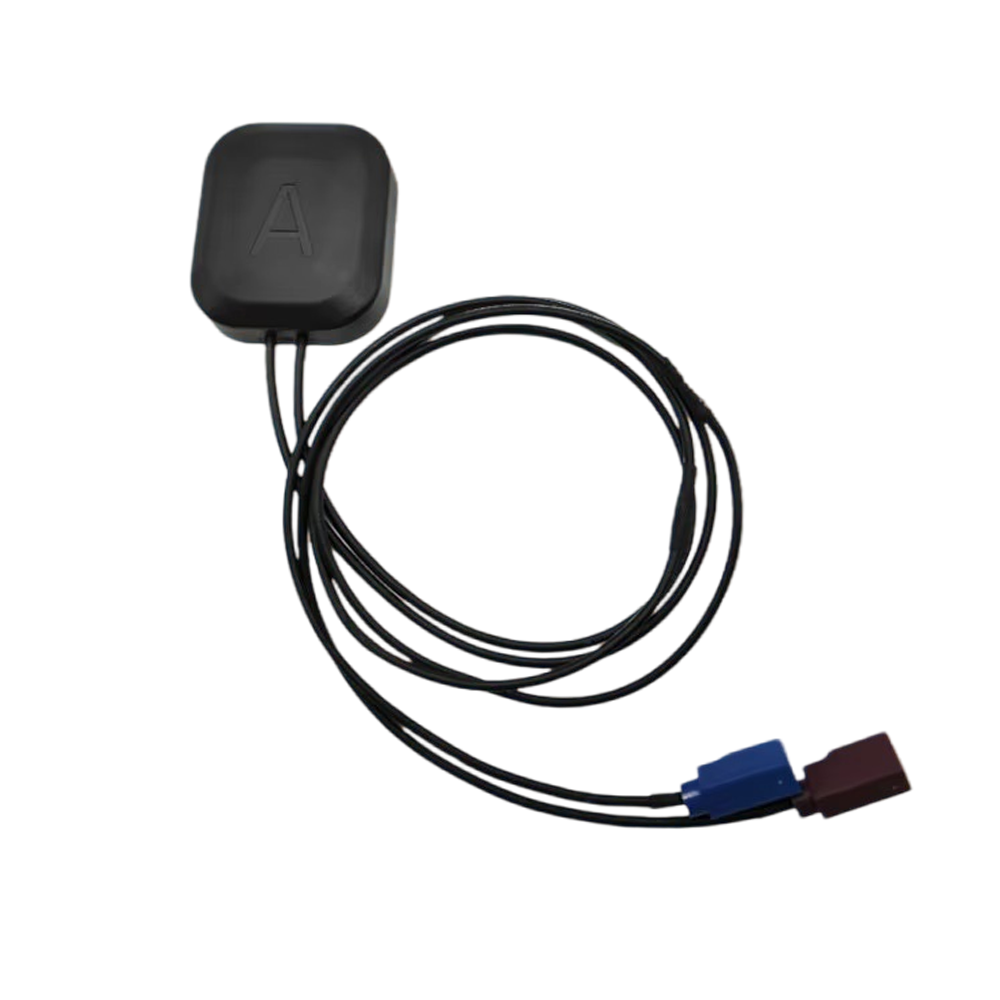
SMA, RPSMA, and FAKRA connectors are the most common options. FAKRA connectors offer a sturdy snapin connection that replaces traditional screwon SMA connectors and are optimized for automated manufacturing. MINI FAKRA connectors provide a compact solution for tight spaces, while MATEAX connectors support advanced automotive data transmission up to 15 GHz.
Installation Best Practices
Grounding and Ground Plane Design
Proper grounding is critical for combo antenna performance. The antenna requires a grounding pad for electrical connection to the application PCB. For twolayer PCBs of typical thickness (1.0 mm), the bottom ground layer can be continuous underneath the antenna pad, but the vertical spacing between pad and continuous ground planes should be at least 0.8 mm.
Cable Routing and Connector Torque
Use shielded lowloss cables and ensure proper torque on connectors. For Nconnectors, a torque of 0.6–0.9 Nm is recommended. Keep cable runs as short as possible to minimize signal loss.
Environmental Sealing
Every hole drilled into a vehicle cab is a potential point of failure for water leaks and structural rust. Secure the antenna with an oversized industrial EPDM gasket and a heavyduty threaded shank to create an impenetrable IP67 seal.
Testing and Validation
After installation, verify VSWR across all bands, confirm isolation between GNSS and WiFi ports, and test GPS acquisition time and accuracy under realworld conditions. For fleet applications, test with the vehicle's engine running to ensure no interference from the alternator or ignition system.
Market Trends and Future Outlook
The global chip antenna market was valued at USD 2.10 billion in 2025 and is estimated to grow to USD 5.88 billion by 2031, representing a CAGR of 18.72% during the forecast period. The broader wireless antennas in electronic devices market was valued at USD 597 million in 2025 and is forecast to reach USD 1,078 million by 2032, with a CAGR of 8.8%.
5G and 6G Integration
As 5G adoption accelerates, combo antennas are evolving to support more bands in smaller packages. The potential to design combo antennas is limited only by what can be fitted into the available space, and customers can choose from a range of cellular configurations.
Miniaturization and LTCC Technology
LTCC (LowTemperature CoFired Ceramic) antennas held 57.35% of the chip antenna market share, driven by their low loss tangent and dimensional stability. These attributes are critical for automotive radar modules and compact IoT devices.
Edge AI and MultiRadio Convergence
Private 5G industrial networks are driving sub6 GHz sensor demand, while WiFi 6E reference designs mandate chip antennas in smart appliances. The convergence of GNSS, WiFi, Bluetooth, and cellular into singlepackage solutions will continue to drive innovation.
Supplier Landscape
The combo antenna market features established players including Amphenol Procom, Molex, Skycross, Galtronics, Auden, Sunway, 2J Antennas, TE Connectivity, ISKRA, CTi, Taoglas, Panorama, and WAGO Corp. When evaluating suppliers, consider:
Technical support: Can they provide simulation data and custom tuning?
Certification: Do their products meet automotive PPAP and ISO 26262 requirements?
Customization: Can they adjust cable lengths, connector types, and frequency bands?
Production capacity: Can they scale to meet your volume requirements?
The global combo antenna market is segmented into 2in1, 3in1, and other configurations, with applications spanning communication, automotive, and other industries. Key regions include North America, Europe, AsiaPacific, South America, and the Middle East & Africa.
A GPS WiFi Bluetooth combo antenna is more than a convenience—it is a strategic component that reduces system complexity, lowers installation costs, and improves RF performance by eliminating the interference challenges of separate antennas. Whether you are building a fleet telematics platform, a smart home gateway, or an autonomous vehicle, selecting the right combo antenna requires careful attention to frequency bands, isolation, environmental durability, and mounting configuration.
As the chip antenna market races toward USD 5.88 billion by 2031, driven by 5G, IoT, and automotive ADAS adoption, combo antenna technology will continue to evolve toward higher integration, smaller footprints, and broader frequency coverage. Partnering with an experienced antenna manufacturer who understands your application's unique RF environment is the surest path to reliable, longterm connectivity performance.
Lucy Yang | lucy.y@toxutech.com
Dotty Zhao | sales04@toxutech.com
Global Business Director / Sales Team / Global Operations


 En
En Cn
Cn Korean
 Home >