

-
Products -PCBA Manufacturing RF Connectors RF Cable Assemblys Embedded Antennas External Antennas GNSS Positioning Solutions
RF Connectors

RF Cable Assemblys
Embedded Antennas
External Antennas
GNSS Positioning Solutions































 Language


Language


Time:2026-10-16 Views:0
Introduction: Why the Dual Band GNSS WiFi Antenna Matters
In the rapidly evolving world of IoT, autonomous vehicles, precision agriculture, and smart city infrastructure, the ability to simultaneously determine precise location and maintain reliable wireless connectivity is no longer a luxury—it is a fundamental requirement. The dual band GNSS WiFi antenna has emerged as a critical enabling technology that addresses this dual need within a single, compact form factor.
Traditional antenna deployments required separate components: one antenna for satellite positioning and another for WiFi communication. This approach increased bill-of-materials costs, complicated system integration, and introduced cross-frequency interference risks. The dual band GNSS WiFi antenna solves these challenges by integrating both functions into a unified design, delivering high-precision positioning alongside robust wireless data transmission.
This comprehensive guide explores the technical foundations, frequency band architecture, application scenarios, selection criteria, and market trends surrounding dual band GNSS WiFi antennas. Whether you are an RF engineer designing a fleet telematics system, a procurement specialist sourcing antennas for a smart city project, or a product manager evaluating connectivity options, this article provides the actionable insights you need.
What Is a Dual Band GNSS WiFi Antenna?
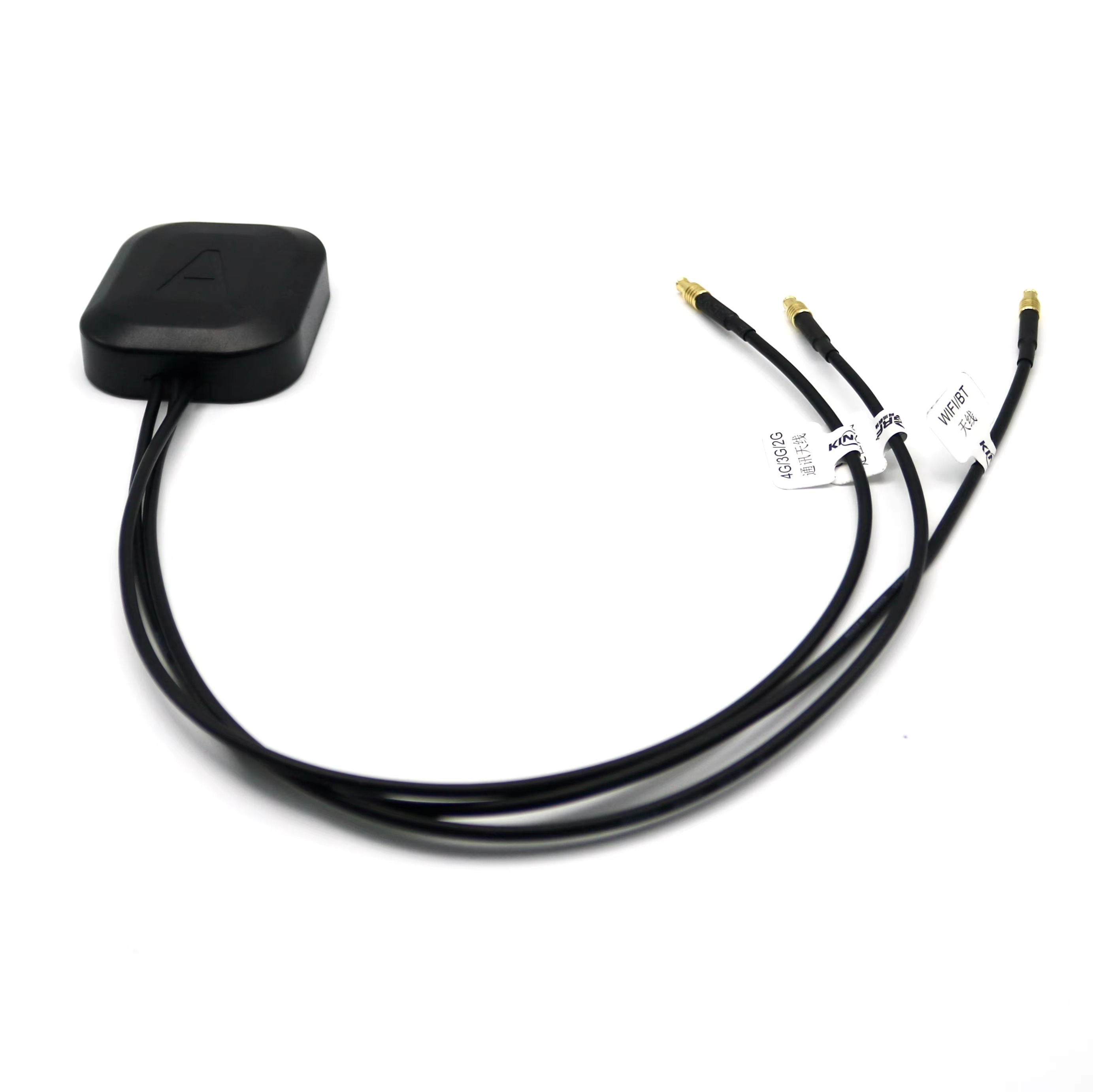
A dual band GNSS WiFi antenna is an integrated RF component that combines two distinct frequency capabilities: dual-band GNSS reception for satellite-based positioning and dual-band WiFi operation for wireless data communication. The term “dual band” in this context typically refers to the antenna's ability to operate across two frequency ranges within each function—for GNSS, this often means L1 and L5 (or L1 and L2); for WiFi, it encompasses both the 2.4 GHz and 5 GHz bands.
The fundamental architecture of such an antenna involves multiple radiating elements housed within a single radome or embedded package. Each element is tuned to its respective frequency range, and diplexers or multiplexers are employed to route signals to the appropriate receiver circuitry without mutual interference. This frequency-domain multiplexing ensures that incoming GNSS signals can be received and routed separately from WiFi data, preserving signal integrity for both functions.
The integration of GNSS and WiFi into a single antenna represents more than mere convenience. It eliminates the need for multiple mounting holes, reduces cable complexity, and streamlines production quality control. In environments where space is at a premium—such as vehicle rooftops, UAV airframes, or compact IoT gateways—this consolidation is not just beneficial but essential.
Understanding GNSS Frequency Bands: L1, L2, and L5
To appreciate the value of a dual band GNSS antenna, one must first understand the satellite navigation frequency landscape. GNSS constellations—including GPS (United States), GLONASS (Russia), BeiDou (China), Galileo (European Union), QZSS (Japan), and NavIC (India)—transmit signals across several frequency bands in the L-band spectrum.
The L1 Band (1575.42 MHz)
The L1 band is the primary frequency for most global navigation systems. GPS L1, Galileo E1, BeiDou B1C, and QZSS L1 all operate in the vicinity of 1575.42 MHz. This band has been the backbone of civilian satellite navigation since the inception of GPS, offering broad compatibility and mature receiver ecosystem support.
The L2 Band (1227.60 MHz)
The L2 band, centered at 1227.60 MHz, serves as a secondary frequency that enhances positioning accuracy. By receiving signals on both L1 and L2, a dual band GNSS antenna enables receivers to correct for ionospheric delay—a major source of positioning error in single-frequency systems. The dual-frequency approach allows for the calculation of total electron content along the signal path, significantly improving horizontal accuracy.
The L5 Band (1176.45 MHz)
The L5 band represents the most modern GNSS frequency, offering higher signal power and improved resistance to multipath interference. GPS L5, Galileo E5a, and BeiDou B2a all utilize this band. L5 signals benefit from a wider bandwidth and advanced modulation schemes, making them particularly valuable in urban canyons and other challenging environments where signal reflection and attenuation are common.
Dual Band Configurations
A dual band GNSS antenna typically supports two of these three bands. The most common configurations are L1+L2 and L1+L5. The L1+L5 combination has gained particular traction in recent years, as L5's superior signal characteristics complement L1's broad constellation support. For applications requiring the highest level of accuracy—such as RTK (Real-Time Kinematic) surveying or autonomous vehicle navigation—multi-band antennas covering L1, L2, and L5 are increasingly specified.
The Siretta Echo 52, for example, is an embedded multi-band GNSS antenna that delivers high-accuracy positioning across L1 (1575 MHz), L2 (1227 MHz), and L5 (1176 MHz) bands, supporting GPS, Galileo, BeiDou, QZSS, and NavIC constellations. Its stacked ceramic patch structure and two-stage LNA provide strong RHCP gain with excellent axial purity, yielding robust performance even in low-signal or multipath environments.
WiFi Frequency Bands: 2.4 GHz and 5 GHz
The WiFi component of a dual band GNSS WiFi antenna operates across two distinct frequency ranges, each with its own characteristics and use cases.
The 2.4 GHz Band
The 2.4 GHz ISM band (typically 2.4–2.5 GHz) is the most widely used WiFi frequency globally. Its longer wavelength provides better penetration through walls and obstacles, making it ideal for broad coverage applications. However, the 2.4 GHz band is also heavily congested, shared by Bluetooth, Zigbee, and countless other wireless devices.
The 5 GHz Band
The 5 GHz band (4.9–6 GHz, extending to 7.2 GHz in WiFi 6E and WiFi 7 implementations) offers significantly more available spectrum and higher data throughput. While its shorter wavelength limits range and obstacle penetration compared to 2.4 GHz, the 5 GHz band is essential for high-bandwidth applications such as video streaming, real-time data uploads, and large file transfers.
Modern dual band GNSS WiFi antennas often support MIMO (Multiple-Input Multiple-Output) configurations for WiFi, with two or more independent WiFi elements operating concurrently across both bands. The Mobile Mark LTMG504, for instance, provides four WiFi connections for MIMO operation across 2.4–2.5 GHz and 4.9–6 GHz, alongside a separate GNSS connection covering 1561, 1575, and 1602 MHz. All five connections terminate with SMA plugs, and a metal ground plane is recommended for optimal performance.
The Poynting MIMO-4-15 takes this integration further, housing two cellular MIMO antennas, two dual-band WiFi antennas, and a GPS/GLONASS antenna in a single enclosure. Its dual-band 2×2 MIMO WiFi antennas support concurrent 2.4 GHz and 5–7.2 GHz operation for improved wireless performance.
How the Dual Band GNSS WiFi Antenna Works
The engineering behind a dual band GNSS WiFi antenna involves careful management of multiple frequency bands within a shared physical structure.
Diplexer-Based Signal Routing
A typical implementation uses diplexers to separate GNSS and WiFi signals at the antenna output. Each diplexer is configured to implement frequency-domain multiplexing, allowing the antenna to support WiFi frequency communications while ensuring incoming GNSS signals are received and routed separately from WiFi data. WiFi signals are directed to the WiFi modem, while GNSS data is routed to a low-noise amplifier before reaching the GNSS receiver.
Variable Power Combining and Phase Shifting
In more sophisticated designs, multiple multiband antennas are used in conjunction with variable power combiners and phase shifters to optimize GNSS reception. A variable combiner can offset the detuning effects of one or both antennas based on the device environment, while a variable phase shifter steers the GPS reception pattern skyward based on device orientation. An orientation-measurement unit—incorporating accelerometers, gyroscopes, or gravitometers—provides the data needed for this adaptive beam steering.
Ceramic Patch and Stacked Structures
For GNSS elements, stacked ceramic patch structures are common. These use high-dielectric ceramic substrates to reduce physical size while maintaining performance. The stacked configuration allows multiple frequency bands to be served by a single compact package. Ground-plane independence is a key feature of modern designs, enabling the antenna to perform consistently even when mounted on surfaces with varying conductive properties.
Active Amplification
Most dual band GNSS WiFi antennas incorporate active amplification for the GNSS path. A typical two-stage low-noise amplifier (LNA) provides strong signal reception with a noise figure of ≤1.3 dB, ensuring that the weak satellite signals are adequately boosted before transmission through lossy coaxial cables to the receiver. The Mobile Mark LTM2900 Series, for example, includes a built-in GNSS amplifier with a gain of 26 dB, requiring a DC supply of 2.7 to 5 V and consuming less than 20 mA.
Key Specifications to Evaluate
When selecting a dual band GNSS WiFi antenna, several technical specifications demand careful consideration.
Frequency Coverage
The antenna must cover the specific GNSS bands required by your application's constellation strategy. For basic positioning, L1 coverage suffices. For improved accuracy, L1+L2 or L1+L5 is necessary. For RTK and high-precision applications, L1+L2+L5 coverage is recommended. On the WiFi side, ensure support for both 2.4 GHz and 5 GHz bands, with consideration for WiFi 6E and WiFi 7 compatibility in next-generation deployments.
Gain and VSWR
Gain is typically expressed in dBi (decibels relative to isotropic) for passive antennas or dB for active amplifier gain. GNSS gain for embedded antennas typically ranges from 2 to 5 dBiC (circular polarization), while active gain can reach 25–28 dB. VSWR (Voltage Standing Wave Ratio) should be as low as possible, ideally below 2:1, to minimize signal reflection and power loss.
Polarization
GNSS signals are right-hand circularly polarized (RHCP), and the antenna should match this polarization to maximize signal reception. WiFi signals, by contrast, typically use linear polarization. A well-designed dual band GNSS WiFi antenna manages both polarization requirements within its multi-element architecture.
Impedance and Connectors
The standard impedance for both GNSS and WiFi antenna systems is 50 ohms. Connector types vary by application: SMA is common for external antennas, while U.FL/MHF1 is typical for embedded designs. Cable length and type (e.g., 1.13 mm mini coax) also affect performance and should be specified according to installation requirements.
Environmental Ratings
For outdoor deployments, IP67 or IP68 ratings are essential. The LTM2900 Series, for example, carries an IP69K rating for high-pressure jet washing resistance, making it suitable for heavy machinery and commercial vehicle applications. Operating temperature range should cover at least -40°C to +85°C for industrial and automotive use.
Isolation and Interference
When GNSS and WiFi elements share a common housing, isolation between the two paths is critical. Poor isolation can cause WiFi transmissions to desensitize the sensitive GNSS receiver. Look for antennas with specified isolation figures (typically >20 dB) and consider the use of shielding and filtering in the system design.
Applications and Use Cases
The dual band GNSS WiFi antenna serves a remarkably diverse range of applications, unified by the need for combined positioning and wireless connectivity.
Fleet Management and Telematics
Commercial fleet operators rely on dual band GNSS WiFi antennas for vehicle tracking, route optimization, and driver behavior monitoring. These systems require continuous, accurate location data from GNSS, combined with reliable WiFi or cellular backhaul for uploading telemetry data to cloud platforms. The Mobile Mark LTM2900 Series is specifically designed for fleet management and telematics systems, supporting Wi-Fi 6E and Wi-Fi 7 for onboard high-bandwidth applications alongside multi-constellation GNSS operation.
Autonomous Vehicles and Robotics
Autonomous ground vehicles, drones, and mobile robots depend on high-precision GNSS for navigation and positioning, while simultaneously requiring WiFi connectivity for remote operation, sensor data offloading, and fleet coordination. The combination of dual band GNSS (L1+L5) and dual band WiFi enables these platforms to achieve centimeter-level positioning accuracy while maintaining robust command and control links.
Precision Agriculture
Modern precision agriculture leverages GNSS-guided tractors, harvesters, and drones to optimize planting, spraying, and harvesting operations. RTK-level positioning requires multi-band GNSS reception, while WiFi connectivity facilitates data transfer between field equipment and farm management systems. Dual band GNSS WiFi antennas are increasingly standard equipment on agricultural machinery.
Smart Cities and Infrastructure
Smart city deployments—including intelligent traffic systems, smart lighting, environmental monitoring, and public safety networks—require distributed sensors and controllers with both location awareness and wireless connectivity. Dual band GNSS WiFi antennas provide the positioning and communication foundation for these applications, often in combination with cellular backhaul.
Surveying and Mapping
Geodetic surveying and mapping applications demand the highest levels of positioning accuracy. Multi-band GNSS antennas covering L1, L2, and L5, combined with WiFi for data transfer to field controllers, form the core of modern surveying equipment. The Siretta Echo 52, with its compact 25×25×12.5 mm embedded ceramic design and ground-plane independence, is ideally suited for high-precision GNSS receivers and RTK modules in portable surveying equipment.
Public Safety and Emergency Services
Land mobile radio systems, emergency response vehicles, and disaster management networks rely on dual band GNSS WiFi antennas for location tracking and communication. The LTMG312 from Mobile Mark is optimized for P25 radio systems and public safety communications, providing integrated tracking and data transmission for commercial fleets.
Industrial IoT Gateways
Industrial gateways that bridge field devices to cloud platforms frequently require both positioning and local wireless connectivity. Triple-combo antennas integrating GNSS, cellular, and WiFi are becoming the standard for these applications, reducing installation complexity and improving reliability.
Market Trends Driving Adoption
The global antenna market is undergoing significant transformation, with multi-band combo integration emerging as a dominant trend.
Market Growth
The global GNSS antenna and GPS antenna market was estimated at USD 5,320 million in 2025 and is projected to grow at a compound annual growth rate of 4.60% during the forecast period. The high-precision GNSS antenna segment specifically was valued at USD 1,426.61 million in 2025, with a projected CAGR of 6.40%. More broadly, the global wireless antennas in electronic devices market is forecast to grow from USD 597 million in 2025 to USD 1,078 million by 2032, representing a CAGR of 8.8%.
Miniaturization
Modern IoT hardware is increasingly compact, with trackers, sensors, drones, and smart locks offering limited internal space for RF components. High-dielectric ceramic substrates cut antenna size by 40% without performance loss, while stacked patch GNSS antennas measuring just 20×20×8 mm support GPS, BeiDou, Galileo, and GLONASS. Flexible FPC antennas (19×8 mm) fit curved shells and narrow PCB gaps, expanding design possibilities for compact devices.
Multi-Band Combo Integration
Multi-band combo antennas, integrating multiple frequencies in one high-isolation housing, are mainstream in 2026. Popular configurations include GNSS+4G/5G dual combo for vehicle telematics, GNSS+cellular+WiFi triple combo for industrial gateways, and all-in-one antennas for heavy machinery. These antennas cut BOM and assembly costs, simplify layout, suppress interference, and streamline production—one mounting hole replaces multiple, and unified cables ease quality control.
A European fleet client reported 32% lower BOM costs, 70% less assembly time, and failure rates dropping from 18% to below 3% after 12-month testing with integrated combo antennas.
High Waterproof and Ruggedization
Over 60% of IoT equipment is outdoor-deployed—trucks, marine vessels, agricultural machinery, smart meters—and ordinary IP65 antennas fail against heavy rain, salt spray, UV radiation, and extreme temperatures after 1–2 years. Buyers increasingly prioritize IP67/IP68/IP69K waterproof antennas, with UV-stabilized shells, anti-salt-spray bases, and wide temperature resistance becoming standard requirements.
Selection Guide: Choosing the Right Antenna
Step 1: Define Your Positioning Accuracy Requirements
If your application requires only basic location awareness (e.g., asset tracking at the city-block level), a single-band L1 GNSS antenna may suffice. For meter-level accuracy, L1+L5 dual band is recommended. For decimeter or centimeter-level accuracy—required for RTK, autonomous navigation, or surveying—a multi-band antenna covering L1, L2, and L5 is necessary.
Step 2: Determine Your WiFi Requirements
Consider the data throughput and range requirements of your application. For low-bandwidth telemetry, 2.4 GHz alone may be adequate. For high-definition video streaming or large file transfers, dual band WiFi with 5 GHz support is essential. If MIMO operation is required for throughput or reliability, select an antenna with multiple WiFi elements.
Step 3: Evaluate Environmental and Mechanical Constraints
Outdoor applications demand IP67 or higher ratings. Vehicle-mounted antennas must withstand vibration, temperature extremes, and UV exposure. Embedded designs require compact form factors with ground-plane independence. Consider mounting options: screw mount, adhesive mount, magnetic mount, or through-hole mount, each with different installation requirements.
Step 4: Assess System Integration Requirements
Review connector types, cable lengths, and power supply requirements. Active GNSS antennas require DC power (typically 2.7–5 V) and must be compatible with the receiver's bias-tee or power injection scheme. Ensure that the antenna's gain and noise figure align with the receiver's sensitivity specifications.
Step 5: Consider Future-Proofing
WiFi 6E and WiFi 7 are extending WiFi operation into the 6 GHz and 7.2 GHz bands. If your product roadmap includes next-generation WiFi, select an antenna that supports these extended frequency ranges. Similarly, consider whether future GNSS constellations or signals (e.g., L-Band corrections, NavIC) may require additional frequency coverage.
Installation Best Practices
Proper installation is critical to achieving optimal performance from any dual band GNSS WiFi antenna.
Clear Sky View
GNSS antennas require an unobstructed view of the sky to receive satellite signals effectively. Install the antenna as high as possible (recommended >2 meters for fixed installations) and ensure a clear view down to the horizon. Avoid placement near tall buildings, metal structures, trees, or water surfaces that can cause multipath reflections.
Ground Plane Considerations
Adequate ground plane is essential for GNSS antenna performance. The minimum recommended ground plane radius is 60 mm. For vehicle installations, the vehicle roof itself often serves as an effective ground plane. Metal ground planes improve antenna directivity and reduce interference from below.
Separation from Interference Sources
Maintain physical separation between the GNSS antenna and powerful RF emitters such as cellular transmitters, high-current wiring, and other antennas. For combined GNSS/WiFi antennas, ensure adequate isolation between elements within the antenna and consider additional filtering if WiFi transmit power is high.
Level Mounting and Stability
Mount the antenna level with respect to the ground and secure it firmly to prevent movement or vibration. For vehicle applications, the best placement is typically on the roof, centered as close to the vehicle's center as possible. For RTK and surveying applications, antenna center must align with the reference mark, and eccentricity should be measured and recorded with ≤1 mm accuracy.
Cable Management
Use low-loss coaxial cable and keep cable runs as short as practical. For active antennas, account for DC voltage drop across the cable length. Secure cables to prevent strain on connectors and protect against abrasion and environmental exposure.
SEO-Optimized Content Strategy for Antenna Product Pages
For manufacturers and distributors of dual band GNSS WiFi antennas, an effective SEO strategy is essential for reaching technical buyers. Several best practices apply specifically to antenna product pages.
Keyword Research and Targeting
Identify high-intent keywords such as “dual band GNSS WiFi antenna,” “GNSS L1 L5 WiFi antenna,” “multi-constellation antenna,” and “combo antenna for IoT.” Long-tail variations like “IP67 dual band GNSS WiFi antenna for fleet management” capture buyers with specific requirements.
Technical Content Depth
Technical buyers value detailed specifications. Include complete frequency range tables, gain figures, VSWR values, connector types, environmental ratings, and mechanical dimensions. Structured data markup (Product schema) helps search engines understand and display this information effectively.
Application-Focused Content
Create content that addresses specific application scenarios—fleet telematics, precision agriculture, autonomous vehicles—and explains how the antenna meets those needs. This approach captures buyers searching for solutions to specific problems rather than generic antenna specifications.
Visual and Technical Documentation
High-quality product images with descriptive alt text, downloadable datasheets, and installation guides improve both user experience and search visibility. Compress images to WebP format and ensure mobile page speed scores are optimized.
Internal Linking and Site Architecture
Structure the site with clear category hierarchies: Antennas > GNSS Antennas > Dual Band GNSS WiFi Antennas. Internally link from technical guides and application pages to relevant product pages, creating a web of contextually relevant content that search engines can crawl and rank.
The dual band GNSS WiFi antenna represents a convergence of two critical wireless technologies into a single, elegant solution. As IoT deployments proliferate, autonomous systems mature, and precision positioning becomes accessible to an ever-wider range of applications, the demand for integrated antennas that deliver both location and connectivity will only accelerate.
The market data supports this trajectory: GNSS antenna markets growing at 4–6% annually, wireless antenna markets expanding at nearly 9% CAGR, and multi-band combo antennas emerging as the default choice for new designs. The era of separate, single-function antennas is giving way to integrated solutions that reduce cost, simplify installation, and improve system reliability.
For engineers and procurement professionals, the key takeaway is clear: when specifying antenna solutions for next-generation positioning and connectivity systems, prioritize dual band GNSS WiFi antennas that offer comprehensive frequency coverage, robust environmental ratings, and proven performance in real-world deployments. The right antenna is not merely a component—it is the foundation upon which reliable, precise, and connected systems are built.
Lucy Yang | lucy.y@toxutech.com
Dotty Zhao | sales04@toxutech.com
Global Business Director / Sales Team / Global Operations


 En
En Cn
Cn Korean
 Home >